Guide
Court Marriage in India: The Complete Guide to the Law, the Steps, the Documents and the Timelines
Twenty-seven thousand people a month search for "court marriage" in India. Most of what they find is a lawyer's advertisement or a page copied from another page. This is the whole picture, from an 1872 campaign in Calcutta to the appointment slot on your phone.
- "Court marriage" means a marriage under the Special Marriage Act, 1954, or registering a religious marriage
- The 30-day notice is the step that trips most couples; its publication is optional in Uttar Pradesh since 2021
- Registration of every marriage has been compulsory in principle since the Supreme Court said so in 2006
- The certificate is conclusive proof of the marriage
Contracts · 38 min read · By The Shaadiwaale team
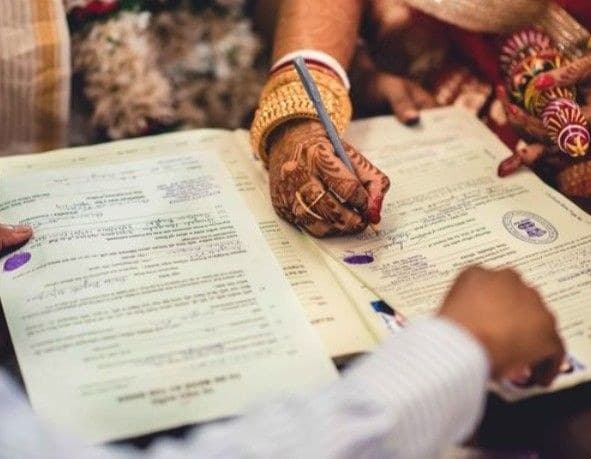
Somewhere in India this morning, a couple is standing outside a sub-registrar's office with a folder of photocopies, three friends who took the day off, and no idea whether they will walk out married. One of them has read that it takes a day. The other has read that it takes two months. An agent at the gate is offering to "get it done" for a fee. A relative has been told, wrongly, that a court marriage means giving up your religion.
All of that confusion comes from the same place: "court marriage" is not a legal term. It is what people call two different things, and the law behind both is old, patched many times, and run differently in every state. We wrote this guide to settle it. It explains what court marriage actually is, where it came from, what has changed in the last few years, who can do it, the exact steps, the documents, how long it really takes, and what to do afterwards, including how to have the big celebration too.
One honest note before we start. We are a wedding planning site, not a law firm. Everything here is tied to the section of the Act or the court judgment it comes from, and a practising lawyer has read it, but it is general information, not advice about your situation. If your case has a complication, a lawyer who knows your state's practice is worth the fee.
The quick answer: a court marriage is usually a marriage under the Special Marriage Act, 1954, which lets any two adults marry without a religious ceremony. You give notice at the Marriage Officer's office in a district where one of you has lived for 30 days, wait 30 days for objections, then sign a declaration in front of the officer and three witnesses and receive a certificate that is conclusive proof of the marriage. The other thing people call court marriage is registering a wedding that already happened in a religious ceremony, which is quicker, needs proof of the ceremony, and has been compulsory in principle across India since a Supreme Court order in 2006. The 30-day notice is the step that causes the most trouble; its publication is optional in Uttar Pradesh since a 2021 High Court ruling, but mandatory most places. Timelines run from a single visit for registration of an existing marriage to about five to eight weeks for a fresh Special Marriage Act wedding, depending on the state.
What's in this guide
- What court marriage actually is, and what it is not
- A short history: 1872 to 1954 to today
- What has changed recently
- Who can marry under the Special Marriage Act
- The steps, one by one
- The documents, and why applications get rejected
- The timelines, state by state
- Registering a religious marriage: the other kind of court marriage
- Special cases: interfaith, inter-caste, NRI and foreign partners, remarriage, no family support
- Fees, agents and online systems
- After the certificate: name change, passport, bank, and the celebration
- Court marriage and the big wedding: having both
- Frequently asked questions
What court marriage actually is, and what it is not
Start by separating the two things the phrase covers, because the steps, the papers and the time are different for each.
1. A marriage under the Special Marriage Act, 1954. This is a civil marriage: no priest, no ceremony, no religion required of either party. It is solemnised by a government officer called the Marriage Officer, usually the sub-registrar or an officer in the district collectorate, after a notice period. Any two adults can use it, whatever their religions, and it is the only route when the two of you follow different religions and neither wants to convert. The Act was passed by Parliament in 1954 and came into force on 1 January 1955.1 When people say "court marriage", this is usually what they mean.
2. Registering a marriage that already happened. You had the pheras, the nikah, the church wedding or the Anand Karaj, and now you want the government's certificate. Hindus, Buddhists, Sikhs and Jains register under section 8 of the Hindu Marriage Act, 1955, through their state's rules; Christians under the Christian Marriage Act; Parsis under their own Act; Muslims through state registration rules or, in some states, the Special Marriage Act's registration chapter. This is also called court marriage in everyday speech, and it is the more common of the two, because the Supreme Court made registration of all marriages compulsory in principle in 2006.2
There is a third, less used route: the Special Marriage Act's own chapter III lets a couple who married in any other form register that marriage under the Act, which changes the law that governs them from then on.3 We cover it below, because it matters for interfaith couples.
What court marriage is not.
- It is not a conversion. Nobody changes religion. The old 1872 law did require a declaration of not professing any religion; the 1954 Act removed that entirely.4
- It does not happen in a courtroom. Despite the name, you will not see a judge. The Marriage Officer's room is an office, often in the collectorate or the sub-registrar's building.
- It is not an elopement, legally. The 30-day notice exists precisely so the marriage is public before it happens. Whether that is a good thing is the subject of a live legal argument, which we come to.
- It is not less of a marriage. The certificate under section 13 of the Act is "conclusive evidence" that the marriage was solemnised.3 For passports, visas, banks and property it is often the easiest proof of marriage there is.
- It does not stop you having a wedding. Many couples do the court marriage first and the celebration later, or the reverse. The last section of this guide is about doing both well.
One consequence people do not expect: a marriage under the Special Marriage Act changes which inheritance law applies to you. Section 21 says succession to the property of a person married under the Act is governed by the Indian Succession Act, 1925, rather than their religious personal law, with an exception in section 21A for two Hindus, Buddhists, Sikhs or Jains marrying each other.3 For most couples this makes no practical difference. For a few, especially where a family business or ancestral property is involved, it is worth half an hour with a lawyer before you sign.
A short history: 1872 to 1954 to today
Court marriage in India began as a religious reform movement's problem.
In the 1860s the Brahmo Samaj, the Bengali reform movement, found that its members' weddings had no legal standing. They had rejected the rituals of orthodox Hindu marriage, so the courts did not recognise their ceremonies as Hindu marriages, and there was no other law to marry under. Keshub Chandra Sen led a campaign from 1860 for a simple civil form of marriage.4
The answer was Act III of 1872, introduced into the Imperial Legislative Council by Henry Sumner Maine, the legal scholar. It created the first civil marriage in India, with notice, witnesses and a registrar. It also came with a condition that shaped a century of prejudice: both parties had to declare that they did not profess the Hindu, Muslim, Christian, Parsi, Buddhist, Sikh or Jain religion.1 In effect, to marry outside your community you had to declare yourself outside every community. That is where the idea that "court marriage means giving up your religion" comes from, and why it still circulates in families today.
The 1872 Act was amended in 1923 to let Hindus, Buddhists, Sikhs and Jains marry each other under it without the renunciation, though the price was still steep: such a marriage cut the couple off from their joint family under Hindu law.
Then came independence, a constitution that promised equality, and a Parliament that wanted a marriage law for every Indian regardless of faith. The Special Marriage Act, 1954, received the President's assent on 9 October 1954 and came into force on 1 January 1955.1 It did three big things. It dropped the renunciation entirely, so anyone could marry under it without saying anything about religion. It opened the Act to interfaith couples as a matter of right. And it kept the 1872 design of a public notice and a waiting period, which was meant, in the words of one analysis, "to ensure that the man did not already have a spouse and does not marry a minor".4
The Hindu Marriage Act followed in 1955 and provided, in section 8, for states to register Hindu marriages. For the next fifty years registration stayed optional almost everywhere, and the vast majority of Indian marriages went unrecorded. A few states moved earlier: Maharashtra and Gujarat under the Bombay Registration of Marriages Act of 1953, Karnataka in 1976, Himachal Pradesh in 1996, Andhra Pradesh in 2002.2
The turning point was a case about something else. In Seema v. Ashwani Kumar, a maintenance dispute, the Supreme Court noticed how often women could not prove they were married at all. On 14 February 2006 it directed that all marriages, of every religion, be compulsorily registered, and told every state and union territory to notify rules within three months.2 The states did, at different speeds and with different forms, which is why the registration procedure still differs from one state to the next.
And then, in the last decade, the law started to move faster than at any time since 1954. That is the next section.
| Year | What happened |
|---|---|
| 1860s | Brahmo Samaj campaigns for a civil form of marriage |
| 1872 | Act III of 1872: India's first civil marriage, with renunciation of religion required |
| 1923 | Amendment lets Hindus, Buddhists, Sikhs and Jains marry under the Act without renouncing (the amendment's exact terms are being confirmed) |
| 1954 | Special Marriage Act passed; in force 1 January 1955; renunciation dropped |
| 1955 | Hindu Marriage Act; section 8 allows states to register Hindu marriages |
| 2006 | Supreme Court, Seema v. Ashwani Kumar: registration of all marriages to be compulsory |
| 2021 | Allahabad High Court: publication of the 30-day notice is optional in UP |
| 2023 | Supreme Court, Supriyo: no right to marry for same-sex couples under the Act |
| 2025 | Uttarakhand's Uniform Civil Code in force: compulsory registration of marriages and live-in relationships; review petitions in Supriyo dismissed |
What has changed: the last few years
If you last looked into court marriage before 2020, five things are different.
1. The 30-day notice is being questioned, and in one state it is optional
Sections 5 to 7 of the Act require the couple to give notice to the Marriage Officer, who enters it in a Marriage Notice Book "open for inspection at all reasonable times, without fee", and anyone may object within 30 days.3 In practice many offices also pin the notice to a board, and in some states copies have been sent to the couple's home addresses. For interfaith and inter-caste couples, that public notice has become, in one legal commentator's words, "an invitation to moral policing".4
On 13 January 2021, in Safiya Sultana v. State of U.P., Justice Vivek Chaudhary of the Allahabad High Court held that publishing the notice is optional: the couple may ask for it in writing when they give notice, and if they do not, the Marriage Officer must proceed without publishing it. The court said making publication mandatory "would invade in the fundamental rights of liberty and privacy, including within its sphere freedom to choose for marriage without interference from state and non-state actors", relying on the Supreme Court's privacy judgment in Puttaswamy, and asked why a civil marriage should carry a heavier procedural burden than a religious one, which needs no notice at all.5
That ruling binds Marriage Officers in Uttar Pradesh. Elsewhere the law on the books is unchanged, and petitions challenging the notice provisions were transferred to the Supreme Court in January 2023 to be heard with the marriage equality case.1 As of this writing the 30-day wait itself still applies everywhere; what the Allahabad ruling removed in UP is the publication, not the waiting period.
2. Registration is compulsory in principle, and increasingly in practice
Since the 2006 Supreme Court direction, every state has rules requiring marriages to be registered.2 What has changed since is enforcement by convenience: passport offices, visa consulates, banks and insurers now routinely ask for a marriage certificate, so a couple that never bothered to register in 2010 finds in 2026 that they cannot easily add a spouse to a policy or apply for a dependent visa without one. Registration has gone from a formality to a document you need.
3. Same-sex couples: the door was closed, for now
On 17 October 2023 a five-judge bench of the Supreme Court in Supriyo v. Union of India held that there is no fundamental right to marry and that the Special Marriage Act could not be read to include same-sex couples; that, the majority said, was for Parliament.6 All five judges agreed that the Union government should set up a committee to examine the rights and entitlements of queer couples without calling their relationship a marriage. Review petitions were dismissed on 9 January 2025, the court finding "no error apparent on the record".7 So in 2026 a same-sex couple cannot marry under any Indian law, and this guide, to its regret, applies only to a man and a woman.
4. Uttarakhand wrote a new rulebook
On 27 January 2025 Uttarakhand became the first state to bring a Uniform Civil Code into force. For marriage it means compulsory registration, with an online portal, and, controversially, compulsory registration of live-in relationships by residents within a month of starting one, with a fine or jail for not doing so; it also bans polygamy and certain practices, and it does not apply to Scheduled Tribes.8 If you live in Uttarakhand, or are from there and live elsewhere, your rules are different from the rest of the country, and you should read the state's own portal rather than this guide. Other states have said they are watching.
5. The forms went online, unevenly
Most states now take the application, or at least the appointment, online: Delhi through its e-District portal, Maharashtra through its registration department's site, Karnataka through Kaveri, Tamil Nadu through its registration portal, and so on. The paperwork is the same; the queue is shorter. But the systems differ, the slots fill, and some offices still want everything in person. Our city guides, linked from the cluster plan above as they are written, give the exact portal for each city.
The short version: the law is kinder to couples than it was in 2019, in one state much kinder, and the paperwork is easier to start. The 30-day wait, the three witnesses and the documents have not changed.
Who can marry under the Special Marriage Act
Section 4 of the Act sets four conditions, and the Marriage Officer will check every one of them against your documents.3
| Condition | What it means in practice | What proves it |
|---|---|---|
| Neither of you has a living spouse | You are unmarried, divorced, or widowed. A pending divorce does not count; the decree must be final | Your sworn affidavit; the divorce decree or the death certificate if it applies |
| Both of you can give valid consent | Neither is of unsound mind, nor suffering from a mental disorder that makes them unfit for marriage, nor subject to recurrent attacks of insanity, in the Act's old-fashioned words | The affidavit; the officer's own judgment on the day |
| The man is at least 21 and the woman at least 18 | No exceptions, no parental consent workaround | Birth certificate, school leaving certificate, passport or similar |
| You are not within the "degrees of prohibited relationship" | You are not closely related by blood or marriage as listed in the First Schedule; a custom that permits the marriage can save it | The affidavit |
A few points families often get wrong.
Parents' consent is not needed. Two adults can marry under the Act without anyone's permission. Parents can object within the 30 days, but only on the grounds in section 4 above, meaning that one of the four conditions is not met. "We do not approve" is not a ground, and an objection on that basis must be rejected after inquiry. More on objections in the steps below.
Religion does not matter, in either direction. Two Hindus can marry under the Act if they prefer a civil ceremony. A Hindu and a Muslim, a Christian and a Sikh, a Jain and an atheist: all can marry under it without anyone converting. There is no requirement to profess any religion or none.
Caste does not matter. The Act is silent on caste. An inter-caste couple faces exactly the same four conditions as anyone else.
Residence matters, for the paperwork. Section 5 requires the notice to be given in a district where at least one of you has lived for 30 days or more immediately before giving notice.3 This is a procedural condition, not an eligibility one, but it decides where you can file and which office you deal with. Students and people who have just moved cities often trip on it.
Foreign citizens can marry under the Act in India, as long as one of the two meets the residence requirement and the foreign partner can produce the documents the office asks for, usually including a certificate from their embassy that they are free to marry. We cover this under special cases.
Same-sex couples cannot, as explained above, following the Supreme Court's 2023 judgment.6
If any of the four conditions is not met, section 24 makes the marriage void, which is to say it never legally existed, and a false declaration in the notice or affidavit is an offence. The affidavit is not a formality; it is the document the whole thing rests on.
The steps, one by one
This is the Special Marriage Act route, from first visit to certificate. The registration of an existing religious marriage is shorter and is covered in its own section below.
Step 1. Work out which office
The Marriage Officer for your district: in most states the sub-registrar or an officer at the district collectorate or sub-divisional magistrate's office. The district must be one where at least one of you has lived for the last 30 days.3 If you have just moved, wait out the 30 days or file in your old district. Check your state's registration portal for the exact office and whether appointments are online.
Step 2. Give the notice of intended marriage
Both of you sign a notice in the form in the Second Schedule, which asks for your names, condition (unmarried, widowed, divorced), occupation, age, address and how long you have lived there.3 You attach the documents in the next section and pay the fee. In most states you can start this online and then appear in person to sign; in some you must appear to file. Both of you must be there.
Step 3. The notice is recorded, and usually published
The officer enters a copy in the Marriage Notice Book, which anyone may inspect free of charge, and in most states puts a copy on the office notice board; if one of you lives in another district, a copy is sent to that district's officer to display too.3 In Uttar Pradesh, following the 2021 Allahabad ruling, publication happens only if you ask for it in writing.5 Elsewhere, assume it will be displayed.
Step 4. The 30 days
The waiting period runs from the date the notice is published. During it, any person may object, but only on the ground that the marriage would break one of the section 4 conditions.3 Use the month well: gather the three witnesses, book leave, and if you are planning a celebration afterwards, start on it. The marriage must be solemnised within three months of the notice; after that the notice lapses and you start again.
Step 5. If someone objects
The officer must inquire into the objection and decide within 30 days. If the objection is upheld, the marriage is refused and you can appeal to the district court within 30 days. If it is rejected, the marriage goes ahead. An objection made in bad faith can cost the objector, since the officer can award costs up to a fixed sum.3 Most objections families make, about approval or caste or religion, are not grounds under section 4 and must be dismissed. Still, an objection adds up to a month, and this is where a lawyer is worth having.
Step 6. The day itself
After the 30 days pass with no objection, or the objection is rejected, you book the solemnisation. On the day, both of you and three witnesses appear before the Marriage Officer with original identity documents. Each witness must be an adult with valid ID; they do not need to be family, and in most offices they can be friends, colleagues or neighbours. You and the three witnesses sign a declaration in the form in the Third Schedule, in the officer's presence.3
Then the one piece of ceremony the Act insists on. Section 12 says the marriage is not complete and binding unless each of you says to the other, in the presence of the officer and the witnesses, in a language you understand: "I, A, take thee B, to be my lawful wife (or husband)".3 Apart from that, there is no ritual. Many couples exchange rings or garlands at this point, and most offices allow it as long as it is quick. The marriage can be solemnised at the office or, with the officer's agreement and a higher fee in most states, at another place.
Step 7. The certificate
The officer enters the marriage in the Marriage Certificate Book and gives you the certificate, signed by both of you and the witnesses. Under section 13 it is conclusive evidence of the marriage.3 Some offices hand it over the same day; others issue it within a few days or make it available for download from the portal. Take several certified copies; you will need them for the passport office, the bank and the insurer.
| Step | Who must be present | Typical time |
|---|---|---|
| Notice | Both of you | One visit, or online plus one visit |
| Waiting period | Nobody | 30 days from publication |
| Objection, if any | Both of you may be called | Up to 30 more days |
| Solemnisation | Both of you and three witnesses | One visit, usually under an hour |
| Certificate | Collection by either, or download | Same day to a week |
Total, with no objection and a slot available on day 31: about five weeks. With a queue for appointments, six to eight. With an objection, add a month.
The documents, and why applications get rejected
The Act itself does not list documents; it says what must be proved, and each state's rules say how. The list below is what offices across the country ask for, with the state's own portal as the final word. Bring originals and two photocopies of everything, and self-attest the copies.
For each of you
Together
Why applications are rejected or sent back
From the reasons offices give and the cases lawyers describe, the common failures are these.
- The address does not match. The notice says you have lived in the district for 30 days, but every document shows another city. Get one recent document at the current address before you file.
- The age proof is the wrong kind. Aadhaar or a PAN card offered as proof of age. Bring the birth or school certificate.
- Names differ between documents. A middle name on one, an initial on another, a spelling change after school. Carry a notarised affidavit explaining that all the variants are one person, or fix the documents first.
- The affidavit is in the wrong format or notarised on the wrong date. Ask the office for its format and swear it within the period they accept.
- A pending divorce. An interim order is not a decree. The marriage cannot proceed until the divorce is final.
- Photographs that do not match the forms, or too few of them.
- A witness without valid ID, or a witness under 18.
- A gap in the timeline: the notice lapsed because the solemnisation was not done within three months, usually because an appointment slot could not be found. Book the slot the day the 30 days end.
None of these is fatal. All of them cost a visit, and some cost the month. The fix for every one is the same: have someone who has done it recently look at your folder before you go. Our planning checklist lets you add each of these as a task with a date, worked back from your appointment.
The timelines: how long it really takes
The Act fixes the shape of the timeline: 30 days of notice, up to 30 more if there is an objection, and a three-month window after notice in which to solemnise.3 Everything else is the state's rules and the office's queue.
| Route | Fastest realistic | Typical | Slow |
|---|---|---|---|
| Special Marriage Act, no objection | About 5 weeks: notice on day 1, solemnised on day 31 or 32 | 6 to 8 weeks, allowing for an appointment slot after the 30 days | 3 months, if slots are scarce or papers are sent back once |
| Special Marriage Act, with an objection | 6 to 7 weeks if the objection is dismissed quickly | 9 to 10 weeks | Longer if the objector appeals to the district court |
| Registering an existing Hindu marriage | Same day, in states with a tatkal or priority service | 1 to 3 weeks between application and appointment | 1 to 2 months where appointments are backed up |
| Registering an existing marriage under the Special Marriage Act (chapter III) | About 5 weeks, because of its own 30-day notice | 6 to 8 weeks | 3 months |
These are the shapes, not promises. The number that changes most from city to city is the gap between the end of the 30 days and the first available appointment, and that is what our city guides will track.
State by state. The procedure is the same Act everywhere, but the portals, the forms and the speed differ. A few examples of what to look for, each to be confirmed on the state's own site:
- Delhi. Applications and appointments through the Delhi government's e-District portal; the Special Marriage Act route and Hindu Marriage Act registration are separate services; a priority registration service has existed for existing marriages. The office is the sub-divisional magistrate's for your area.
- Maharashtra (Mumbai). Registration of existing marriages under the Maharashtra Regulation of Marriage Bureaus and Registration of Marriages Act, 1998, through the local ward office or the registration department's portal; Special Marriage Act matters through the Marriage Officer at the sub-registrar's office.
- Karnataka (Bangalore). Through the Kaveri online services portal of the registration department, with the sub-registrar as Marriage Officer.
- Uttar Pradesh. The one state where the notice is not published unless you ask, following the Allahabad High Court's 2021 ruling.5
- Uttarakhand. Its own code since January 2025, with compulsory registration and an online portal.8 Read the state's rules, not this guide.
How to lose the least time.
- Fix the residence proof before anything else; it is the first thing checked.
- File the notice on a Monday, so the 30 days end on a working day.
- Book the solemnisation slot the moment the 30 days end, or earlier if the portal allows advance booking for a date after the period.
- Line up four witnesses, not three, in case one cannot come.
- Keep the three-month window in mind: a lapsed notice means starting over.
And a reassurance: the 30 days feel long when you are waiting, but they are the same for everyone, and they end. Most couples spend them planning the celebration.
Registering a religious marriage: the other kind of court marriage
Most Indian couples do not marry under the Special Marriage Act. They marry by their own rites, with the pheras or the nikah or the church, and then, sooner or later, they register that marriage. Since the Supreme Court's 2006 direction every state has rules for this,2 and a growing number of ordinary tasks, from a passport to a joint home loan, now ask for the certificate.
Which law registers which marriage
| You married by | Registration is under | Notes |
|---|---|---|
| Hindu, Buddhist, Sikh or Jain rites | Section 8 of the Hindu Marriage Act, 1955, through the state's rules | The most common route. Both parties must be Hindu, Buddhist, Sikh or Jain |
| Christian rites | The Christian Marriage Act, 1872 | The church's own register is usually the first record; the state issues the certificate |
| Parsi rites | The Parsi Marriage and Divorce Act, 1936 | Through the Parsi registrar |
| Muslim rites | State registration rules, or the nikahnama plus a state certificate; in some states the Special Marriage Act's chapter III | Practice varies most here; check the state |
| Any rite, where you want the Special Marriage Act to govern you | Chapter III, sections 15 and 16 of the Special Marriage Act | Changes the law of succession that applies to you; has its own 30-day notice |
How registration of a Hindu marriage works, in most states
- Apply, online or at the office, in the district where the marriage took place or where either of you lives.
- Attach proof of the marriage: the wedding invitation card, photographs of the ceremony showing both of you, and often a certificate from the priest or the venue or the temple. Some states want an affidavit from the priest.
- Attach the same identity, age and residence proofs as for a court marriage, plus photographs.
- Appear together with two or three witnesses, usually including a parent or close relative from each side if available, on the appointment date.
- The registrar verifies, you all sign the register, and the certificate is issued, often the same day.
There is no 30-day notice for this route, which is the main reason it is faster. The marriage already happened; the state is recording it, not permitting it.
The time limit question. Many states set a period within which a marriage should be registered, commonly within a few weeks or months of the wedding, with a late fee or a condonation process afterwards. A marriage from 2015 can still be registered in 2026; it just takes an extra form, a reason, and sometimes a higher fee. Not registering does not make a Hindu marriage invalid, but it makes proving it harder, which is exactly the problem the Supreme Court set out to fix.
Registering under the Special Marriage Act instead. Chapter III lets a couple married in any form register under the Act if a ceremony was performed, they have been living together as husband and wife since, neither has another spouse, both were of age, they are not within the prohibited degrees, and one of them has lived in the district for 30 days.3 The officer gives public notice and allows 30 days for objections before entering the certificate. Why would anyone choose the longer route? Usually because the couple is interfaith, married by one partner's rites, and wants the neutral framework of the Act for the future, especially its succession rules. It is a decision to take with a lawyer, not from a guide.
Special cases
Interfaith couples
The Special Marriage Act exists for you. Neither of you converts, neither of you declares anything about religion, and the four conditions are the same as for anyone else. Three practical things to know.
First, the notice. In most states it will be displayed for 30 days, and in some districts copies have been sent to home addresses. If you have reason to fear family or community interference, plan the timing of the notice accordingly, and consider filing in a district where the display will not be seen by the people you are worried about, as long as one of you has lived there for 30 days. In Uttar Pradesh, ask in writing that the notice not be published, as the Allahabad High Court allows.5
Second, the anti-conversion laws. Several states, including Uttar Pradesh, Madhya Pradesh, Gujarat, Uttarakhand, Himachal Pradesh and Karnataka, have laws against religious conversion by force, fraud or inducement, and some of them treat conversion for the purpose of marriage as unlawful unless declared in advance to the district authorities. A Special Marriage Act wedding involves no conversion and is not affected by these laws, which is one more reason to use it rather than converting to marry under a personal law. If either of you is considering conversion for any reason, take legal advice in your state first.
Third, succession. As explained earlier, marriage under the Act brings you under the Indian Succession Act for inheritance, which for an interfaith couple is often simpler than two personal laws.3
Inter-caste couples
The law does not see caste. You can marry under the Act or by religious rites and register in the ordinary way. The difficulties inter-caste couples face are social, not legal, and the notice period is where they tend to arrive. The same advice applies: plan the timing, know that an objection on the ground of caste must be dismissed because it is not a section 4 ground, and keep a lawyer's number. Several state governments run incentive schemes for inter-caste marriages, administered through social welfare departments; the certificate is what unlocks them.
A foreign partner
A foreign citizen can marry under the Act in India. The office will want their passport and visa, proof that they are free to marry, usually a certificate of no impediment or a single-status affidavit from their embassy or consulate in India, and, depending on the state, proof that one of the two of you has lived in the district for 30 days. Some embassies issue the certificate the same day; others take weeks and want documents from the home country, so start there. After the marriage, the certificate is the document the partner's home country will ask for in any spouse visa process, and most will want it apostilled by the Ministry of External Affairs. If you marry abroad instead, Indian citizens marrying each other at an Indian embassy do so under the Foreign Marriage Act, 1969, and a marriage valid where it was performed is generally recognised in India.
Non-resident Indians
An NRI partner who does not meet the 30-day residence can still marry under the Act if the Indian-resident partner does. The notice and the solemnisation both require the NRI to be present in person, so plan two trips or one long one: the notice visit, then the 30 days, then the solemnisation. Many couples register an existing religious marriage instead, which needs one visit. Whatever the route, get extra certified copies and the apostille before leaving India; a foreign consulate will ask for them.
Remarriage after divorce or the death of a spouse
The only extra document is the proof that the earlier marriage has ended: the certified final divorce decree, or the death certificate. Interim or ex parte orders that have not become final are not enough, and a marriage solemnised while a divorce is pending is void under section 24.3 If the decree was passed abroad, the office may want it authenticated.
No family support
You do not need anyone's consent, and the three witnesses can be friends. What you do need is a plan for the 30 days: somewhere safe to live, your original documents in your own hands, and ideally a lawyer who can respond if an objection is filed or if the office is slow. If you fear for your safety, the police have a duty to protect adults who have chosen to marry, and High Courts regularly order protection for couples; a lawyer can file for it quickly. Several states and NGOs run safe houses for couples in this position. We say this plainly because the people who search for "court marriage" at two in the morning are often exactly these couples, and the law is on your side even when the room is not.
Fees, agents and the online systems
The official fee is small. The Act leaves fees to the states,3 and in every state the government fee for a notice, a solemnisation or a registration is a few hundred rupees at most, with a higher charge if the officer comes to a venue outside the office and a late fee for registering an old marriage. We are not printing the figures here because they change and differ by state; the fee is on your state's registration portal, and our city guides will carry the current number for each city. If someone quotes you thousands for the "government fee", that is not the government's fee.
The notary and the affidavit cost a little more: a notary's charge for swearing the affidavits, and a lawyer's fee if you have one draft them. A lawyer is not required for any part of the process.
Agents. Outside most registration offices there are people who will offer to handle everything for a fee. Some are useful: they know the office's format for the affidavit, which counter to go to, and which photocopies are needed. Some are not: they take money for "speeding up" a 30-day period that cannot be sped up, or for "arranging" witnesses, or for a certificate that turns out not to be registered at all. Three rules. Never hand over your original documents to anyone except the office counter. Never pay for anything you cannot see on the official portal or fee list. And check the certificate afterwards on the state's portal or by asking the office; a genuine one is in the Marriage Certificate Book.
The online systems. Every large state now has a portal where you can at least book the appointment and often file the whole application: Delhi's e-District, Maharashtra's registration department site, Karnataka's Kaveri, Tamil Nadu's registration portal and others. They are genuinely useful and genuinely uneven. Common frustrations are slots that vanish, document uploads that fail on size, and a requirement to appear in person anyway. Treat the portal as the way to start and to book; treat the office as where it finishes. If a portal asks for a payment to anyone other than the state treasury, close it.
"Online court marriage" does not exist. Both of you, and the three witnesses, must be physically present before the Marriage Officer for a Special Marriage Act wedding; section 11 and section 12 require it.3 During the pandemic a few courts allowed video appearances for registration of existing marriages in specific cases, and some states have since experimented with video verification for registration, but there is no general online marriage. Any site promising one is selling something else.
After the certificate
The certificate is the beginning of a short list of admin, most of which is optional.
Copies first. Get at least three certified copies, or confirm the certificate can be downloaded from the portal with a verification code. Keep one original somewhere safe and never post it.
Changing a name, if you want to. Nobody has to. If one of you chooses to take or add a surname, the order is: a notarised affidavit for the change of name; a newspaper notice in two papers, as the Gazette requires in most states; then the Gazette notification; then, with the Gazette and the marriage certificate, the passport, Aadhaar, PAN and bank. The marriage certificate alone is accepted by the passport office for a surname change on marriage, which is why many people start there. A correction to the certificate itself, for a spelling error or a changed name, is a separate application to the office that issued it, and the earlier you do it the easier it is.
Passport. A new passport with the spouse's name added, or a surname changed, is a re-issue with the marriage certificate as the supporting document. Allow the usual processing time plus police verification if the address changed.
Aadhaar, PAN, bank, insurance, employer. Each is a form and a copy of the certificate. Add your spouse as nominee on accounts and policies; this is the moment most people forget and regret.
Property and succession. If either of you owns property, and especially if you married under the Special Marriage Act, which brings you under the Indian Succession Act,3 make a will. It is a one-page document that saves your family a year.
Tell the world, or don't. A court marriage can be entirely private. It can also be announced, and the announcement is the first photo most couples share. If you want an outfit for the day, the office does not mind; brides have worn everything from jeans to a full lehenga to the registrar's room. Our piece on what to wear to a court marriage, and the one on court marriage photos, are linked from the cluster plan as they are written.
And the celebration. Which brings us to the last section.
Court marriage and the big wedding: having both
Here is the thing the lawyer's websites never say: a court marriage and a wedding are not alternatives. More and more couples do both, and there are good reasons to.
Court first, celebration later. The legal marriage happens quietly, on a weekday, with three friends. The celebration happens when the families, the money and the muhurat line up, which may be months later. This is how a great many interfaith and inter-city couples do it, and how couples with a visa deadline or a job move do it. The certificate is in hand; the wedding is a party, not a pressure. One honest note: once you are legally married, some pandits and some families feel the religious ceremony has lost its meaning. Others feel the opposite, that the ceremony is the real wedding and the paper was admin. Talk about it before you choose the order.
Celebration first, registration after. The traditional order, and still the most common. The pheras or the nikah on the muhurat, the party, and then, within the state's time limit, the registration with the photographs and the card as proof. The only thing to plan is not to forget: put the registration in the planning checklist as a dated task, and keep ten wedding photographs that show both your faces and the ceremony, because the registrar will ask for them.
Both on the same day. Possible in some offices, which will solemnise at a venue for a higher fee; a Special Marriage Act ceremony in a garden followed by the reception. It needs the notice period to have ended and the officer to agree, and it is more common for registration of an existing marriage, where the registrar attends the venue. Ask your office early.
What a court marriage frees you to do. With the legal part settled, the celebration can be exactly as big or small as you want. Some couples find that the court marriage takes the fear out of a family conversation; the fact is a fact, and the question becomes how to celebrate it. Some use it to hold a wedding in a form their faith would not otherwise allow, with two ceremonies or none. Some simply have a lunch.
Whatever you choose, the planning is the same as any wedding, with one extra line. Our checklist lets you add the notice date, the appointment and the certificate as tasks next to the venue and the caterer, and the budget tool treats the court marriage as a function with its own small costs. If the celebration comes later, the guest list and invitations are ready when you are.
The Special Marriage Act was written by people who believed two adults should be able to marry on their own terms. A century and a half of amendment and seventy years of practice have not changed that idea, only made it easier to use. If this guide has one message, it is that the paperwork is finite, the 30 days end, and on the other side of them is a marriage that no one can question and a celebration that is entirely yours.
Frequently asked questions
What is court marriage?
Usually a marriage under the Special Marriage Act, 1954: a civil marriage before a government Marriage Officer, with no religious ceremony, open to any two adults of any religion. People also use the phrase for registering a marriage that already took place by religious rites.
How long does court marriage take?
Under the Special Marriage Act, about five to eight weeks: a 30-day notice period, then an appointment for the solemnisation. An objection can add up to 30 days. Registering an existing religious marriage has no notice period and can take from a day to a few weeks depending on the office.
What documents are needed for court marriage?
For each of you: proof of age (birth or school certificate or passport), proof of identity, proof of 30 days' residence in the district, passport photographs and a sworn affidavit; plus the divorce decree or death certificate if you were married before, and embassy papers for a foreign citizen. On the day, three adult witnesses with ID. The full checklist is above.
Do we need our parents' permission?
No. Two adults, a man of 21 and a woman of 18 or older, can marry under the Act without anyone's consent. Parents can object within the 30 days only on the legal grounds in section 4 of the Act, and disapproval is not one of them.
Does court marriage mean giving up our religion?
No. That was a requirement of the 1872 law, and the 1954 Act removed it. Nobody declares or changes anything about religion.
Can a Hindu and a Muslim do a court marriage?
Yes. The Special Marriage Act exists for exactly this, and neither person converts. The 30-day notice is displayed in most states, so plan its timing; in Uttar Pradesh you can ask for it not to be published.
Is the 30-day notice compulsory?
The 30-day waiting period applies everywhere. Publication of the notice is optional in Uttar Pradesh since the Allahabad High Court's 2021 ruling in Safiya Sultana; in other states the notice is still displayed. Challenges to the notice are before the Supreme Court.
Can we do court marriage online?
No. You can file and book online in most states, but both of you and three witnesses must appear in person before the Marriage Officer for the marriage itself.
How much does court marriage cost?
The government fee is a few hundred rupees in every state, more if the officer attends a venue. Notary charges and any lawyer's fee are extra. The exact fee is on your state's registration portal.
Is a court marriage certificate valid everywhere?
Yes. Under section 13 of the Act it is conclusive evidence of the marriage, and it is accepted by passport offices, consulates, banks and courts across India. For use abroad, get it apostilled by the Ministry of External Affairs.
Can same-sex couples marry under the Special Marriage Act?
Not as of 2026. The Supreme Court held in October 2023 that the Act cannot be read to include same-sex couples and that the matter is for Parliament; review petitions were dismissed in January 2025.
Can we have a wedding ceremony after a court marriage?
Yes, and many couples do. The court marriage is the legal marriage; the ceremony and the celebration can follow whenever you like, and nothing about the certificate stops a religious ceremony afterwards.
What happens if someone objects to our marriage?
The Marriage Officer must inquire and decide within 30 days. If the objection is not on one of the section 4 grounds, it must be rejected and the marriage goes ahead. If it is upheld, you can appeal to the district court within 30 days.
We married years ago and never registered. Is it too late?
No. Every state has a process for late registration, usually with a late fee or a declaration explaining the delay. The marriage was valid all along; registration gives you the proof.
Plan it on Shaadiwaale
- Put the notice, the appointment and the certificate on your checklist
- The court marriage as a function in your budget
- The guest list for the celebration, whenever it comes
- Invitations for the celebration, one family at a time
- A registry where guests promise what you need
- What a wedding really costs in 2026
Share this guide
Send it to the family group, or keep it for later.
Questions about your wedding?
Our team answers questions about venues, vendors and the budget, free on WhatsApp.
About Shaadiwaale
Indian wedding planning in one place: venues and vendors with real prices, free kundli matching, invitations and tools to plan every function together.
Every function. Every family. One plan.
Notes
- Special Marriage Act, 1954, Wikipedia. Dates of assent and commencement, the 1872 predecessor and its renunciation clause, and the transfer of notice challenges to the Supreme Court in January 2023. en.wikipedia.org ↩
- Compulsory registration of marriages in India: a legal analysis, CaseMine. Seema v. Ashwani Kumar (14 February 2006) and the states' registration laws. casemine.com ↩
- The Special Marriage Act, 1954, India Code (the official text). Sections 4 to 8, 11 to 13, 15 and 16, 21 and 21A, 24, and the Schedules. indiacode.nic.in ↩
- Has the Special Marriage Act failed to protect inter-faith couples?, IAS Gyan. The Brahmo Samaj campaign, Henry Maine, the purpose and criticism of the notice. iasgyan.in ↩
- Notice of intended marriage: publication optional under the Special Marriage Act, LiveLaw, January 2021. Safiya Sultana v. State of U.P., Allahabad High Court, 13 January 2021. livelaw.in ↩
- Plea for marriage equality, Supreme Court Observer. Supriyo v. Union of India, 17 October 2023. scobserver.in ↩
- Supreme Court dismisses petitions to review its judgment refusing to recognise same-sex marriages, LiveLaw, 9 January 2025. livelaw.in ↩
- Uttarakhand rolls out Uniform Civil Code, becomes first state to do so, LiveLaw, 27 January 2025. livelaw.in ↩