Guide
The Golden Sherwani for the Groom: How Much Gold Is Right, and the Maharaja Cut That Earns It
Golden sherwanis and maharaja styles broke out in India's groom searches this quarter. What the gold actually signals, which royal cut to build it on, the 2026 colours and fits, and how not to outshine your own wedding.
- Golden sherwanis and maharaja styles broke out in India's groom searches this quarter
- The 2026 reading of gold: soft tones by day, zardozi for the high formality ceremonies
- The achkan is the explicitly royal cut; the Jodhpuri wins through form, not embroidery
- Heavily embroidered sherwanis need simple accessories; minimal ones can take layering
Outfits and beauty · 10 min read · By The Shaadiwaale team
The groom's searches have turned to gold. In the 90 days to the end of October, "golden sherwani for groom" and a maharaja styled sherwani broke out on Google in India under sherwani,1 which tells you what 2026's grooms want: not a safe navy suit in Indian clothing, but the full ceremonial register.
The trade is ready for them, with one refinement. "The gold sherwani has long carried associations with celebration and grandeur," as one 2026 colour guide puts it, but the modern versions run to softer tones and more controlled embroidery, and worn well, gold can be one of the most impactful choices a groom can make.2
This guide covers the gold question first, then the royal cuts that carry it, the 2026 styles and colours by function, and the fit rules that outlast every trend.
Quick answer: A golden sherwani for the groom works best in 2026 as soft gold rather than full shine: the daytime palettes run ivory, champagne, soft gold and dusty rose, ivory and gold photograph beautifully under indoor light, and zardozi, gold and silver thread work, is the embellishment for high formality occasions.3 For the maharaja register, the achkan is the explicitly royal cut, a knee length, fitted, high collared style with Mughal court roots, "Channel your inner Maharaja," as one house puts it,4 with the Jodhpuri's clean court lines and the Maratha inspired Peshwai nearby.3 Fit rules: the shoulder seam at the natural shoulder, the hem at or just below the knee, full length for the main ceremony, and restrained accessories on heavy embroidery.
In this article
- The sherwani styles at a glance
- The golden sherwani: grandeur with a volume dial
- The maharaja cuts: achkan, Jodhpuri, Peshwai, angrakha
- What 2026 changed: Indo Western, the dhoti sherwani, tonal dressing
- Colour by function and hour
- Fit and fabric: the rules that outlast trends
- Finishing the look without overdoing it
1. The sherwani styles at a glance
| The cut | What it is | Where it belongs |
|---|---|---|
| Full length embroidered | Below the knee, zardozi or thread work | The main ceremony |
| Achkan | Knee length, fitted, high collar, court roots | The royal register, warmer days |
| Jodhpuri | Shorter, structured, military closures | Receptions, the understated groom |
| Peshwai | Maratha inspired, flared skirt | Grooms who want drama below the waist |
| Angrakha | Diagonal closure, Mughal and Rajput lines | The heritage statement |
| Indo Western | Western jacket cut, Indian fabric and work | Sangeet and reception |
| Jacket over kurta | Hip or thigh length layer | Mehndi, morning functions |
| Dhoti sherwani | The coat over a draped dhoti | The most talked about 2026 trend |
The cuts and their occasions follow the 2026 style guides cited below (source; source).
The rest of the wardrobe: designers, prices and the full groom's plan are in The Groom's Wardrobe in 2026.
2. The golden sherwani: grandeur with a volume dial
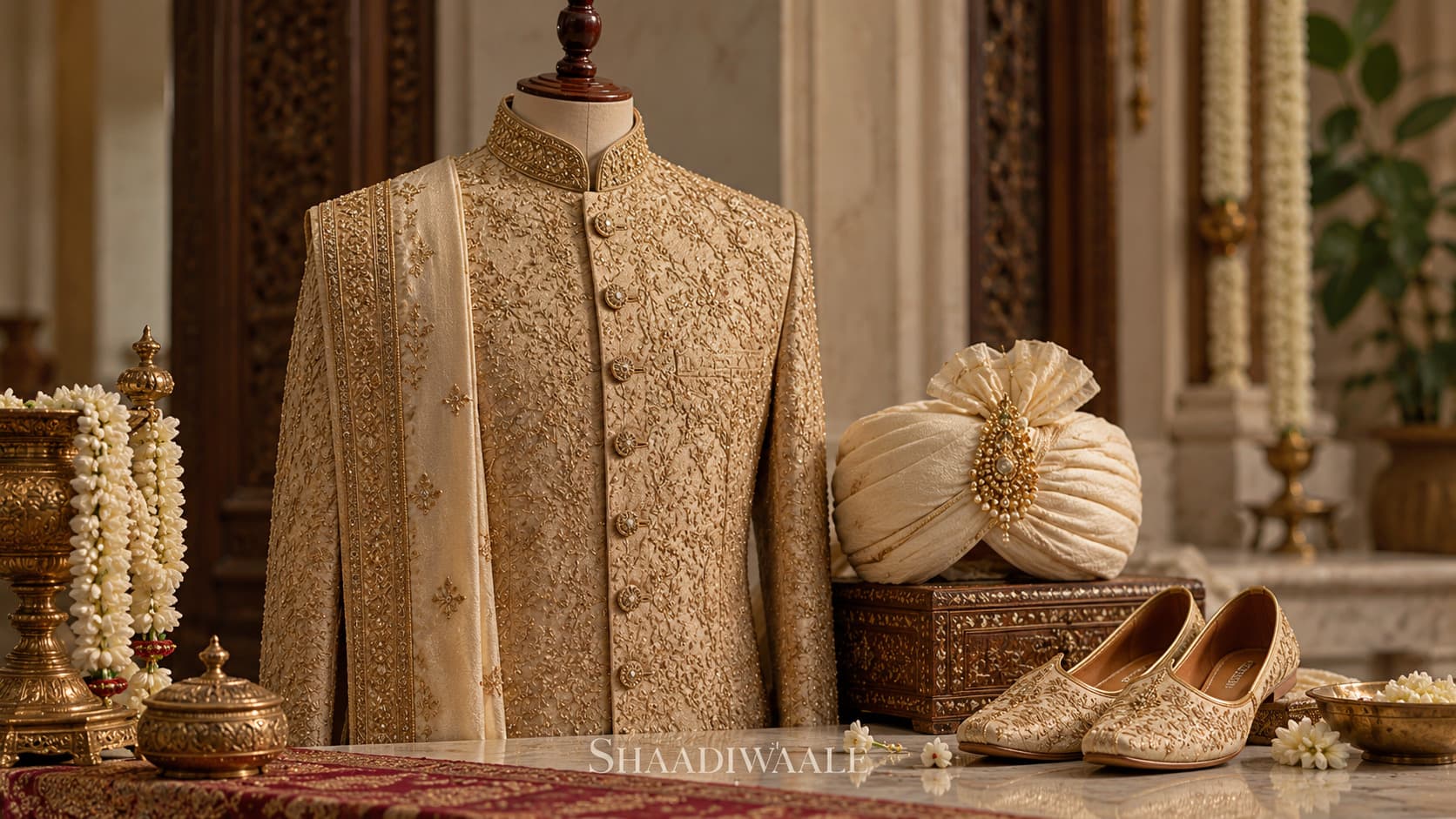
Gold on a groom is a register, not a colour, and the 2026 guidance is about where to set the dial. At the soft end sit the daytime palettes, ivory, champagne, soft gold and dusty rose, with the note that ivory and gold photograph beautifully under indoor lighting.3 At the ceremonial end sits zardozi, gold and silver thread work reserved in the same guide for high formality occasions.3
The colour guide's reading matches: gold carries celebration and grandeur, the modern versions use softer tones and more controlled embroidery, and it lands naturally against wheatish skin, with metallic accents working well on darker skin too.2 For pairings, the same guide notes that ivory pairs naturally with gold, champagne and neutral tones, and that maroon complements gold and ivory embroidery, which is exactly the bridge to a bride in red or maroon.2
The practical reading: full gold silk with heavy work is a pheras outfit; soft gold or ivory with gold embroidery serves the same register by daylight; and one golden layer, a jacket or stole over ivory, buys the glow without the glare.
Coordinate, do not match: the guides' advice is a palette that complements the bride's outfit rather than copying it; see what the brides' side is wearing in The Lehengas India Searched For This Season.
3. The maharaja cuts: achkan, Jodhpuri, Peshwai, angrakha
The second breakout search was for a maharaja styled sherwani, and the trade has a whole royal wing for it. The achkan is the explicitly princely cut: knee length, coat styled, fitted through the body with a high collar, carrying what one house calls aristocratic elegance, with roots in the Mughal era's royal courts, introduced with the words "Channel your inner Maharaja".4
Around it sit the other court styles. The Jodhpuri, rooted in Rajasthani court dress, makes its case through sophistication of form rather than embroidery, clean lines and military inspired closures,3 worn classically with white churidars and polished mojris.4 The Peshwai brings the Maratha empire's flared skirt silhouette, and the angrakha its diagonal closure from Mughal and Rajput aesthetics.3
Put the two breakouts together and the brief writes itself: a maharaja cut in a gold register, an achkan or angrakha in soft gold silk with zardozi at the collar and cuffs, is the exact outfit India has been typing into Google.
Find the tailors of the royal register: the groom wear designers in our directory take this brief every season.
4. What 2026 changed: Indo Western, the dhoti sherwani, tonal dressing
Three shifts mark the 2026 lists. The Indo Western fusion, a Western jacket's cut carrying Indian fabric and embellishment, is called the biggest shift in the year's wedding fashion, and the dhoti sherwani, the coat worn over a draped dhoti, one of its most talked about trends.3 The third is quieter: the colour guides describe 2026 as favouring tonal dressing, monochrome looks whose depth comes from texture and layering within one colour family.2
Tonal dressing is the most useful of the three for the golden groom: an outfit built entirely in golds and ivories, the sherwani one tone, the kurta another, the stole a third, reads expensive without a single extra stone.
The fusion cuts, meanwhile, solve the week's other days: the Indo Western and the jacket over kurta belong to the sangeet and reception, where the full ceremonial sherwani would wear twice as heavy.3
One outfit per function is a budget line: put each in the wedding budget before the fittings begin.
5. Colour by function and hour
The 2026 palettes split cleanly by the clock, with the pairing notes from the colour guide (source; source):
| When | The palette | The note |
|---|---|---|
| Daytime and outdoor | Ivory, champagne, soft gold, dusty rose | Soft gold's natural home |
| Evening | Emerald green, royal navy, deep burgundy, midnight black | Navy pairs with silver and ivory detailing |
| Destination and beach | Sage green, powder blue, warm white | Light fabrics carry light colours |
From the colour guide's side: cream and ivory suit daytime ceremonies and traditional settings, navy belongs to evening functions and contemporary themes, maroon is the traditional ceremonial choice that complements gold and ivory embroidery, and the deeper greens are for grooms who want to stand out.2
The one coordination rule repeated across the guides: complement the bride's palette, never copy it. Her red and your soft gold with maroon details is a photograph; matching outfits are a uniform.
Save the palette: pin the colour combinations to an Inspiration board the two of you share.
6. Fit and fabric: the rules that outlast trends
The buying rules in the 2026 guide are blessedly unfashionable.3 Fit: the shoulder seam sits at the natural shoulder's edge, and the hem falls at or just below the knee. Body: taller grooms carry the full length; shorter or broader grooms do better in a mid length or fitted achkan cut. Occasion: full length for the main ceremony, jacket and Indo Western styles for the sangeet and reception.
Fabric follows the calendar: silk and raw silk for the richest drape at formal ceremonies, velvet for deep luxury at winter weddings, linen silk blends for summer and destination days, premium cotton for daytime and outdoor events.3 A golden sherwani for a December pheras and one for a Goa morning are, properly, two different garments.
And schedule the fittings like the groom matters, because he does: the first fitting when the outfit is chosen, the second a fortnight out, and a final try on with the actual shoes, because the hem was measured to them.
The groom's hair finishes the fit: the 2026 cuts that serve a sherwani are in our wedding hairstyles guide.
7. Finishing the look without overdoing it
The accessories rule from the 2026 guide is the whole art in one line: heavily embroidered sherwanis need simple accessories, and minimal ones can take more layering.3 A zardozi covered golden achkan wants nothing but a safa and polished mojris; an unadorned ivory one has room for the stole, the brooch and the layered beads.
The classic kit, by tradition: the safa or turban, the stole over one shoulder, a brooch or kalgi where the family keeps one, mojris or juttis, and little else. The guides' own pairing for the understated Jodhpuri route is white churidars and polished mojris.4
One last mirror test before the baraat: if the sherwani, the safa, the stole and the garland are all speaking at once, remove one. The maharaja look was never about wearing everything; it was about looking like you did not have to.
Our team has seen a thousand grooms dressed: ask them to point you to the right groom wear people in your city.
Closing thoughts
The breakout searches were right about something: after years of the understated groom, the ceremonial register is back, gold and all. The 2026 version just plays it smarter, soft gold by day, zardozi at the pheras, a royal cut doing the structural work, and one colour family worn deep rather than six worn thin. Channel the maharaja; skip the costume.
And put the palace on the invitation too: the Blue Zardosi design among our online wedding invitations wears exactly this register, navy, gold and velvet, and it is free to design.
Frequently asked questions
Is a golden sherwani a good choice for the groom?
Yes, with the tone chosen deliberately. Gold has long carried associations with celebration and grandeur, and the 2026 colour guides call it one of the most impactful choices a groom can make when worn well, in softer modern tones with more controlled embroidery. Soft gold and champagne sit in the daytime palettes, ivory and gold photograph beautifully under indoor light, and full gold silk with zardozi belongs to the high formality ceremonies. It flatters wheatish skin naturally, and metallic accents work well on darker skin too.
What is a maharaja style sherwani?
In the trade it usually means the royal court cuts. The achkan is the explicitly princely one, a knee length, fitted, high collared coat with roots in the Mughal courts, sold with the line "Channel your inner Maharaja". The Jodhpuri carries Rajasthani court dress's clean lines and military closures, the Peshwai the Maratha empire's flared skirt, and the angrakha a diagonal closure from Mughal and Rajput aesthetics. A maharaja look in 2026 is one of these cuts in a rich register, soft gold, ivory or deep maroon, with zardozi work and a safa.
Which sherwani colour suits which wedding function?
By the 2026 guides: daytime and outdoor functions take ivory, champagne, soft gold and dusty rose; evening functions take emerald, royal navy, deep burgundy and midnight black, with navy pairing well with silver and ivory detailing; destination and beach days take sage, powder blue and warm white. Maroon remains the traditional ceremonial choice and complements gold and ivory embroidery. The repeated rule is to complement the bride's palette rather than match it, so the two outfits photograph as a pair, not a uniform.
What should a groom wear with a heavily embroidered sherwani?
As little as possible. The 2026 buying guides put it plainly: heavily embroidered sherwanis need simple accessories, while minimal sherwanis can take more layering. With a zardozi covered golden achkan, that means the safa, polished mojris and perhaps one brooch, and nothing else competing. Save the stole, the layered beads and the statement kalgi for the plainer outfits that have room for them. The understated route, a Jodhpuri with white churidars and polished mojris, shows how far restraint alone can carry a groom.
What is the difference between a sherwani, an achkan and a Jodhpuri?
All three are fitted Indian coats; the differences are length and attitude. The classic sherwani is the longest, falling below the knee with side slits and a mandarin collar, the full ceremonial garment. The achkan is knee length and closer fitting, the royal court's silhouette, suited also to warmer days. The Jodhpuri is shorter and structured, a bandhgala collared jacket with military inspired closures, worn where sophistication should come from form rather than embroidery. Grooms often use all three across one wedding: achkan or sherwani at the ceremony, Jodhpuri at the reception.
What are the sherwani trends for 2026?
Three stand out in the year's guides. Indo Western fusion, a Western jacket's cut in Indian fabric and embellishment, is called the biggest shift in 2026 wedding fashion, at home at sangeets and receptions. The dhoti sherwani, the coat worn over a draped dhoti, is one of the year's most talked about trends. And tonal dressing runs through the colour guides: monochrome looks built in one colour family, their depth coming from texture and layering. For the golden groom, that last one is the gift, an all gold and ivory look that reads rich without extra ornament.
Share this guide
Send it to the family group, or keep it for later.
Questions about your wedding?
Our team answers questions about venues, vendors and the budget, free on WhatsApp.
About Shaadiwaale
Indian wedding planning in one place: venues and vendors with real prices, free kundli matching, invitations and tools to plan every function together.
Every function. Every family. One plan.
Notes
- Google Trends: sherwani, India, past 90 days, Google Trends, seen 31 October 2026. ↩
- Best Sherwani Colours for Grooms in 2026: A Complete Style Guide, Bharat Reshma, 2026, seen 31 October 2026. ↩
- Sherwani for Men 2026: Styles, Trends and The Complete Wedding Guide, Bonsoir, 27 May 2026. ↩
- Sherwani Styles for Grooms: Royal Wedding Looks, Manyavar, 29 January 2025. ↩