Editorial
The Groom's Wardrobe in 2026: Manish Malhotra, Sabyasachi, Raghavendra Rathore, and What to Wear at Every Price
For most of wedding history the groom was an afterthought in cream. Not any more. Here is what the three houses that changed Indian menswear each do best, who else sits at the top table, and an honest price ladder from couture to rental.
- Sabyasachi dresses the groom to match the bride, down to the tiger buttons
- Manish Malhotra makes the sharp, embellished groom; menswear is 35 per cent of his business
- Raghavendra Rathore owns the bandhgala
- Listed prices run from about 25,000 rupees for a designer shirt to over 9 lakh for a couture sherwani, and a good look exists at every rung
Outfits and beauty · 24 min read · By The Shaadiwaale team
There is a photograph of almost every Indian wedding before about 2010 in which the bride is a jewel box and the groom is a beige rectangle. He is wearing a sherwani somebody's uncle recommended, in a shade of cream that matched nothing, with a safa tied by a man at the venue who had tied forty that week. He looks happy. He also looks like he got dressed in the dark.
That groom is gone. Somewhere between Virat Kohli's old-rose safa in Tuscany, Ranveer Singh's turbans at Lake Como and Vicky Kaushal's tiger buttons at Fort Barwara, Indian men decided that the wedding was their day too, and three fashion houses were ready for them. Manish Malhotra, who told Esquire India in 2025 that menswear is now 35 per cent of his business and one of its fastest-growing parts.1 Sabyasachi, whose grooms are built to stand next to his brides without disappearing. And Raghavendra Rathore, the Jodhpur royal who took a court jacket and made it the most useful garment in an Indian man's wardrobe.
This is a sister piece to our Five Sabyasachi Brides, and like that one it is a celebration. We are not paid by any of these houses and nobody at them has read this. We admire the work, and we also know that most grooms will not spend what their work costs, so the second half of this guide is an honest price ladder from couture to rental, with what you actually get at every rung, and how to dress the five functions well whatever your number is.
Two rules we have kept. Every price is a figure listed on the brand's own site on 4 October 2026, or a figure a designer gave in a published interview, and we say which. And where a house does not publish prices, we say that too, rather than repeating a number from a gossip page.
The quick answer: go to Sabyasachi when the bride is in Sabyasachi, or when you want heritage, texture and a look that reads as one picture with hers. Go to Manish Malhotra for the sharp, embellished, slightly filmi groom, especially for the reception. Go to Raghavendra Rathore for a bandhgala you will wear for the next twenty years. Below them, designer ready-to-wear, the premium high street, the affordable chains and rental each give you a real wedding look, and the fit matters more than the label at every price.
The grammar of groomswear
Before the houses, the words, because a groom who knows them buys better.
| Garment | What it is | Where it shines |
|---|---|---|
| Sherwani | The long coat, buttoned to the neck, worn over a kurta and churidar or trousers. The wedding-day default across north and west India | The pheras, the baraat, the big photograph |
| Achkan | The sherwani's slimmer, older cousin: closer to the body, often plainer, with a flared skirt. The royal courts' coat | Grooms who want length without heaviness; Rajasthani and Lucknowi weddings |
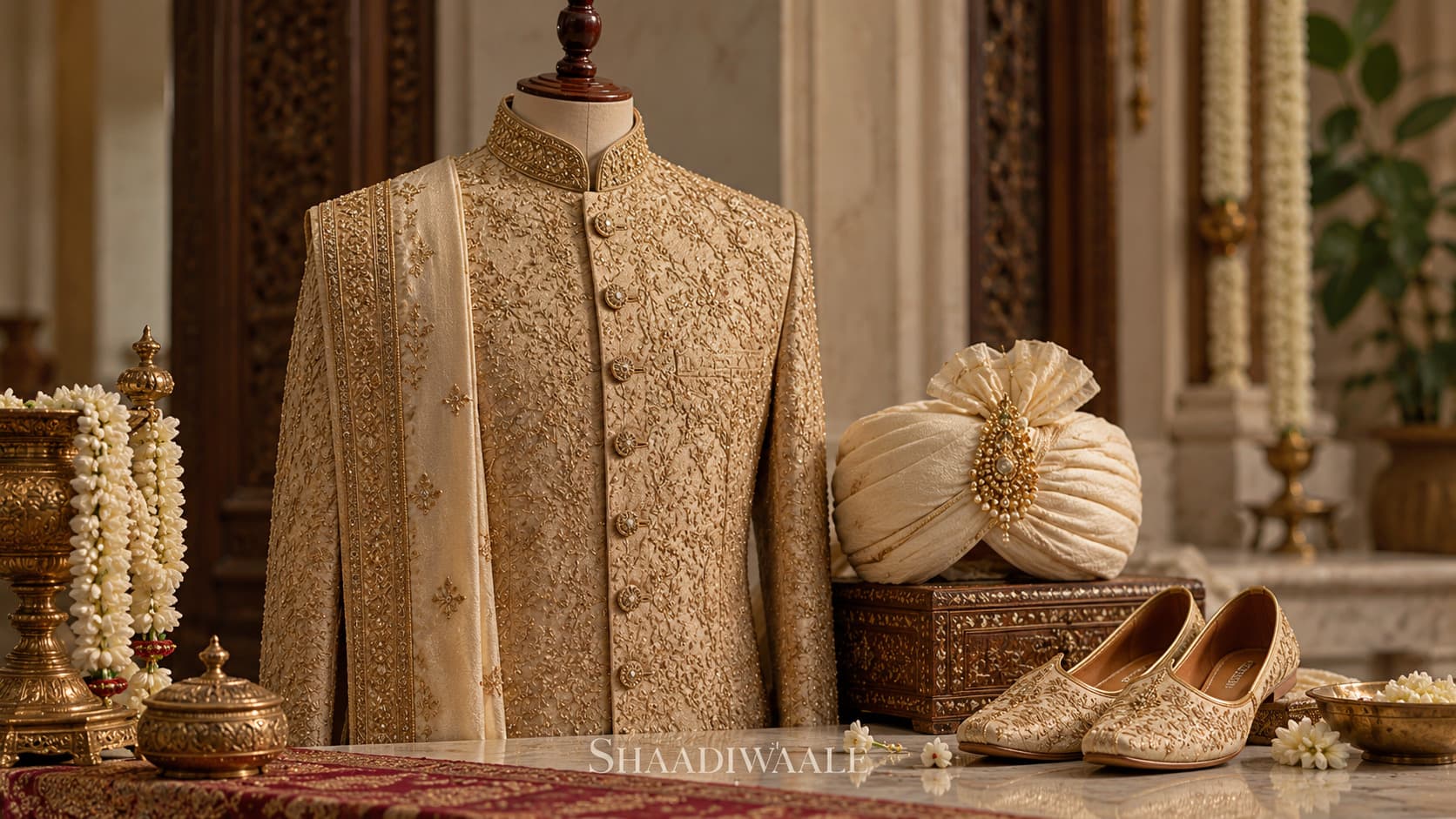
| Bandhgala | The closed-neck jacket, ending at the hip, worn with trousers or breeches. Also called the Jodhpuri or Nehru jacket, though purists will tell you those are three different things | Receptions, cocktails, the sangeet; and the one piece you will wear again |
| Kurta and pyjama or churidar | The base layer and the simplest look. In heavy silk with a dupatta it is a wedding outfit; in cotton it is a haldi outfit | Haldi, mehndi, the morning functions, the groom's own comfort |
| Nehru jacket | The sleeveless version of the bandhgala, worn over a kurta | Mehndi and sangeet; the groom's father |
| Dhoti and angavastram, veshti, mundu | The south's wedding wear: a draped lower garment in silk or cotton with a shawl | Tamil, Telugu, Kannada, Malayali and Bengali weddings, where the sherwani can look borrowed |
| Safa or pagdi | The turban. Tied on the day, from a length of fabric, or pre-tied | The baraat and the pheras; it is the groom's crown and the first thing people see |
| Dupatta or stole | The shawl over one shoulder, often the most embroidered piece | The wedding; it is where a plain sherwani gets its drama |
| Mojari or jutti | The flat leather shoes, pointed, often embroidered | Everything except the reception, where many grooms switch to oxfords |
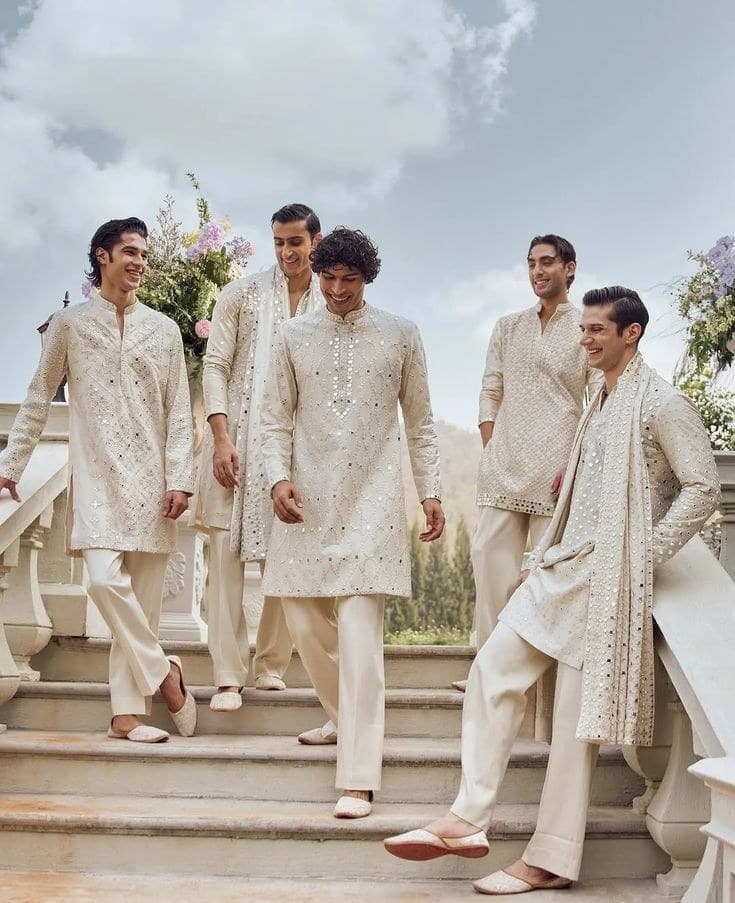
The combinations that work: sherwani plus churidar plus safa plus dupatta for the ceremony; bandhgala plus trousers for the reception; kurta plus Nehru jacket for the sangeet; plain kurta for the haldi. Across all of them, one colour family for the whole look, and never more than one piece that shouts.
And the most important word in groomswear: fit. A sherwani that pulls at the chest, a bandhgala with a collar that gapes, trousers that pool at the shoe: these are what make an expensive outfit look cheap and a cheap one look expensive. Every rung of the price ladder below can be fitted well. Insist on it.
Sabyasachi: the groom who matches the bride
Sabyasachi came to menswear the way it came to everything: through the wedding, and through the woman. The house dressed Anushka Sharma, Deepika Padukone, Katrina Kaif and Alia Bhatt, and in every case it dressed the groom too, in the same workshop, the same palette and the same mood. That is the first thing to understand about a Sabyasachi groom: he is designed to be half of a picture.
What the house does best. Heritage texture. An ivory raw silk sherwani hand-embroidered in a vintage Benarasi pattern with an old-rose silk kota safa, which is what Virat Kohli wore in Tuscany, so that he and Anushka read as one palette.2 An ivory silk sherwani with marori embroidery, a tussar georgette shawl with a zari pallu, a gold Benarasi tissue safa with a kilangi, and a necklace of emeralds and rose-cut diamonds, which is what Vicky Kaushal wore at Fort Barwara.3 Ranveer Singh's sherwani at Lake Como came from the house's India Revival Project, its long campaign to put old textiles back into use.4 The pattern is clear: the groom gets the same hand-done, slow-made surfaces as the bride, usually in ivory so that her colour is the colour, with the drama moved to the shawl, the safa and the jewellery.
The signature you can spot across a room. The buttons. The house's hand-crafted, gold-plated Bengal Tiger buttons are its crest, named in the description of Vicky Kaushal's sherwani,3 and once you know to look for them you see them on every Sabyasachi groom in every wedding album. The second signature is jewellery for men: a layered necklace of uncut stones over the sherwani, which almost no other house does with a straight face.
Who it suits. A groom whose bride is in Sabyasachi, first and obviously. A groom who wants to look like he belongs to an old family even if he does not. A groom who is comfortable in ivory and gold and does not want to compete. It suits a traditional ceremony far better than a cocktail, and it photographs best in daylight and against old stone.
Who it does not suit. A groom who wants to be noticed before the bride is. A reception where the brief is sharp and modern. Anyone in a hurry: the work is slow by design.
Price. The house does not publish menswear prices on its site, which lists its men's collections under Heritage and Weddings but shows no figures.5 Expect couture pricing, by appointment at the stores, and expect the groom's look to be scoped alongside the bride's. We will not print a number we cannot source.
Where else the Sabyasachi look lives. The house's partnership with Aditya Birla Fashion since 2021 has not produced a cheaper men's line,6 but its influence is everywhere: ivory sherwanis with a single coloured safa, heritage buttons, men's necklaces. If you want the mood without the appointment, those are the three things to ask any tailor for.
Manish Malhotra: the sharp, embellished groom
If Sabyasachi dresses the groom to match the bride, Manish Malhotra dresses him to be photographed. Thirty years of dressing Bollywood on screen taught the designer what reads from a distance and under lights, and his menswear carries that knowledge. The label launched in 2005; Reliance Brands bought a 40 per cent stake in its parent company in October 2021, when it had four flagship stores in Mumbai, Delhi and Hyderabad.7
What the house does best. Sharpness with embellishment. Malhotra told Esquire India in November 2025 that his approach was "always about being sharp for me, that men should not have too much fuss", and the clothes bear it out: tailored bandhgalas, contemporary sherwanis and Indo-Western hybrids, mostly in ivory and white because of how regal they look, with zardozi and hand embroidery as the texture and jewelled collar pins, brooches, cufflinks and tiepins as the statement.1 He has dressed Sidharth Malhotra for his wedding to Kiara Advani and Varun Dhawan among many others, and he is not afraid of drama: "Why should only women wear a trail?" he asked in the same interview.1
The signature you can spot across a room. Surface. Where a Sabyasachi sherwani is textured, a Manish Malhotra one glitters: dense threadwork and dori, zardozi, Kashmiri embroidery, sequins placed to catch stage light. The house's own site sorts its 239 men's looks by occasion, Groom, Sangeet, Mehendi, Reception, Cocktail, which tells you how it thinks: a wardrobe for the whole week, not one coat.8
Who it suits. The groom who wants to shine, in the literal sense. The reception and the sangeet above all, where a sharp embroidered bandhgala in ivory or black is the look of the decade. A groom marrying a Manish Malhotra bride, for the same matching reason as Sabyasachi. Anyone who likes a modern cut: his sherwanis are shorter and closer than the heritage houses'.
Who it does not suit. The groom who wants to disappear into tradition. Very old-fashioned ceremonies in daylight, where the glitter can look like evening wear at breakfast.
Price, from the house's own site on 4 October 2026. Sherwanis listed from 1,80,000 to 9,05,000 rupees; bandhgalas from 1,45,000 to 4,95,000; kurta sets from 64,000 to 3,45,000; the cheapest men's piece visible a black shirt with a lion motif at 25,500.8 These are ready-to-wear listings; couture for a specific groom is by appointment and priced on the brief. Malhotra himself told Esquire that grooms now spend 5 to 6 lakh on wedding attire where they spent about 2 lakh when he started,1 which is a useful anchor for what the top of the market considers normal.
Raghavendra Rathore: the bandhgala, perfected
The third house is the one grooms' fathers already know. Raghavendra Rathore was born in Jodhpur in 1967 into the city's royal family, a descendant of Rao Jodha who founded it; he graduated from Parsons in New York in 1992, assisted Donna Karan at DKNY and then Oscar de la Renta in Paris, and came home to start a label in 1994, followed a decade later by Raghavendra Rathore Jodhpur, the bespoke menswear house.9
What the house does best. One garment, better than anyone. The bandhgala, the closed-neck jacket of the Rajput courts, was a relic when Rathore picked it up; his brand is credited with reviving it and turning it into a global wardrobe staple.9 Where other houses make a bandhgala as one item in a range, Rathore has spent thirty years on its proportions: the exact height of the collar, the line of the shoulder, the length that works with breeches and the length that works with trousers. The house dresses the Emir of Qatar, Amitabh Bachchan, Saif Ali Khan and Virat Kohli,9 and a Rathore bandhgala is the thing a certain kind of Indian man buys once and wears to weddings for twenty years.
The signature you can spot across a room. Restraint. No embroidery, or very little; the drama is in the cut, the cloth and the colour, a deep velvet or a bottle green or a plain ivory. The Jodhpuri breeches, cut full at the thigh and tight at the calf, when a groom wants the full court look. And the details: a pocket square, a brooch, a pair of polished shoes.
Who it suits. The groom who wants to look like himself, only more so. Receptions and cocktails above all. Grooms over thirty, grooms in uniformed or formal professions, grooms whose brides are in something quiet. Rajasthani weddings, obviously. And the father of the bride or groom, who will never look better than in a Rathore bandhgala.
Who it does not suit. A groom who wants a heavy, embroidered pheras look. The house makes achkans and will embroider, but that is not what it is for.
Price, from the house's own site on 4 October 2026. Kurtas from 34,999 to 68,999 rupees; waistcoats from 48,999 to 2,83,999; bandhgala jackets from 94,999 to 1,76,999; achkans from 4,12,999 to 5,30,999, all including tax, with bespoke by appointment, virtual styling and trunk shows for made-to-measure pieces.10 Of the three houses, this is the one where a single ready-to-wear jacket under a lakh buys you the real thing.
The rest of the top table
Three houses lead, but a groom with the budget has more than three doors to knock on, and each of these does one thing the big three do not.
| House | Go there for | Best function |
|---|---|---|
| Tarun Tahiliani | Drape and structure together: sherwanis that fall like a sari, Swarovski and fine zardozi, and the most elegant ivory in the business. Also the designer behind Tasva, Aditya Birla's accessible menswear line, so his eye reaches a lower rung too | The wedding ceremony, the reception |
| Shantnu and Nikhil | The military-ceremonial groom: epaulettes, sashes, brooches, a sharp black or deep blue bandhgala with a regimental feel. Nobody does the modern reception groom with more swagger | Reception, cocktail, sangeet |
| Anita Dongre | Jaipur craft and lightness: gota patti, hand block, a palette of pastels and jewel tones, and a groom who looks relaxed in daylight. Strong on the mehndi and haldi | Mehndi, haldi, daytime weddings |
| Kunal Rawal | The young groom's designer: unstructured, layered, textured, sometimes a little undone, with hand-embroidery that reads as modern rather than heritage. Grooms who hate stiffness | Sangeet, cocktail, a non-traditional ceremony |
| Anamika Khanna | The artist's choice: unexpected proportions, draped layers, embroidery as texture rather than sparkle. For the groom whose bride is in Anamika Khanna | The ceremony, when the couple wants to look like a painting |
| Gaurav Gupta | Sculpture. Indo-Western, futuristic lines, for the groom who wants a reception look nobody has seen | Reception only |
| Antar-Agni, Ujjawal Dubey | The quiet, draped, monochrome groom: asymmetric kurtas, cowls, charcoal and ivory. For a man who finds a sherwani costume-like | Sangeet, cocktail, a small intimate ceremony |
Two more names grooms ask about. Rohit Bal, who died in November 2024, was the great romantic of Indian menswear, all velvet and lotus embroidery; the house continues and his archive is the thing to ask for. And the many excellent regional houses, from Lucknow's chikankari families to Hyderabad's sherwani specialists to Chennai's silk weavers, who will make a groom's outfit in the local idiom for a fraction of the Mumbai names, and often better for a local wedding.
We are not printing prices for these houses because we have not checked each one's site, and we would rather give you a sound description than an unsound number. Our team is collecting listed prices for a follow-up piece on designer groomswear by budget.
The complete price ladder
Here is the honest part. Most grooms are not spending 5 lakh on a sherwani, and most do not need to. Indian menswear now has five clear rungs, and a good wedding look exists on every one of them. The prices on the top two rungs are the brands' own listings on 4 October 2026; the lower rungs are described by what you get, with prices to be added as our team checks the brand sites and collects quotes.
Rung 1. Couture and bespoke
What it is. The three houses above and the top table, made or fitted for you, by appointment, usually alongside the bride's outfit. Hand embroidery, heritage textiles, several fittings, a stylist's eye on the whole look including the safa, the jewellery and the shoes.
What it costs. Sabyasachi does not publish prices. Manish Malhotra's ready-to-wear sherwanis list from 1,80,000 to 9,05,000 rupees, bandhgalas from 1,45,000 to 4,95,000;8 Raghavendra Rathore's achkans from 4,12,999 to 5,30,999.10 Malhotra's own figure for what a groom spends at this level today is 5 to 6 lakh.1
What you are paying for. Hands and hours, as in the bride's lehenga. Fabric you cannot buy by the metre. A fit that accounts for how you stand when you are nervous. And the knowledge that the two of you were dressed by one eye.
Worth it when the bride is at the same house, the wedding is large and photographed, and the outfit will be in the family's pictures for fifty years.
Rung 2. Designer ready-to-wear
What it is. The same houses' off-the-rack pieces, altered to fit, and the ready lines of the top table. One fitting, two at most. The embroidery is real but lighter; the fabric is the house's; the label is the label.
What it costs. Raghavendra Rathore's bandhgala jackets list from 94,999 to 1,76,999 rupees and kurtas from 34,999;10 Manish Malhotra's kurta sets from 64,000 and his cheapest men's piece, a shirt, at 25,500.8 Call it roughly 35,000 to 1,80,000 for a complete designer look from a listed range.
What you are paying for. The house's cut and taste, which is most of what you see in a photograph, without the hours of bespoke embroidery. A Rathore bandhgala at this rung is the single best-value piece in Indian menswear, because it is the house's actual signature at its lowest price.
Worth it when you want one piece that lasts: the bandhgala for the reception, worn again for every wedding you attend for a decade.
Rung 3. Premium high street and designer diffusion
What it is. Brands built to put designer taste in a mall: Tasva, Aditya Birla's menswear line designed with Tarun Tahiliani, which describes itself as high-quality ethnic wear for men at great price points;11 the upper ranges of Manyavar; Fabindia's silks; the better Delhi and Mumbai boutiques. Machine embroidery with hand finishing, good fabric, standard sizes with in-store alteration.
What it costs. Typically in the tens of thousands for a sherwani set, less for a kurta and jacket. Exact ranges from the brand sites to be added here.
What you are paying for. Consistency and convenience. You can see the outfit, try it, take it home, and come back for the hem. The designs borrow from the houses above, a year or two behind.
Worth it when you want a wedding-day sherwani that looks right in photographs without a six-month lead time, which is most grooms.
Rung 4. Affordable chains and local tailors
What it is. The mass ethnic-wear chains at their core ranges, the wedding markets of every city (Chandni Chowk, Dadar, Commercial Street, Charminar), and the local tailor working from a photograph you bring him. Polyester-silk blends, machine embroidery, bright colour.
What it costs. From a few thousand rupees for a kurta set to the low tens of thousands for a full sherwani with safa and shoes. Exact ranges to be added from quotes.
What you are paying for. The look at the price. The two things that go wrong at this rung are fit and shine: a sherwani that is too loose, in a fabric that catches light like plastic. Both are fixable. Pay for alteration. Choose matte over shiny. Spend the saving on a good safa and real leather mojaris, which are what people see.
Worth it when the budget is the budget, and for the functions other than the ceremony, where a plain kurta in good cotton beats a cheap sherwani every time.
Rung 5. Rental
What it is. Designer and premium outfits rented for the day or the weekend, from rental services in the big cities and increasingly online, including pieces from the houses above.
What it costs. Usually a fraction of the purchase price, with a deposit and alteration charges on top. Ranges to be added from the rental services' own listings.
What you are paying for. A couture look for one night. Grooms rent for the reception more than the ceremony, since the ceremony outfit is the one families like to keep. Check the alteration policy before you commit, and book early for peak season dates.
Worth it when the reception needs a sharp bandhgala you will not wear again, or the budget is going to the bride.
| Rung | A complete look, roughly | The thing to insist on |
|---|---|---|
| Couture | Several lakh; by appointment; Malhotra's figure is 5 to 6 lakh | Fittings, and the safa and jewellery scoped in |
| Designer ready-to-wear | About 35,000 to 1,80,000 from listed ranges | Alteration by the house, not a local tailor |
| Premium high street | Tens of thousands; ranges to be added | Matte fabric, in-store alteration |
| Affordable | A few thousand to the low tens of thousands; ranges to be added | Fit above everything; spend on the safa and shoes |
| Rental | A fraction of purchase; ranges to be added | Alteration policy and an early booking |
Dressing the functions
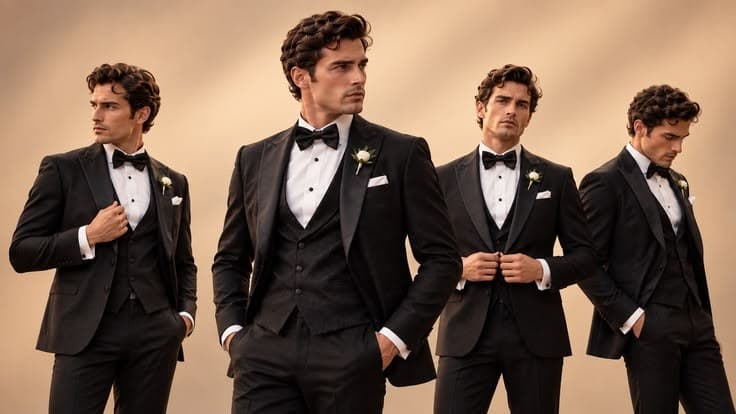
The mistake is to think of the groom's outfit, singular. A modern wedding is four or five functions, and the groom who spends everything on the sherwani and turns up to the sangeet in a borrowed kurta has got the arithmetic backwards. Here is how to spread the money and the drama.
Haldi. Plain, light, washable, and yellow or white, because turmeric is going on it and never coming off. A cotton or linen kurta with a pyjama, bare feet or chappals. This is the function to spend the least on and enjoy the most. If the budget is tight anywhere, it is here.
Mehndi. Colour and ease. A kurta in a strong colour, a Nehru jacket or a printed bandi over it, mojaris. This is where Anita Dongre's palette and Kunal Rawal's layering come into their own, and where the affordable chains are at their best because the brief is cheerful, not grand. Grooms increasingly take a little mehndi themselves, a motif on one palm, so wear a sleeve that rolls.
Sangeet. The performance outfit, and the one with the most freedom. A sharp bandhgala for a formal sangeet; an embroidered kurta with a jacket for a family one; an Indo-Western if you are going to dance, because you will. Shantnu and Nikhil, Kunal Rawal and Manish Malhotra's Sangeet edit were made for this. Rent here if you rent anywhere.
The wedding ceremony. The sherwani, the safa, the dupatta, the mojaris, the family. This is where Sabyasachi, Tahiliani and the heritage look belong, and where ivory with one colour is almost never wrong. In the south, the veshti and angavastram in silk, and please do not import a sherwani where a veshti is the tradition; it looks like a costume and the elders will say so. Match the bride's palette, not her embroidery.
The reception. The bandhgala's moment. Black, midnight, bottle green or ivory, sharply cut, with trousers and good shoes. Raghavendra Rathore owns this; Manish Malhotra and Shantnu and Nikhil make the embellished version. Of all the groom's outfits this is the one worth buying well because it is the one you will wear again.
| Function | The look | Where to spend |
|---|---|---|
| Haldi | Plain cotton kurta, white or yellow | Almost nothing |
| Mehndi | Coloured kurta, bandi or Nehru jacket, mojaris | A little; the affordable chains shine here |
| Sangeet | Bandhgala or embroidered kurta set; something you can move in | Rent, or a designer ready-to-wear jacket |
| Wedding | Sherwani or achkan, safa, dupatta, mojaris; or veshti and angavastram | The most, and the piece the family keeps |
| Reception | Sharp bandhgala with trousers | The second most, and the piece you keep |
The one rule across all five: one colour family per function, and across the week a palette rather than five unrelated outfits, so the album reads as one groom and not five strangers.
Fit, fabric, colour: how to buy well at any price
Three things decide whether a groom looks expensive, and none of them is the label.
Fit. A sherwani should sit close through the chest and shoulder with no pulling at the buttons, skim the waist without clinging, and end somewhere between mid-thigh and the knee depending on your height; shorter men should go shorter. The collar of a bandhgala should touch the neck all the way round with a finger's room, never gape, never choke. Sleeves end at the wrist bone. Trousers break once on the shoe, churidars gather cleanly at the ankle. If any of this is not true in the shop, it will not be true at the wedding; alteration is where a thousand rupees buys the most.
Fabric. Raw silk, matka silk, silk brocade, velvet and good wool-silk blends look expensive because they absorb and reflect light in a way that moves. Shiny polyester-satin looks cheap because it reflects everything, flat. At the affordable rung, choose the matte option every time and let the embroidery do the shining. In summer, choose weight carefully: a heavy velvet bandhgala in a Delhi May is a mistake you will remember, and linen or cotton silk for the daytime functions is not a compromise but good sense.
Colour. Ivory is the safest wedding-ceremony colour because it flatters every skin tone and lets the bride's colour lead; it is why all three houses default to it. Add one colour in the safa or dupatta, picked from the bride's outfit or the decor. For the reception, go dark: black, midnight, bottle green, wine. For the mehndi and sangeet, go brave: a strong colour you would not wear to the office, because this is the one week you can. Avoid matching the bride exactly; echo her.
The details that cost little and show a lot. A safa tied by someone who knows how, with a kilangi or a brooch. Real leather mojaris, broken in before the day. A pocket square or a kalgi. Clean, trimmed nails, because the ring photograph is coming. A watch that is either very good or absent.
The one spend that is always worth it. A trial fitting in the full outfit, with the safa on, two weeks before, photographed on a phone from the front and side. Every problem you will have on the day will be visible in that photograph, and there is still time to fix it.
Mistakes grooms make, and the timeline that avoids them
Starting late. The bride's outfit is ordered six months out; the groom's is often an afterthought at six weeks. Couture needs the same lead time as hers. Even ready-to-wear needs two fittings and the safa, shoes and dupatta sourced to match.
Buying the sherwani first. Decide the palette of the whole week with the bride, then buy. The groom who buys a maroon sherwani before learning the bride is in red has a problem no tailor can solve.
Matching, not echoing. Same colour, same embroidery, same everything looks like a uniform. Pick up one of her colours, or her metal, and leave the rest.
Ignoring the safa. It is the top of every photograph. A badly tied safa in a mismatched fabric undoes a good sherwani. Buy the safa fabric with the outfit and book the person who ties it.
Shoes as an afterthought. New mojaris hurt. Wear them in for a week. For the reception, polish the oxfords the day before, not the day of.
One outfit for five functions. Covered above: spread the money, and let the haldi be cheap so the reception can be good.
Forgetting the fathers. Both fathers will be in every photograph with you. A bandhgala each, in the family's palette, is the best money a groom spends on other people.
| When | What |
|---|---|
| 6 months out | Settle the palette with the bride. Decide the rung. Book couture appointments if that is the plan |
| 4 months | Order or buy the ceremony outfit. Choose the safa fabric and dupatta with it |
| 3 months | Reception bandhgala, sangeet outfit. Book rental if renting |
| 2 months | Mehndi and haldi outfits. Fathers' and brothers' outfits |
| 6 weeks | First fitting of everything. Shoes bought and worn in from now |
| 2 weeks | Final fitting, full outfit with safa, photographed front and side |
| The week | Safa-tier booked; everything pressed, hung, and in one place with a list |
Put these in your checklist as dated tasks and they stop being a worry.
Frequently asked questions
Which designer is best for a groom's sherwani?
For a heritage ceremony look that matches a Sabyasachi bride, Sabyasachi. For a sharp, embellished look, especially for the reception, Manish Malhotra. For the bandhgala, Raghavendra Rathore. Tarun Tahiliani, Shantnu and Nikhil, Anita Dongre and Kunal Rawal each do one thing the big three do not; see the table above.
How much does a Manish Malhotra sherwani cost?
On the house's own site on 4 October 2026, men's sherwanis were listed from 1,80,000 to 9,05,000 rupees and bandhgalas from 1,45,000 to 4,95,000. Couture for a specific groom is priced on the brief.
How much does a Sabyasachi sherwani cost?
The house does not publish menswear prices. It sells by appointment, and we will not print a figure we cannot source.
How much does a Raghavendra Rathore bandhgala cost?
On the house's site on 4 October 2026, bandhgala jackets were listed from 94,999 to 1,76,999 rupees, kurtas from 34,999, and achkans from 4,12,999 to 5,30,999, all including tax.
What should a groom spend on his wedding outfit?
Manish Malhotra told Esquire India in 2025 that grooms at his level now spend 5 to 6 lakh. Most grooms spend far less, and a good look exists at every rung from couture to rental; the ladder above says what you get at each.
Sherwani or bandhgala?
Sherwani for the ceremony, bandhgala for the reception. If you can only buy one well, make it the bandhgala, because you will wear it again.
What colour should the groom wear?
Ivory for the ceremony with one colour from the bride's outfit in the safa or dupatta; dark for the reception; brave for the mehndi and sangeet. Echo the bride, do not match her.
Can a groom rent his wedding outfit?
Yes, and many do, especially for the reception and sangeet. Check the alteration policy and book early for peak dates. Families usually prefer to buy the ceremony outfit.
How early should a groom order his outfit?
Couture, six months. Ready-to-wear, three to four months, to allow two fittings and time to source the safa and shoes. The timeline above works back from the date.
Share this guide
Send it to the family group, or keep it for later.
Questions about your wedding?
Our team answers questions about venues, vendors and the budget, free on WhatsApp.
About Shaadiwaale
Indian wedding planning in one place: venues and vendors with real prices, free kundli matching, invitations and tools to plan every function together.
Every function. Every family. One plan.
Notes
- Manish Malhotra on rewriting the rules of how Indian men dress, Esquire India, 19 November 2025. His quotes, the 35 per cent figure, and the 5 to 6 lakh figure. esquireindia.co.in ↩
- Virushka get hitched: all the Sabyasachi looks, The Quint, December 2017. Virat Kohli's sherwani. thequint.com ↩
- Katrina Kaif and Vicky Kaushal pick Sabyasachi, Gulf News, 10 December 2021. Vicky Kaushal's outfit and the tiger buttons. gulfnews.com ↩
- Sabyasachi shares the making video of Deepika and Ranveer's outfits, BollywoodShaadis, 29 November 2018. Ranveer Singh's sherwani. bollywoodshaadis.com ↩
- Sabyasachi, the house's own site. Men's collections, no prices listed. sabyasachi.com ↩
- Sabyasachi sells 51 per cent stake to Aditya Birla Fashion, WION, 27 January 2021. wionews.com ↩
- Reliance Brands acquires 40 per cent stake in Manish Malhotra, FashionNetwork, 18 October 2021. in.fashionnetwork.com ↩
- Manish Malhotra, men's collection, the house's own site. Listed prices and the occasion edits. manishmalhotra.in ↩
- Raghavendra Rathore, Wikipedia. Biography, the bandhgala revival, clients. en.wikipedia.org ↩
- Raghavendra Rathore Jodhpur, all products, the house's own site. Listed prices and bespoke services. rathore.com ↩
- Tasva, Aditya Birla Fashion's menswear line. tasva.com ↩