Editorial
Five Sabyasachi Brides: The Greatest Wedding Looks the House Ever Made
Pale pink in Tuscany, a blessing hidden in a veil, 3,720 hours of Calcutta embroidery, a red lehenga built in homage to a groom, and an ivory sari that broke the oldest rule. Five looks, told close enough to touch.
- Anushka's pale pink lehenga made soft colour acceptable for an Indian bride
- Deepika's veil carried a Sanskrit blessing stitched in gold
- Priyanka's lehenga took 110 embroiderers 3,720 hours
- Alia's ivory organza sari turned minimal into a bridal style of its own
Outfits and beauty · 17 min read · By The Shaadiwaale team
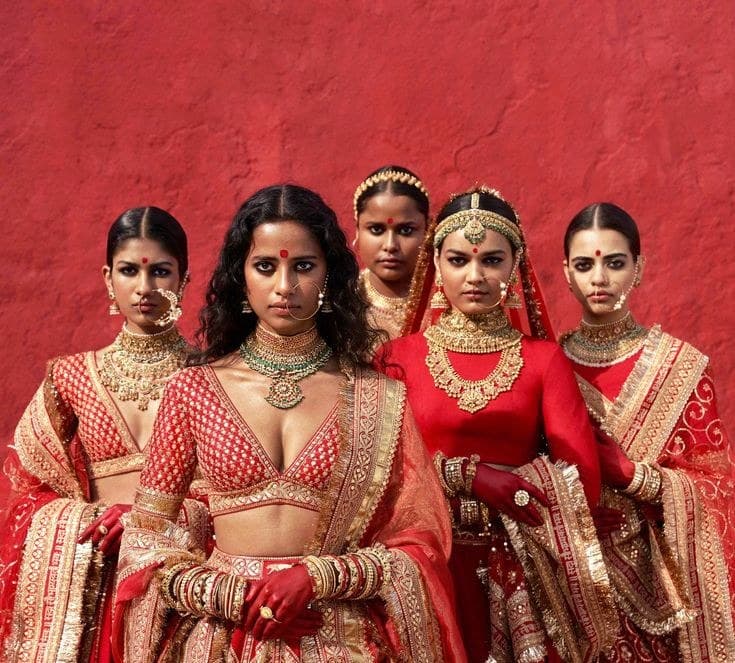
There is a particular sound a Sabyasachi lehenga makes. Not a rustle, exactly. Heavier than that. It is the sound of several kilos of hand-worked silk and metal thread settling as a bride sits down, a soft, expensive thud, followed by the tiny click of a thousand sequins finding their places. If you have been to an Indian wedding in the last ten years, you have heard it. If you have been to a big one, you have heard it more than once.
Sabyasachi began in Kolkata in 1999, when Sabyasachi Mukherjee, fresh out of design school, started a label with borrowed money and a conviction that Indian craft did not need to apologise to anyone.1 Twenty-two years later, in January 2021, Aditya Birla Fashion bought a 51 per cent stake in the house, by which point it had stores in India, the US, the UK and the Middle East, a jewellery line, and a hold on the Indian bridal imagination so complete that "a Sabyasachi bride" had become a phrase people used without needing to explain it.1
We should say plainly that this is a love letter. We are not paid by the house, nobody there has seen this piece, and we will happily tell you in another article where to find beautiful work for a tenth of the price. But if you want to understand what the modern Indian bride looks like, and why she looks like that, there is no way around this man and these five dresses.
We have chosen them not because they are the most expensive (nobody outside the house knows, and the numbers that float around online are guesses), but because each one changed something. One made a soft colour acceptable at a Hindu wedding. One hid a prayer in plain sight. One set a record for sheer labour. One was built around the groom's roots rather than the bride's. And one dared to be almost nothing at all, and became the most copied bridal look of its decade.
Here they are, in the order they happened.
1. Anushka Sharma, Tuscany, 11 December 2017: the pale pink that gave brides permission
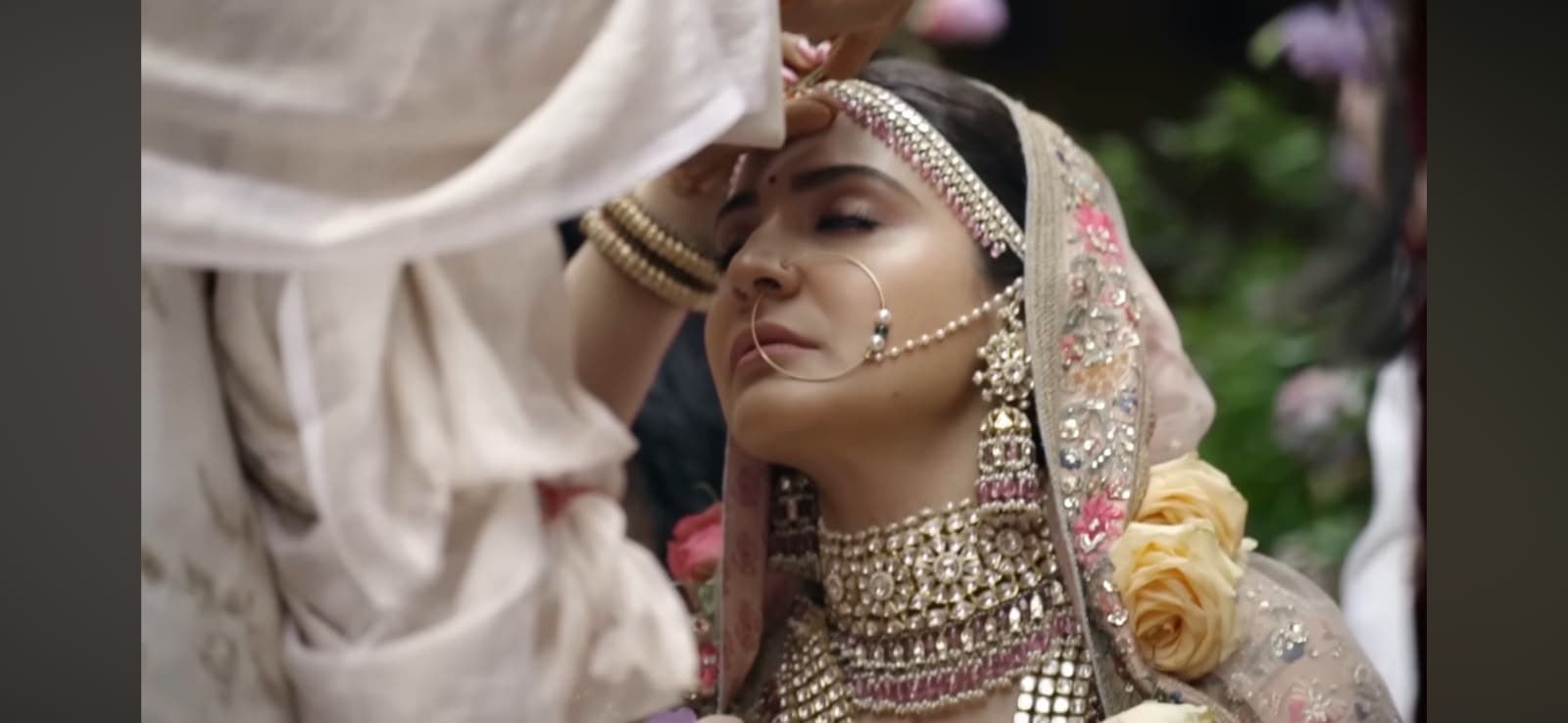
Start with the colour, because the colour was the point.
For as long as anyone could remember, an Indian bride wore red. Maroon if she was daring, deep pink if she was from the right part of the country, gold if she was from the south. Pale pink was for the sister of the bride, the sangeet, a cousin's engagement. It was pretty. It was not bridal.
Then a photograph arrived from a restored 13th-century village in the hills outside Florence, and the rule simply stopped applying. Anushka Sharma, marrying Virat Kohli in near-total secrecy, stood under an arch of pastel flowers in a lehenga the colour of the inside of a seashell, and the whole country exhaled at once.
The house described it as a pale pink lehenga with "Renaissance embroidery in vintage English colours embellished with silver-gold metal thread, pearls and beads".2 Read that again slowly, because every word is doing something. Renaissance, not Mughal: the motifs are European, scrolling florals and leaves that would not look out of place on a Florentine ceiling, which is where she was standing. Vintage English colours: dusty, faded, the palette of an old tapestry rather than a new one, so the embroidery sat into the pink instead of shouting over it. Silver-gold thread: not the brassy yellow gold of a traditional lehenga, but a metal that catches light more quietly, like candlelight in a mirror.
Up close, the surface is a low relief. Pearls and beads are worked in among the thread so that the fabric has texture before it has colour. Run a hand across it in your mind and you feel small hills and valleys, the cool of the pearls, the slight catch of metal thread against skin. The dupatta over her head was edged in the same work and weighed down with a fine border so that it fell in a straight sheet rather than bunching, the way a veil in a Renaissance portrait falls.
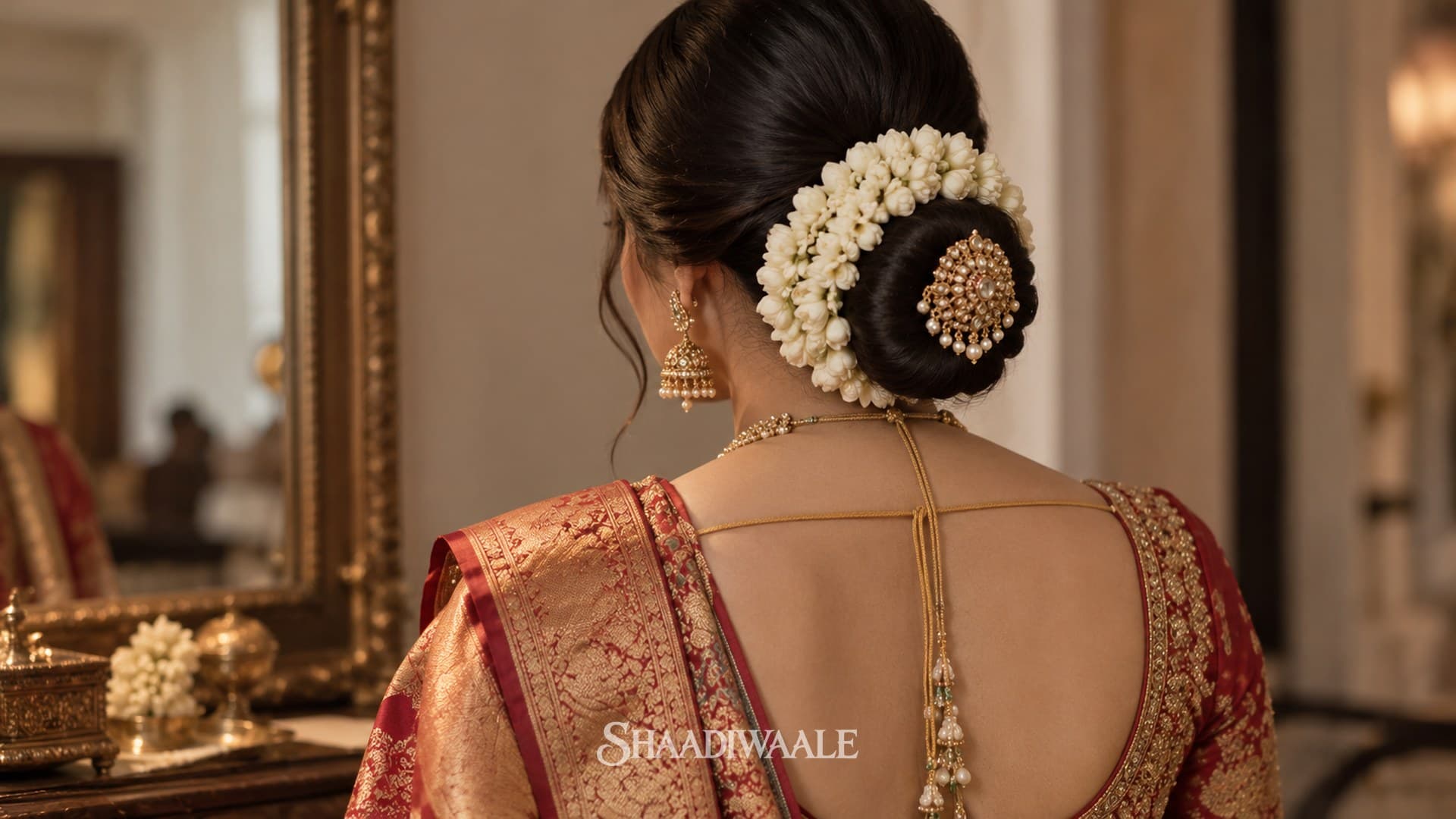
The jewellery was from the house's Heritage line: a wide choker, earrings and a mathapatti set with syndicate uncut diamonds, pale pink spinel and baroque Japanese cultured pearls.2 Uncut diamonds matter here. They do not sparkle the way a cut stone does; they glow, a soft grey-white, which is exactly what you want against a pale pink that a brighter stone would cheapen. The pink spinel picked up the lehenga. The baroque pearls, irregular, lumpy, each one different, kept the whole thing from looking like a jewellery shop window.
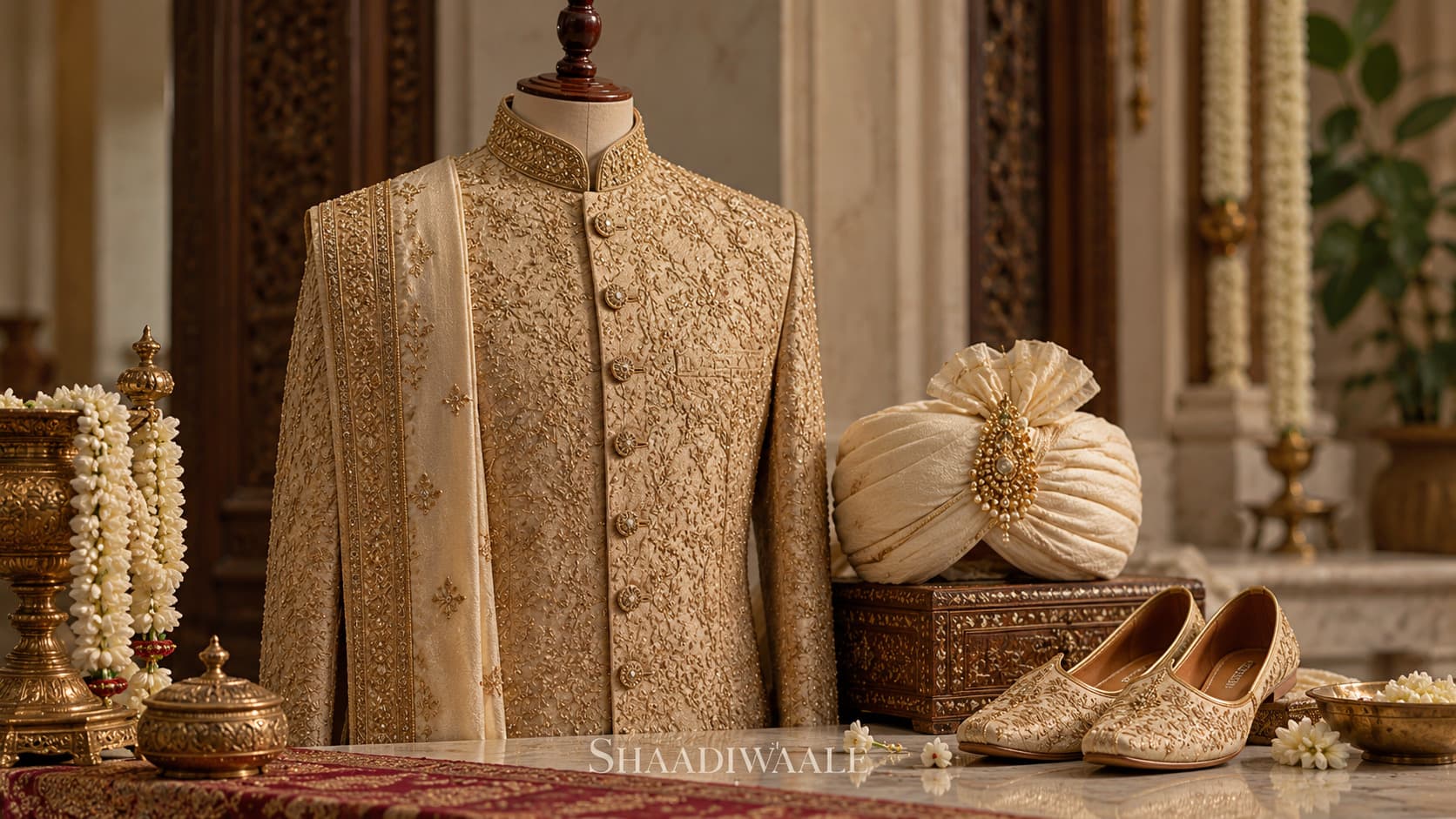
And then the details that were not jewellery at all: fresh Tuscan roses tucked into her hair, kohl-rimmed eyes, and the house's signature micro-dot bindi, barely a pinprick.2 Across from her, Virat wore an ivory raw silk sherwani hand-embroidered in a vintage Benarasi pattern with the house's signature buttons and an old-rose silk kota safa, so the two of them read as one palette rather than a bride and a groom standing near each other.2
Why it is one of the five: within a year, pale pink, blush, peach and ivory were in every bridal lookbook in the country, and brides who had been told they must wear red could point at a photograph and say, she didn't. Sabyasachi had made soft colour not just acceptable but aspirational. It is hard to overstate how many weddings since 2017 have had a bride in a shade that did not exist as a bridal option before that December.
2. Deepika Padukone, Lake Como, 14 and 15 November 2018: the blessing hidden in the veil
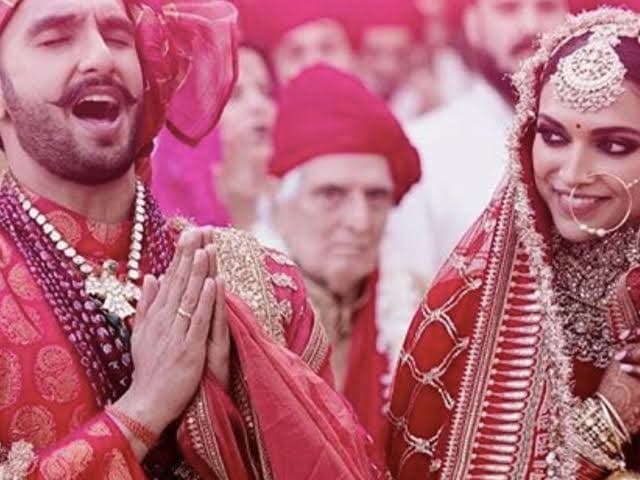
If Anushka's wedding was about what you could see, Deepika Padukone's was about what you almost couldn't.
She and Ranveer Singh married twice in two days at Villa del Balbianello on Lake Como, once by Konkani rites for her family and once by Sindhi rites for his, behind a no-photograph wall so strict that the only pictures the world saw were the ones the couple chose to release.3 Sabyasachi dressed both days, with one honest footnote: the sari she wore for the Konkani ceremony was not his. It was a red and gold Kanjeevaram with real zari and a Gandaberunda, the two-headed bird of Karnataka's royal crest, woven into the body, from Angadi Galleria in Bengaluru, given to her by her mother as Konkani custom asks.4 What the house did on day one was the thing over it, and that is where the story is.
The veil was red, covered edge to edge in gold embroidery and motifs, dense enough that from a distance it read as a solid sheet of warm metal.5 Only when the photographs were enlarged did people notice that the border was not a pattern. It was writing. Running along the edge of the dupatta, in gold thread, in Sanskrit: Sada Saubhagyavati Bhava. May you always be blessed as a married woman.5
It is the blessing an elder gives a bride at the moment of the ceremony, the words a grandmother says with her palm on your head. Sabyasachi stitched it into the fabric so it would be said over her, silently, for the whole day. Think about the hands that made it: an embroiderer in Kolkata, working a sentence letter by letter in metal thread on red silk, knowing that the woman who would wear it might not notice for hours, and that millions of strangers would notice before she did.
Day two was the full red lehenga: a custom piece in gold thread embroidery with peacocks worked explicitly into the skirt and sequins layered through it.4 Peacocks are the oldest motif in Indian bridal wear and the hardest to do well, because they either look like a greeting card or they look alive. These were alive: the tail feathers broke the border rather than sitting inside it. The sequins were there for a reason too. A Sindhi wedding is lit by fire and by lamps, and sequins are made for low, moving light. They do not glitter so much as breathe.
Ranveer's sherwani came from the house's India Revival Project, the designer's long campaign to bring old textile traditions back into living use, with embroidery and hand-sewn buttons that rewarded a close look.4 A fashion journalist put the house's trick to CNN neatly that week: the designs are decadent, but they stay simple and in one tone, instead of the bright, clashing colours Indian weddings usually run on.3 Red and gold and nothing else, for two days, at a lake in Italy.
Why it is one of the five: it taught a generation of brides that the most powerful detail on a wedding outfit can be one nobody sees at first. Within months, embroidered names, dates and blessings were showing up on veils and lehenga hems across the country. The hidden message became a genre.
3. Priyanka Chopra, Jodhpur, 2 December 2018: 3,720 hours of red
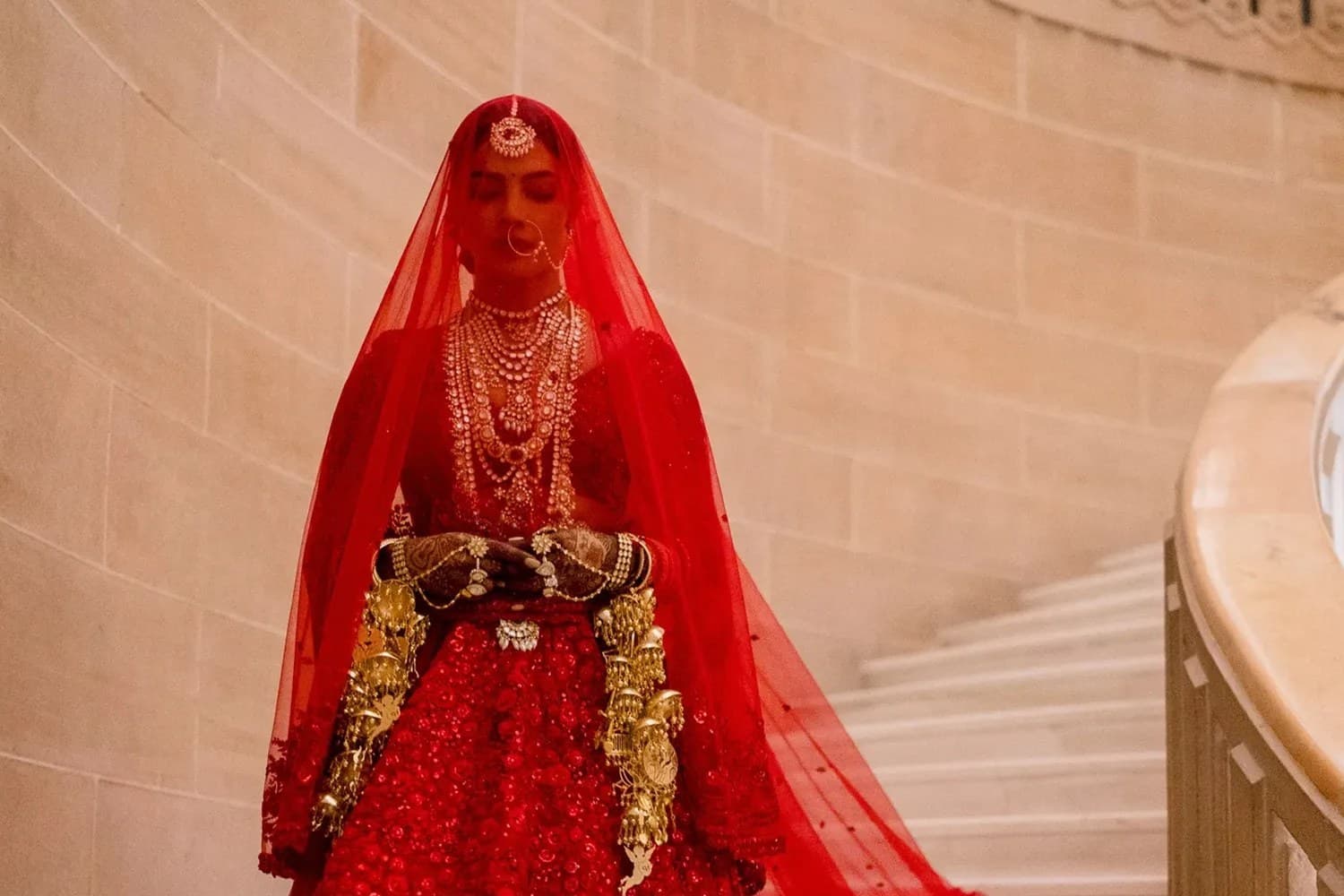
Two weeks after Lake Como, the house did the opposite of hiding anything.
Priyanka Chopra married Nick Jonas at Umaid Bhawan Palace in Jodhpur over a weekend that had a Christian ceremony on the Saturday and a Hindu one on the Sunday. For the Hindu ceremony she wore a red Sabyasachi lehenga, and for once the house put numbers on it. The piece was made by 110 embroiderers in Calcutta and took 3,720 hours to complete.6
Sit with that figure. Three thousand seven hundred and twenty hours is 155 days of one person working around the clock, or, more truthfully, a room full of karigars bent over frames for weeks, each responsible for a few square inches, passing the work along as the light changed. In the workshops of north Kolkata, embroidery is still done on a wooden frame called an adda, with the fabric stretched tight and the embroiderer sitting on the floor, needle in one hand and the thread fed from below. The number of hours is really a count of how many of those afternoons went into one skirt.
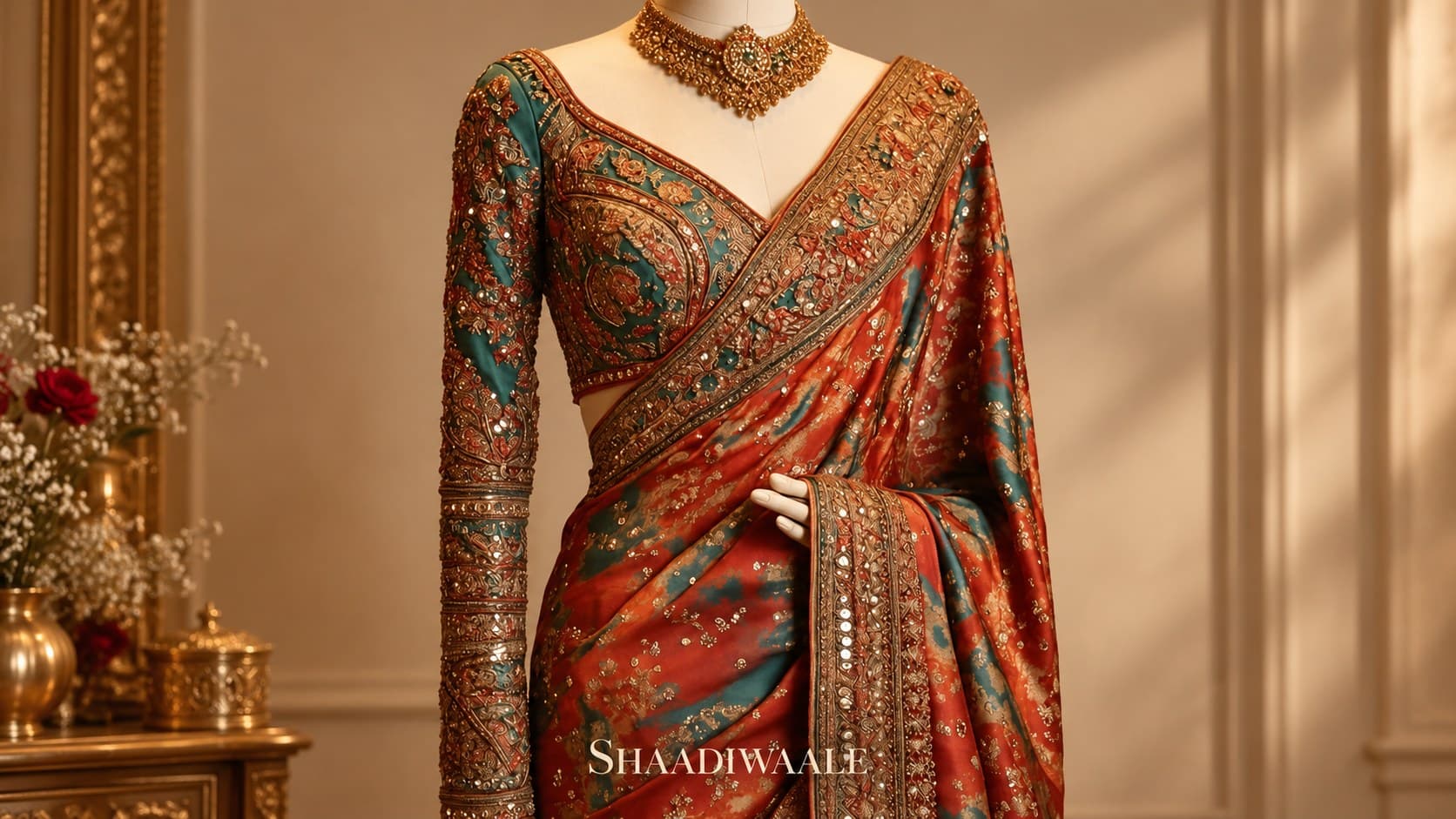
What were they making? Hand-embroidered and hand-cut organza flowers, French knots in silk floss, siam-red crystals, and "layer upon layer of thread-work embroidery".6 Each of those is a different craft. Organza flowers are cut petal by petal from stiff sheer fabric and stitched on so that they stand slightly proud of the surface, which is why the lehenga photographed as if it were in bloom. French knots are tiny raised dots made by wrapping thread around the needle before pulling it through, and in silk floss they catch light like beads of water. Siam red is a deep, slightly blue red, the colour of a pomegranate seed rather than a tomato, and the crystals in that shade were set so that the dress glittered without ever turning orange under the Jodhpur sun. Under all of it, the thread-work: dense, overlapping, the ground that everything else sat on.
Touch it in your mind. The organza petals are crisp and cool and slightly scratchy. The French knots are a texture under your fingertips, like braille. The crystals are hard and cold. The thread is warm. The whole surface is alive with different temperatures, and that is what the camera caught.
The jewellery was built to match the weight of the dress rather than fight it. It drew on the royal Mughal style: uncut diamonds, emeralds and Japanese cultured pearls set in 22-karat gold, with, the house noted, "delicate tiny stars in uncut diamonds, which added an element of whimsy to an otherwise traditional piece".6 Stars, on a Mughal-style necklace, for a bride who had become an international name and was marrying an American pop star at a palace in Rajasthan. Nobody said the word, but the whole look was a bridge.
Why it is one of the five: it is the look that put a number on the craft. Before December 2018, a bride who spent a fortune on embroidery could not easily say what she was paying for. After it, everyone knew the vocabulary: hours, hands, French knots, hand-cut organza. The house turned the invisible labour of Kolkata's workshops into part of the dress's beauty, and brides have been asking their designers "how many hours" ever since.
4. Katrina Kaif, Fort Barwara, 9 December 2021: a red lehenga built for the groom's roots
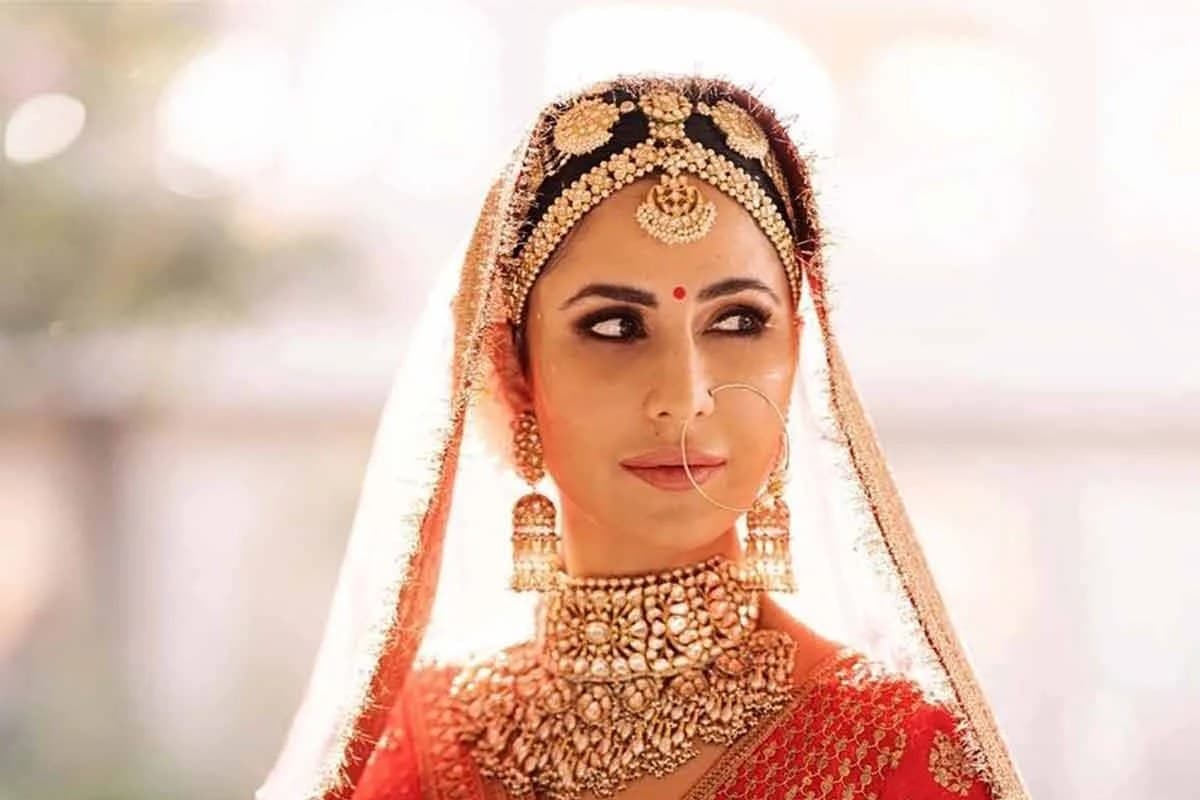
Three years and a pandemic later, red came back, and it came back with a story.
Katrina Kaif married Vicky Kaushal at Six Senses Fort Barwara, a 14th-century fort in Rajasthan, in a lehenga that looked, from a distance, like the most traditional thing a Bollywood bride had worn in years. Up close it was anything but.7
The fabric first: handwoven matka silk.7 Matka is a rough silk, spun from the leftover cocoon after the fine filament has been drawn off, and it has a slubby, uneven texture, almost like linen. It does not shine. It absorbs light. On a red lehenga this is a brave choice, because red usually relies on sheen for drama; matka gives you a red that looks like velvet without the heat, a red you want to lean into rather than step back from. Hold it and it is dry and slightly nubbly under the thumb, with real weight.
Onto that ground the house laid fine tilla work, the flat metallic thread embroidery that reads as lines of light, and then borders of revival zardozi worked in velvet.7 Zardozi is the old Mughal court embroidery, metal wire couched onto cloth, and "revival" is the house's word for doing it the slow, dense, old way rather than the quick commercial way. On velvet it sinks in, so the gold looks as if it is rising out of the red rather than sitting on it.
Then the detail that made the look. The veil was custom-trimmed with handmade kiran, the fine metallic fringe that hangs from the edge of a dupatta, in hand-beaten silver electroplated in gold, and the house said plainly that it was done "in homage to the groom's Punjabi roots".7 Kiran is a Punjabi bridal signature, the thing that shivers and chimes as a bride walks, and here was a woman of British and Kashmiri parentage, marrying into a Punjabi family, carrying a piece of her husband's culture around her face. When she moved, the fringe moved a fraction of a second later. When she stood still, it caught the fort's light and threw it back in a hundred tiny lines.
The jewellery was uncut diamonds in 22-karat gold with hand-strung pearls, again from the Heritage line, kept to a choker, earrings and a maang tikka so that the fringe of the veil could do its work without competition.7
Vicky's side of the frame was a study in how the house dresses a groom when the bride is in red: an ivory silk sherwani with marori embroidery, the house's hand-crafted gold-plated Bengal Tiger buttons, a tussar georgette shawl with a zari marori pallu, a gold Benarasi tissue safa with a kilangi, and a necklace of emeralds, rose-cut and brilliant-cut diamonds, quartz and tourmalines in 18-karat gold.7 The tiger buttons are the house's crest, the way a lion is a car maker's. Once you know to look for them, you see them on every Sabyasachi groom.
Why it is one of the five: it showed that a traditional red lehenga could still carry a new idea, and that the idea could be about the other person. The veil was not about Katrina's heritage. It was about Vicky's. Since 2021, brides have been borrowing motifs, colours and techniques from the groom's side on purpose, and dressing as the family they are joining as well as the one they come from.
5. Alia Bhatt, Mumbai, 14 April 2022: the ivory sari that broke the oldest rule
The last of the five is the quietest, and it may be the one that changed the most.
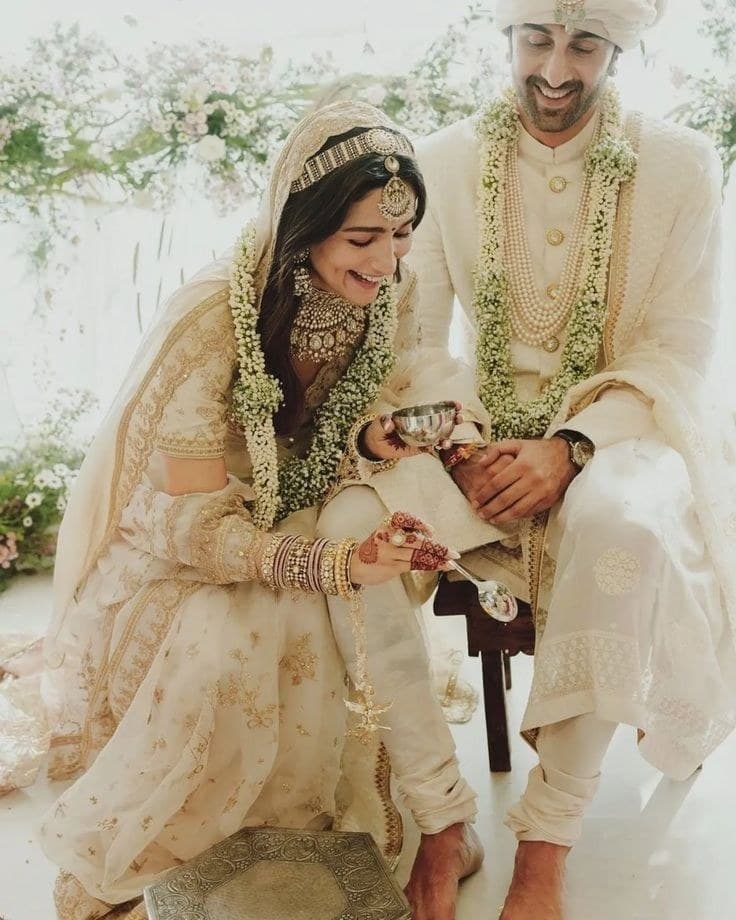
Alia Bhatt married Ranbir Kapoor at home, in the Kapoor family's Bandra building, with a guest list small enough to fit on a balcony. The photographs she released that evening showed her in an ivory organza sari, no lehenga, no red, no heavy border, her hair loose in soft waves, and the internet did the thing it does when something genuinely new appears: it argued for a week and then copied it for three years.8
Organza is the opposite of matka silk. It is sheer, crisp and light, a fabric that holds air. An organza sari does not drape so much as float, and it is unforgiving, because there is nowhere for a flaw to hide. The house embroidered it with fine tilla work in gold, the whole length of it, so that against the light the sari read as ivory and against the body it read as a faint shimmer, like sunlight through a curtain.8 Her stylist described the effect as an enchanted garden, and the motifs bore that out: pastel florals and butterflies worked across the fabric, small enough that you had to be close to see them.8
There was a private joke in it, too. The number eight, Ranbir's favourite, and the infinity sign it becomes on its side, were worked into the design as a repeating motif, and her kalire, the hanging ornaments a Punjabi bride wears at the wrist, were custom-made in silver with clouds, stars, birds and butterflies instead of the usual gold domes.8 Kalire are meant to be shaken over the heads of unmarried friends; these ones would have rung like a wind chime.
The jewellery followed the same logic as the sari: Heritage pieces in uncut diamonds and hand-strung pearls, with an ornate matha patti across the hair parting as the one deliberately grand gesture in an otherwise restrained look.8 Uncut diamonds again, you will notice. Across all five looks, the house never once put a brilliant-cut stone on a bride. The glow, not the sparkle, every time.
And then she did something no Bollywood bride had done with a wedding outfit before: she wore it again. In October 2023 she collected her National Film Award in the same ivory sari, and said afterwards that a special outfit can be worn more than once.9 For a country where bridal lehengas spend decades in a cupboard wrapped in muslin, that one appearance may have done more for the idea of a wedding outfit you actually live in than anything a sustainability campaign has managed.
Why it is one of the five: it proved that a bride could wear almost nothing, in colour and in weight, and still look like the most important person in the room. Ivory and white saris, once thought of as unlucky for a Hindu bride, became a serious option overnight. Minimal bridal is now a category in every designer's collection. Alia's balcony is where it started.
What the five have in common
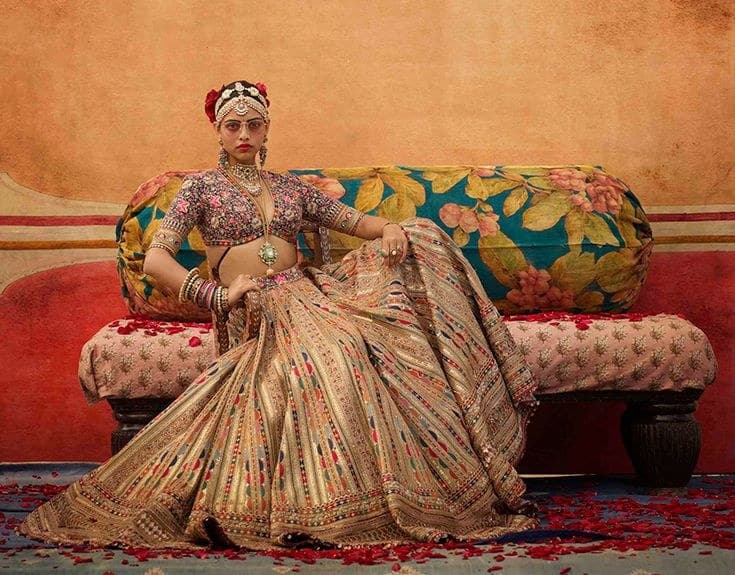
Line them up: pale pink in Tuscany, red and gold on a lake, red with 3,720 hours in a palace, red matka silk in a fort, ivory organza on a balcony. Five different women, five different weddings, five years. And yet you could put them in a room and know at once they came from the same hand. Here is why.
| The house's habit | What it does for the bride |
|---|---|
| Stones | Uncut diamonds every time, with pearls; never a brilliant cut on a bride |
| Colour | One colour, or one colour and gold, head to toe |
| Embroidery | Dense, old techniques done the slow way: zardozi, tilla, French knots, hand-cut organza |
| A secret | A blessing in the veil, a number in the sari, a fringe for the groom's family |
| The groom | Dressed in the same palette and the same workshop, tiger buttons and all |
None of these habits needs a Sabyasachi budget. They are decisions, not price tags, and every one of them is available to a bride working with a tailor in Chandni Chowk or a boutique in Bandra.
Pick one colour and commit to it. The single most copied thing about these five looks is also the cheapest: the absence of clashing colour. A lehenga, dupatta and blouse in one shade, with gold, will photograph better than three shades of anything.
Ask for texture, not just shine. Matka silk, raw silk, organza and velvet all have a hand you can feel. Sequins and stones are the easy part; a fabric that is interesting before anything is sewn onto it is what makes a look feel expensive.
Hide something. Your grandmother's blessing in the hem. His initials in the border. The date, in a script only the two of you read. It costs a few hundred rupees of extra embroidery and it is the detail you will still be touching in thirty years.
Dress the groom from the same shelf. The looks above work because nobody is competing. Have the same person, or at least the same palette, dress both of you.
Buy the uncut diamonds, or the look of them. Polki and kundan, the uncut and the glass-set, are what give these brides their glow. Real polki is an investment; good kundan from a trusted jeweller gives the same softness for a fraction, and nobody at a wedding is carrying a loupe.
Plan to wear it again. Alia's sari at the National Awards is the lesson. If the one outfit you spend the most on can only be worn once, ask the designer to make the blouse and dupatta work with other things, or choose a sari over a lehenga. A wedding outfit that comes out of the cupboard is worth twice one that doesn't. Put the outfit next to every other cost in your wedding budget, and add the trials and fittings to your checklist so the blouse is not the thing that is late.
The house will go on dressing famous brides, and the list above will need a sixth entry sooner or later. But these five are the ones that moved the whole country's idea of what a bride looks like, one pale pink lehenga, one hidden prayer, one impossible number of hours, one fringe for a groom's family, and one ivory sari at a time.
Share this guide
Send it to the family group, or keep it for later.
Questions about your wedding?
Our team answers questions about venues, vendors and the budget, free on WhatsApp.
About Shaadiwaale
Indian wedding planning in one place: venues and vendors with real prices, free kundli matching, invitations and tools to plan every function together.
Every function. Every family. One plan.
Notes
- Sabyasachi sells 51% stake to Aditya Birla Fashion, WION, 27 January 2021. wionews.com ↩
- Virushka get hitched: all the Sabyasachi looks from the wedding, The Quint, December 2017. thequint.com ↩
- Deepika Padukone and Ranveer Singh marry at Lake Como, CNN Style, 15 November 2018. cnn.com ↩
- Sabyasachi shares the making video of Deepika and Ranveer's outfits, BollywoodShaadis, 29 November 2018. bollywoodshaadis.com ↩
- Deepika Padukone's wedding outfit had a secret message on it, Gulf News, 16 November 2018. gulfnews.com ↩
- Details: Priyanka Chopra's wedding outfits, Elle India, 5 December 2018. elle.in ↩
- Katrina Kaif and Vicky Kaushal pick Sabyasachi for wedding outfits, Gulf News, 10 December 2021. gulfnews.com ↩
- Alia Bhatt and Ranbir Kapoor wedding: things you can't miss in Alia's look, EastMojo, 16 April 2022. eastmojo.com ↩
- A special outfit can be worn more than once, Deccan Herald, October 2023. deccanherald.com ↩