Explainer
Vivah Panchami 2026: The Day Ram Married Sita, and Why Many Families Will Not Book It
Vivah Panchami falls on Monday 14 December 2026. What the day remembers, how Janakpur and Ayodhya celebrate a wedding every year, the puja at home, and the tender custom that keeps many families from marrying on it.
- Vivah Panchami falls on Monday 14 December 2026, on Margashirsha Shukla Panchami
- Janakpur holds a symbolic marriage of Ram and Sita every year, with a Ram Baraat and thousands of pilgrims
- At home the puja performs the divine wedding in miniature, down to the ritual knot
- In Mithila and parts of North India, a folk tradition avoids a daughter's wedding on the day
Traditions · 10 min read · By The Shaadiwaale team
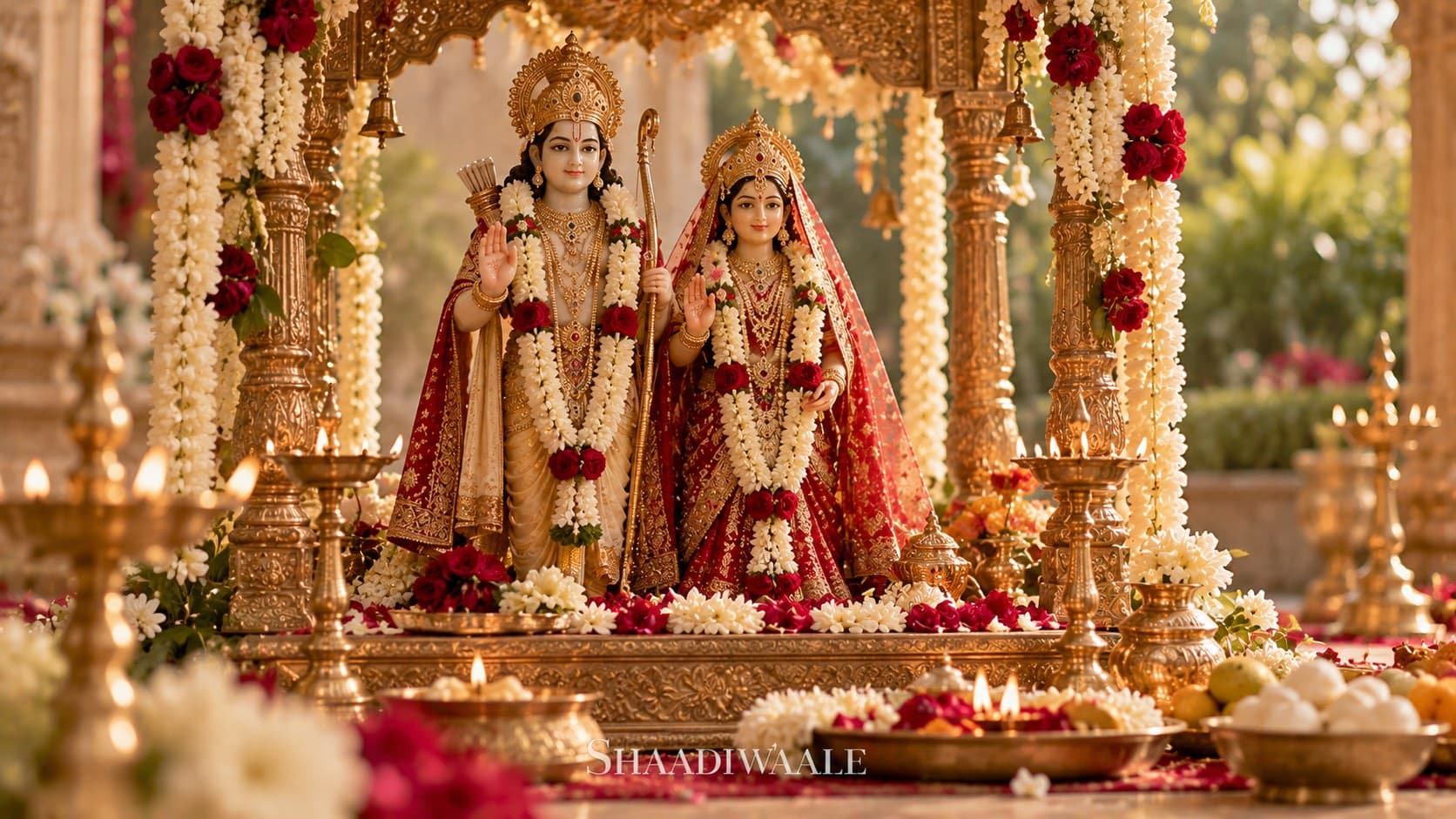
In the middle of the winter wedding season sits a wedding anniversary older than every calendar on the planner's wall: Vivah Panchami, the day tradition holds that Ram married Sita. In 2026 it falls on Monday 14 December, on Margashirsha Shukla Panchami, the fifth day of the bright fortnight.1
It is the most paradoxical date in the season. Temples across North India and Nepal will stage the divine wedding in full, with baraats, mandaps and garlands, and yet in Mithila and parts of North India many families will not hold a daughter's wedding on this very day, a folk tradition with one of the most touching reasons in the whole calendar.2
This explainer covers the 2026 dates, the celebrations in Janakpur and Ayodhya, the puja at home, and the custom, told with the care it deserves, because it is a story about loving a daughter.
Quick answer: Vivah Panchami 2026 falls on Monday 14 December, on Margashirsha Shukla Panchami;1 the panchami tithi runs from about 4:48 pm on Sunday 13 December to about 7:16 pm on Monday 14 December, with the festival observed on the 14th.2 The day commemorates the wedding of Ram and Sita and is observed with special fervour at Janakpurdham in Nepal, where a symbolic marriage ceremony is held and thousands of pilgrims arrive, in the Mithila region, and in Ayodhya.3 At home it is kept with a puja that performs the divine wedding in miniature. In Mithila and parts of North India, a folk tradition avoids holding a daughter's wedding on this day, remembering the hardships of Sita's married life; the sources describe it as an emotional tradition rather than a universal prohibition, and your family's pandit is the right referee.2
In this article
- The 2026 dates at a glance
- What the day remembers
- Janakpur and Ayodhya: a wedding staged every year
- The puja at home
- The custom: why many families will not marry on it
- Vivah Panchami inside the wedding season
- Keeping the day when your own wedding is near
1. The 2026 dates at a glance
| What | When in 2026 |
|---|---|
| Vivah Panchami | Monday 14 December |
| The tithi | Margashirsha Shukla Panchami, the bright fortnight's fifth day |
| Panchami tithi begins | About 4:48 pm, Sunday 13 December |
| Panchami tithi ends | About 7:16 pm, Monday 14 December |
The date is as reported for 20261 and the tithi timings as one panchang gives them;2 panchang minutes differ by city and calendar, so confirm your own city's timings with a local panchang or your pandit.
The season it sits in: the wedding window that holds it opened on Dev Uthani Ekadashi; that story is in Dev Uthani Ekadashi 2026.
2. What the day remembers
Vivah Panchami is observed as the Vivaha Utsava of Sita and Ram, the anniversary of their wedding, kept in temples and the sacred places tied to Ram across North India, the Mithila region and Nepal.3 The day belongs to the Balkand's great set piece: Janak's court, the bow of Shiva, and the wedding at Janakpur that joined Mithila to Ayodhya.
The full story, with the seven facts about it that still shape Indian weddings, from the jaimala to the kanyadaan, is told in our piece on the Ram Sita wedding; this explainer keeps to the festival itself.
One literary tradition gives the day a second anniversary: Goswami Tulsidas is traditionally held to have begun the Ramcharitmanas on this very tithi,2 which is why recitations of the wedding passages carry special weight on it.
The other wedding of the epics: the season's reading pairs well with The Wedding of Ravana.
3. Janakpur and Ayodhya: a wedding staged every year
Nowhere keeps the day like Janakpurdham in Nepal, the capital of the old Mithila where tradition places the wedding itself. The day is of great importance there: thousands of pilgrims arrive, and a symbolic marriage ceremony is held at the Vivah Mandap, the divine couple married again as they are every year.3 A Ram Baraat makes its way to Janakpur,3 the symbolic baraat arriving from Ayodhya.2
Ayodhya keeps the day as Ram's own city, with worship of the divine couple; in 2025 the Ram Dhwajarohan, the hoisting of Ram's Dharma Dhwaja at the Ram Janmabhoomi Mandir, was held on Vivah Panchami itself.3
Elsewhere the day is kept in Ram temples with reenactments of the wedding, Ramayana recitation and processions, and vegetarian food for the day.1
If the season takes you travelling: a December wedding trip can fold a Janakpur or Ayodhya darshan in; our team will happily think it through with you.
4. The puja at home
The home observance performs the divine wedding in miniature, and the reported vidhi runs so:2 bathe and prepare a clean worship space with a red or yellow cloth; place an image of Ram and Sita on it; begin with Ganesha and take the sankalp; offer water, akshat, roli, sandalwood, flowers, incense, the lamp, cloth and naivedya; garland both images and perform a symbolic wedding, down to the ritual knot; read or hear the Balkand's passage on the dhanush yagya and the wedding; then the aarti, prasad and charity according to your means.
Fasting on the day is optional; the sources describe it as mainly a day of celebration.2 The older devotional habits fill it out: devotional songs for Ram at home and in temples, the vrat kathas read aloud, and plays of the couple's life staged.4
As everywhere in this Journal: practice varies by region and family, and the house tradition wins.
Married couples keep it too: worship on the day is traditionally believed to bless a marriage and help marital harmony.4
5. The custom: why many families will not marry on it
Here is the paradox resolved, and it is tender. In Mithila and parts of North India, a folk tradition avoids holding a daughter's wedding on Vivah Panchami.2 The reason, as the tellings give it, looks past the wedding to the marriage that followed: Sita's married life carried fourteen years of exile, abduction by Ravana, and a motherhood begun in a hermitage, and families who love their daughters simply do not wish the shape of that story onto them, however divine the couple.4
The careful framing matters. The sources that describe the custom also describe its limits: it is an emotional tradition rather than a universal prohibition, a tithi alone never decides a wedding muhurat in any case, and communities differ.2 Plenty of families outside the custom's regions marry through mid December happily.
So the practical rule is the one this Journal always gives for dates: the panchang, your community's tradition and your family's pandit settle it together, and the pandit's answer for your family is the right one.
Dates are a matching question too: the wedding dates view in Kundli matching works through the traditional rules, each labelled by the tradition it follows.
6. Vivah Panchami inside the wedding season
The festival sits mid December, deep inside the winter wedding season that opened with Dev Uthani Ekadashi on 20 November. For planning families that means three things.
Venues and vendors around 14 December live by local custom: in regions that keep the avoidance, the date may be unusually easy to book, and in regions that do not, it is a Monday in peak season like any other. The weekend either side of it, 12 and 13 December, will book like any peak December weekend. And for the family's own calendar, the day is a natural fixture even with a wedding weeks away: the temple utsava, the Balkand reading and the puja at home all bless exactly the thing the season is about.
What this article deliberately does not do is list wedding muhurats: those come from the panchang read for your city, your tradition and the couple's details, through your pandit.
Season logistics live here: the venues and vendors book in the order families decide; the checklist keeps the order honest.
7. Keeping the day when your own wedding is near
For a couple marrying this season, Vivah Panchami makes a lovely station on the way to the mandap. The day's whole grammar is a wedding: attending the Vivaha Utsava at a Ram temple, hearing the Balkand's wedding passage, or performing the small home puja with both families is, in effect, attending the archetype of the ceremony you are about to hold.
Families with a daughter marrying that month often keep it simply: the puja, the recitation, a vegetarian table, and the blessings of elders sought for the coming wedding. Where the avoidance custom is kept, it concerns only the solemnising of a marriage on the day itself; the celebration of the divine wedding is the day's entire point.
And the sweetest reading of the custom belongs here too: a tradition that hesitates to marry daughters on Sita's anniversary is, underneath, a prayer that every daughter's marriage be gentler than the story. That is a blessing any wedding season can carry.
When your date is settled: tell everyone beautifully; your online wedding invitation is free to design and carries the muhurat to every phone.
Closing thoughts
Vivah Panchami is the wedding season looking at its own reflection: the one day the calendar marries its most beloved couple again, and the one day many families will not marry at all, for love of their daughters. Keep the puja, hear the Balkand, let Janakpur and Ayodhya stage the baraat, and let your pandit place your own date where your tradition wants it. The season has room for both kinds of devotion.
And whatever date the panchang gives you, the online wedding invitation will be ready the same evening.
Frequently asked questions
When is Vivah Panchami in 2026?
Vivah Panchami falls on Monday 14 December 2026, on Margashirsha Shukla Panchami, the fifth day of the month's bright fortnight. The panchami tithi begins about 4:48 pm on Sunday 13 December and ends about 7:16 pm on Monday 14 December 2026, with the festival observed on the 14th. As with every tithi based date, panchang minutes differ between cities and calendars, so confirm your own city's timings with a local panchang or your family's pandit. The day commemorates the wedding of Ram and Sita.
What is Vivah Panchami and why is it celebrated?
Vivah Panchami is the anniversary of the wedding of Ram and Sita, observed as their Vivaha Utsava in temples and the sacred places tied to Ram across North India, the Mithila region and Nepal. Temples stage reenactments of the divine wedding, recite the Ramayana's wedding passages and take out processions. One literary tradition adds a second anniversary: Goswami Tulsidas is traditionally held to have begun the Ramcharitmanas on this tithi, which gives recitations of the epic a special place on the day. Worship on the day is traditionally believed to bless marriages.
How is Vivah Panchami celebrated in Janakpur and Ayodhya?
Janakpurdham in Nepal, the capital of old Mithila where tradition places the wedding, keeps the day most fully: thousands of pilgrims arrive, a Ram Baraat makes its way there, and a symbolic marriage ceremony is held at the Vivah Mandap, the divine couple wedded again as every year. Ayodhya keeps the day as Ram's own city with worship of the divine couple, and in 2025 the hoisting of Ram's Dharma Dhwaja at the Ram Janmabhoomi Mandir was held on Vivah Panchami itself. Elsewhere, Ram temples stage the wedding and recite the Balkand.
How do I perform the Vivah Panchami puja at home?
The reported vidhi performs the divine wedding in miniature. Prepare a clean worship space with a red or yellow cloth and place an image of Ram and Sita on it. Begin with Ganesha and take the sankalp, then offer water, akshat, roli, sandalwood, flowers, incense, the lamp, cloth and naivedya. Garland both images and perform a symbolic wedding, including the ritual knot, then read or hear the Balkand's passage on the dhanush yagya and the wedding, and finish with the aarti, prasad and charity as you are able. Fasting is optional; practice varies by family.
Why are weddings avoided on Vivah Panchami in some regions?
In Mithila and parts of North India, a folk tradition avoids solemnising a daughter's wedding on Vivah Panchami. The tellings give a tender reason: Sita's married life carried fourteen years of forest exile, abduction by Ravana and a motherhood begun in a hermitage, and families do not wish the shape of that story onto their daughters, however divine the couple. The sources that record the custom also record its limits: it is an emotional tradition rather than a universal prohibition, communities differ, and a tithi alone never decides a muhurat. Your pandit settles it for your family.
Can we hold our wedding on 14 December 2026?
That is a question for your panchang and your pandit, not for an article. Whether any date carries a shubh vivah muhurat depends on the panchang read for your city and tradition and on the couple's own details, and a tithi alone does not decide it. Around Vivah Panchami specifically, regional custom divides: families in and around the Mithila tradition commonly avoid the day for a daughter's wedding, while many communities elsewhere have no such hesitation. Ask your family's pandit early, because mid December venues and vendors book like the peak season it is.
Share this guide
Send it to the family group, or keep it for later.
Questions about your wedding?
Our team answers questions about venues, vendors and the budget, free on WhatsApp.
About Shaadiwaale
Indian wedding planning in one place: venues and vendors with real prices, free kundli matching, invitations and tools to plan every function together.
Every function. Every family. One plan.
Notes
- Vivah Panchami 2026: Date, Tithi, Meaning and Calculation, Samvat, seen 31 October 2026. ↩
- Vivaha Panchami 2026: Date, Puja Vidhi and Significance, Muhurat Choghadiya, seen 31 October 2026. ↩
- Vivaha Panchami, Wikipedia, seen 31 October 2026. ↩
- Vivah Panchami 2022: Reasons Why Hindu Marriages Are Not Held On Lord Ram and Sita's Marriage Day, Boldsky, 23 November 2022. ↩