Explainer
Dev Uthani Ekadashi 2026: The Night Vishnu Wakes, Tulsi Marries, and the Wedding Season Begins
Dev Uthani Ekadashi falls on Friday 20 November 2026, with Tulsi Vivah the next day. What the festival means, how both days are kept at home, and why India's wedding calendar waits for them.
- Dev Uthani Ekadashi falls on Friday 20 November 2026 for Smarta households; some Vaishnava calendars observe 21 November
- Tulsi Vivah, the marriage of the tulsi to the Shaligram, is on Saturday 21 November 2026
- The festival ends Chaturmas: weddings, griha pravesh and new beginnings resume
- The festival opens the season; the specific wedding muhurats come from a panchang and your pandit
Traditions · 11 min read · By The Shaadiwaale team

Twice a year the Hindu calendar turns on a god's sleep. On Devshayani Ekadashi in Ashadha, Lord Vishnu is believed to retire to his rest on Shesha Naga in the Kshir Sagar, and for four months, the Chaturmas, the calendar holds its breath: no weddings, no griha pravesh, no new beginnings.1 Dev Uthani Ekadashi is the morning after: the god wakes, and India starts getting married again.
In 2026 that morning falls on Friday 20 November for Smarta households, with some Vaishnava calendars observing it on Saturday 21 November.2 Questions asking when it falls were among this quarter's breakout searches in India,3 because half the country's wedding planning hangs on it.
And the first wedding of the season belongs to a plant. Tulsi Vivah, the ceremonial marriage of the tulsi to Lord Vishnu in his Shaligram form, follows on Saturday 21 November 2026,1 and in many homes it is performed with all the tenderness of a daughter's wedding.
Quick answer: Dev Uthani Ekadashi (also Prabodhini or Devutthana Ekadashi) falls on Friday 20 November 2026 for Smarta households, with some Vaishnava calendars observing Saturday 21 November; the Ekadashi tithi begins about 7:15 am on 20 November and ends about 6:31 am on 21 November, and the fast is broken the next morning within the Dwadashi window, at times that vary by city and panchang.2 It marks the end of Chaturmas, the four months in which Lord Vishnu is believed to rest, and with his waking the season of weddings, griha pravesh and new beginnings opens again.1 Tulsi Vivah, the marriage of Tulsi Mata to the Shaligram, is on Saturday 21 November 2026.1 Exact wedding muhurats within the season come from a panchang and your pandit.
In this article
- The 2026 dates at a glance
- The story: four months of sleep
- Tulsi Vivah: the wedding that opens the weddings
- How Dev Uthani Ekadashi is kept
- How Tulsi Vivah is performed at home
- Why the wedding season waits for this day
- If you are planning a wedding in the season that opens
1. The 2026 dates at a glance
| What | When in 2026 | Worth knowing |
|---|---|---|
| Dev Uthani Ekadashi (Smarta) | Friday 20 November | The widely observed date |
| Dev Uthani Ekadashi (Vaishnava) | Saturday 21 November | Some Vaishnava calendars |
| Ekadashi tithi | About 7:15 am, 20 November to about 6:31 am, 21 November | Timings from the panchang |
| Parana (breaking the fast) | The next morning, in the Dwadashi window | The exact window varies by city |
| Tulsi Vivah | Saturday 21 November | Kartik Shukla Dwadashi |
| Bhishma Panchak begins | With the Ekadashi, running to Kartik Purnima | A five day observance |
The dates and timings above are as reported for 2026 (source; source); panchang minutes can differ between cities and calendars, so confirm your own city's timings with a local panchang or your pandit.
The same season's shopping day: Dhanteras comes first; our guide to Dhanteras 2026 covers the buying side of the wedding winter.
2. The story: four months of sleep
The frame of the festival is a cosmology of rest. After Devshayani Ekadashi in the month of Ashadha, Lord Vishnu is believed to recline on Shesha Naga in the Kshir Sagar, the ocean of milk, and this four month rest is the Chaturmas.1 The monsoon months pass; the calendar's great beginnings, weddings among them, traditionally pause with him.
Dev Uthani Ekadashi, on the eleventh day of the bright half of Kartik, is the waking. "After four months of rest, Lord Vishnu is believed to wake from his yoga nidra," as one explainer of the 2026 festival puts it,1 and households wake him the old way, with lamps, bells and the conch.
It is worth saying plainly that this is tradition and belief, held differently across regions and families, which is exactly why the same festival answers to several names: Dev Uthani, Devutthana, Prabodhini, the Ekadashi of the awakening.
The season's oldest wedding story: the divine marriage that anchors the other end of the season is in 7 Unknown Facts About the Ram Sita Wedding.
3. Tulsi Vivah: the wedding that opens the weddings
The day after the waking, the tulsi plant is married. Tulsi Vivah celebrates the marriage of Tulsi Mata with Lord Vishnu in his Shaligram form, on Kartik Shukla Dwadashi, Saturday 21 November in 2026.1
The story behind it, told as legend, centres on Vrinda, the devoted wife of the asura Jalandhar, whose devotion was so pure that she is worshipped as Tulsi and wedded to the Lord each year.1 The fuller tellings, which vary in their details across texts and regions, have Vishnu breaking Vrinda's vow of fidelity to make Jalandhar mortal, and Vrinda's holiness answered with the promise of this annual marriage; the versions differ, and a family's own telling is the right one for its puja.
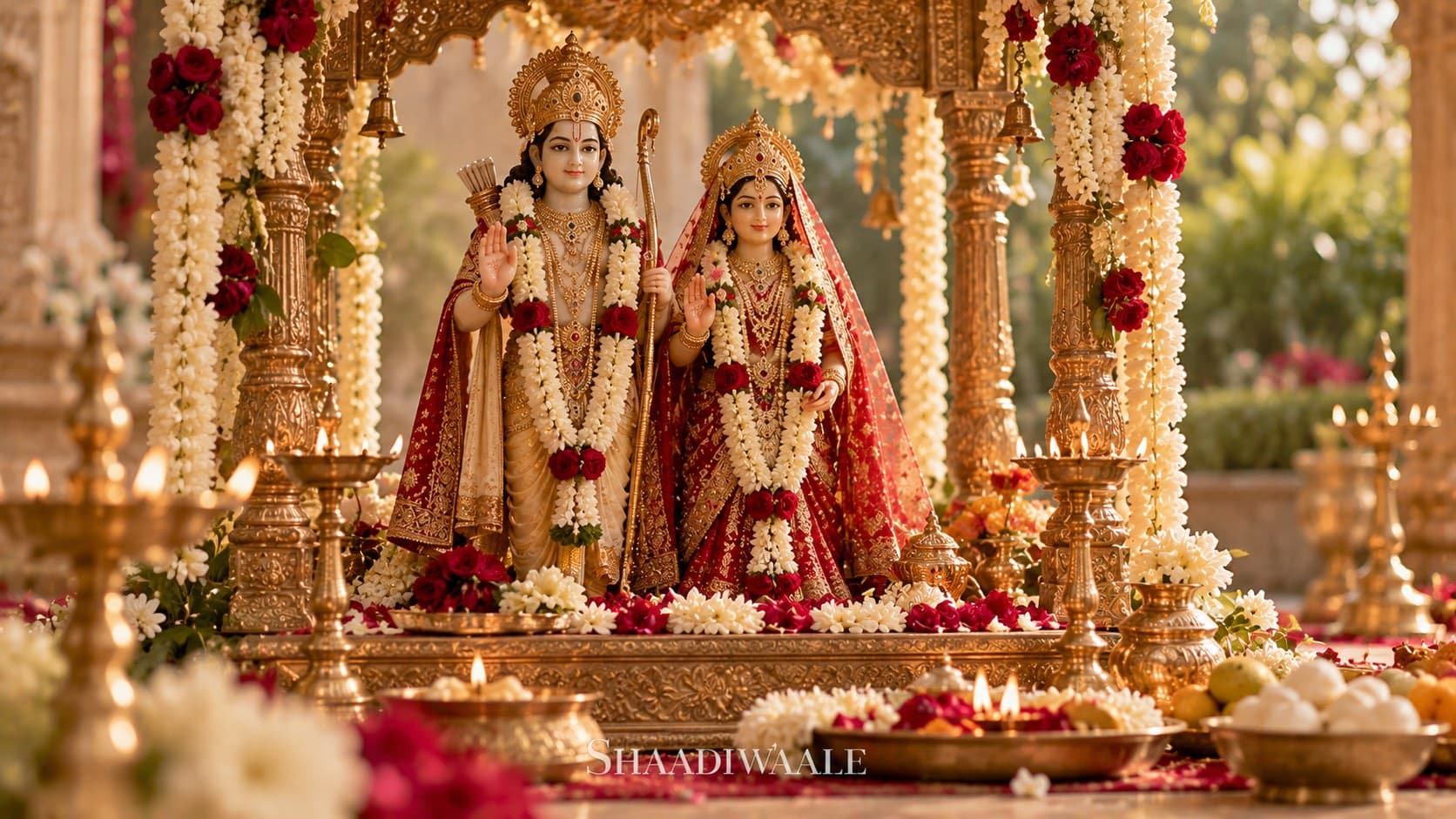
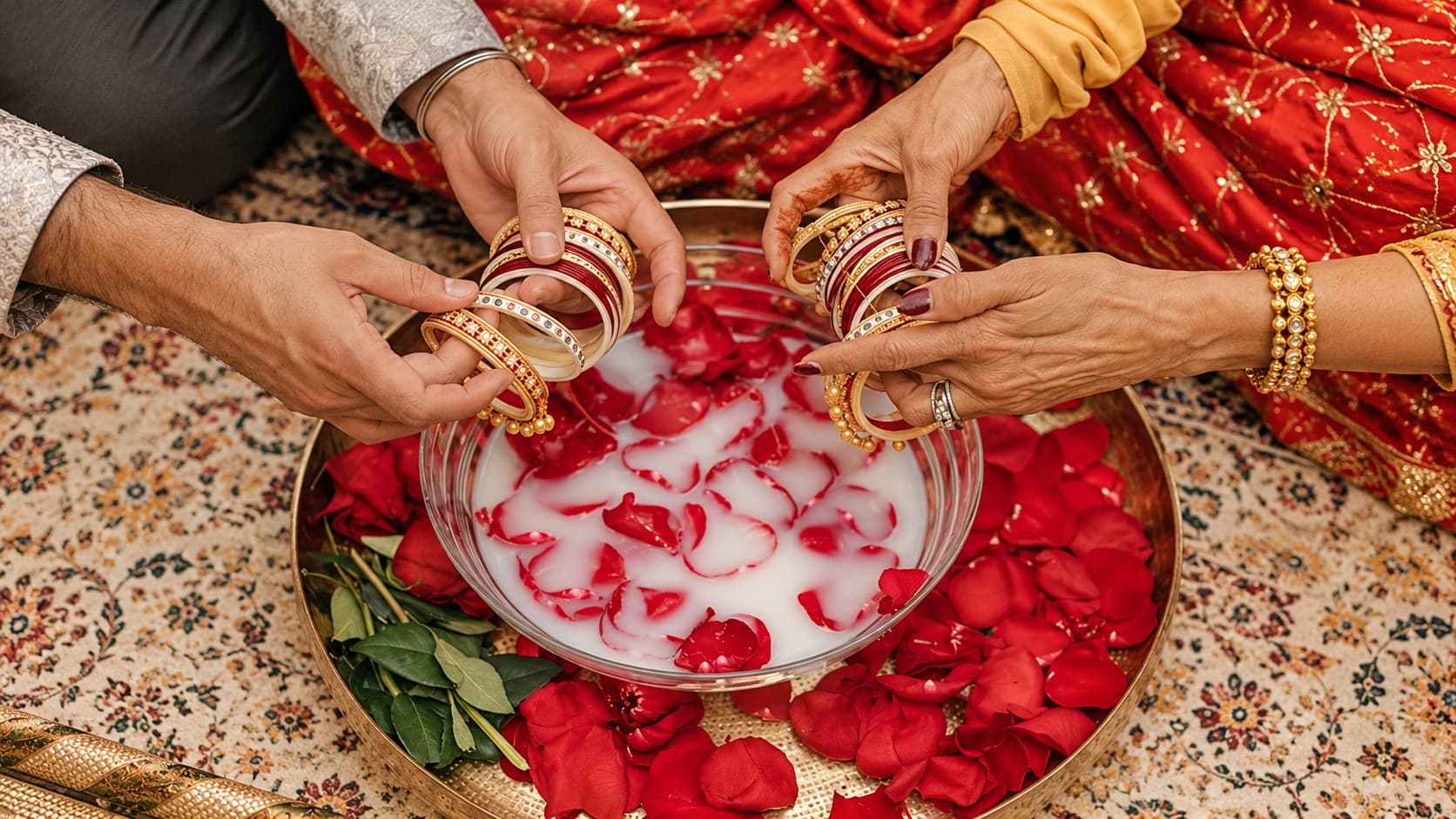
The staging is widely shared: the tulsi dressed as a bride in a red chunri and bangles, a mandap of sugarcane raised around her, and the Shaligram or an idol of Vishnu placed beside her as the groom.1 In many families, performing Tulsi Vivah carries the sentiment of giving a daughter away, which is why homes without a daughter often make a special point of it; the tenderness is the ritual's whole weather.
Every wedding needs its date told beautifully: when the real weddings begin, an online wedding invitation carries the news in one link.
4. How Dev Uthani Ekadashi is kept
The observances reported for 2026 follow the Ekadashi pattern with the waking added.1 The day before, a light, sattvic evening meal. On the day: clean the puja space, light a diya, take the sankalp; draw the Lord's footprints in rice flour or geru, and set sugarcane, singhara, sweet potato and seasonal fruit beside them; offer tulsi leaves, plucked the day before, and yellow flowers. In the evening comes the waking itself: lamps, bells and the conch, with the traditional waking prayer, the chant of Om Namo Bhagavate Vasudevaya, and the Vishnu Sahasranama for those who recite it.
The fast is kept as the household is able, nirjala for some, fruit and milk for others, with rice and grains avoided, and broken the next morning within the Dwadashi window, whose exact times vary by city (source; source). Fasting guidance here is tradition, not medical advice; anyone with a health condition should keep the fast only as their doctor allows.
As with every festival in this Journal, practice varies by region and family, and the house tradition wins.
The season's checklist starts now: put the festival days and the wedding tasks in one place with the wedding checklist.
5. How Tulsi Vivah is performed at home
The home ceremony is a real wedding in miniature. The reported staging is the tulsi dressed as a bride in a red chunri and bangles, a mandap of sugarcane raised around her, and the Shaligram or an idol of Vishnu placed beside her as the groom, with families performing the rituals much like a real wedding.1 In many families the fuller wedding follows in the evening: garlands exchanged, the couple circled as in pheras, the katha read, the aarti sung and prasad distributed, details that vary by region and house tradition.
Two practical notes from the way families actually keep it. First, the mandap materials, sugarcane above all, arrive in the markets in these very weeks, which is its own small seasonal pleasure. Second, the ceremony scales honestly: a full mandap with the extended family or a single diya, a chunri and five minutes of sincerity are both complete.
For a family with a wedding coming in the season, Tulsi Vivah is the gentlest possible rehearsal: the same garlands, the same circling, the same blessings, a month early and in miniature.
The real mandap comes next: when the family's own wedding follows, the venues and vendors on our directory are where the season's bookings begin.
6. Why the wedding season waits for this day
The rule is simple and old: the great beginnings pause while the Lord rests, and resume when he wakes. With Dev Uthani Ekadashi, as the 2026 explainers put it, the season of weddings, griha pravesh and new beginnings opens again,1 and the reports around the date note it as a special time for marriages, with the specific dates depending on muhurat.2
That last clause matters. The festival opens the gate; it does not hand out dates. Which days of the following weeks carry a shubh vivah muhurat is the work of the panchang, read for your city and your tradition, and families settle it with their pandit, who weighs the couple's details as well as the calendar.
Expect the familiar rhythm once the gate opens: a dense run of wedding dates through late November and December, the pause and resumption that the panchang dictates after that, and every good venue in town knowing it before you do.
Dates are also a matching question: our Kundli matching tool includes a wedding dates view that works through the traditional rules, clearly labelled by the tradition each follows.
7. If you are planning a wedding in the season that opens
Treat 20 November as the starting gun that everyone else can also hear. The season's venues, photographers, caterers and mehndi artists book in the order families confirm, and the first fortnight after Dev Uthani absorbs months of postponed intent.
The order of operations that keeps a family sane: settle the muhurat with your pandit first, since everything hangs on it; hold the venue the same week, because the venue is the one vendor that cannot be duplicated; then build outward to the photographer and caterer, whose best teams go earliest. Our guide to what a wedding really costs keeps the numbers honest while the bookings accelerate.
And let the paperwork of joy be the easy part: the guest list, budget and checklist live together in the wedding plan, and the invitation that carries your muhurat to two hundred phones takes one evening to make.
Begin where every booking begins: the venues in your city, with photos and real prices, are on the directory now.
Closing thoughts
Dev Uthani Ekadashi is the calendar's hinge: a god wakes, a plant becomes a bride, and a hundred thousand families reach for their phones to call the pandit, the venue and each other. Keep the festival with whatever fullness your house tradition asks, marry the tulsi with the tenderness the ritual deserves, and then go book your venue before the neighbours do.
When your own date is fixed, put it where no one can lose it: your online wedding invitation is free to design and ready the same evening.
Frequently asked questions
When is Dev Uthani Ekadashi in 2026?
Dev Uthani Ekadashi falls on Friday 20 November 2026 for Smarta households, the widely observed date, while some Vaishnava calendars observe it on Saturday 21 November. The Ekadashi tithi begins about 7:15 am on 20 November and ends about 6:31 am on 21 November 2026, and the fast is broken the following morning within the Dwadashi window, at times that vary by city and panchang. The festival is also called Prabodhini Ekadashi and Devutthana Ekadashi, the Ekadashi of the Lord's awakening, and it falls on the eleventh day of the bright half of Kartik.
When is Tulsi Vivah in 2026?
Tulsi Vivah falls on Saturday 21 November 2026, on Kartik Shukla Dwadashi, the day after Dev Uthani Ekadashi. It celebrates the ceremonial marriage of Tulsi Mata, the sacred basil, with Lord Vishnu in his Shaligram form. In many homes the tulsi is dressed as a bride in a red chunri and bangles under a mandap of sugarcane, with the Shaligram or an idol of Vishnu beside her as the groom, and families perform the rituals much like a real wedding, commonly in the evening with garlands, circling, katha, aarti and prasad. Some families perform it on the Ekadashi itself; the house tradition decides.
What is Chaturmas and why do weddings pause during it?
Chaturmas is the four month period beginning with Devshayani Ekadashi in Ashadha, during which Lord Vishnu is believed to rest in yoga nidra on Shesha Naga in the Kshir Sagar. By tradition, the calendar's great beginnings, weddings and griha pravesh among them, pause while the Lord rests and resume when he wakes on Dev Uthani Ekadashi. This is belief and custom rather than a single uniform rule: practice varies by region, community and family, and some traditions and communities hold ceremonies in the window that others avoid. Your family's pandit is the right referee.
Do weddings begin immediately after Dev Uthani Ekadashi?
The festival opens the season; the panchang supplies the dates. With Vishnu's waking, weddings, griha pravesh and new beginnings resume, and the weeks after 20 November 2026 carry the winter season's first muhurats. But which specific days are shubh vivah muhurats depends on the panchang read for your city and tradition, and on the couple's own details, which is why families settle the date with their pandit rather than from a list. Expect the first fortnight after the festival to be dense with weddings, and venues to book accordingly.
How is Tulsi Vivah performed at home?
The reported staging dresses the tulsi as a bride, with a red chunri and bangles on the pot, raises a mandap of sugarcane over her, and places the Shaligram or an idol of Vishnu beside her as the groom, with families performing the rituals much like a real wedding. The common family practice fills in the rest: the marriage in the evening, garlands exchanged, the couple circled as in pheras, the katha read, the aarti sung and prasad distributed, with the details varying by region and house. The ceremony scales to the household: a full family mandap and a single diya with five sincere minutes are both complete.
What is the story behind Tulsi Vivah?
The katha, told as legend with versions that differ across texts and regions, centres on Vrinda, the devoted wife of the asura Jalandhar, whose purity made her husband invincible. In the common telling, Vishnu broke her vow of fidelity so Jalandhar could be defeated, and Vrinda's holiness was answered with a promise: she would be worshipped as the tulsi plant and married to the Lord each year. The annual Tulsi Vivah keeps that promise. Families tell the story in their own ways, and the version your elders tell at the puja is the right one for your home.
Share this guide
Send it to the family group, or keep it for later.
Questions about your wedding?
Our team answers questions about venues, vendors and the budget, free on WhatsApp.
About Shaadiwaale
Indian wedding planning in one place: venues and vendors with real prices, free kundli matching, invitations and tools to plan every function together.
Every function. Every family. One plan.
Notes
- Dev Uthani Ekadashi 2026: Date, Puja Vidhi and Tulsi Vivah, Rudralife, 28 October 2026. ↩
- Dev Uthani Ekadashi 2026 Date: When Is Ekadashi? Check Tithi, Vrat And Parana Timings, The Sunday Guardian, 27 October 2026. ↩
- Google Trends: tulsi vivah, India, past 90 days, Google Trends, seen 31 October 2026. ↩