Explainer
7 Unknown Facts About the Ram Sita Wedding That Still Shape Every Indian Shaadi
Four brides under one fire, a groom's father who gave first, and the bride's side singing insults at the feast: the Ram Sita wedding as Valmiki and Tulsidas actually tell it, and the rituals it left behind.
- In Valmiki's Ramayana, Sita was virya-shulka, a bride won by valour, not chosen at a swayamvar
- Four couples married on one day: Rama, Lakshmana, Bharata and Shatrughna, two of the brides being Janaka's nieces
- Before the rites, Dasharatha gave four lakh cows to Brahmins, one lakh in the name of each son
- Vivah Panchami falls on Monday 14 December 2026, a date many families avoid for their own weddings
Traditions · 19 min read · By The Shaadiwaale team · Updated 31 October 2026
Every Indian wedding is, in some small way, a cover version. The bride's friends who hold the groom hostage over his shoes, the aunt who sings something unprintable at the baraat, the pandit who pauses before the kanyadaan to explain what the Sanskrit means: all of it has a source text, and the source text is a wedding that, as the story goes, took place in Mithila a very long time ago. The Ram Sita wedding may be the most retold marriage in the subcontinent. It is also, oddly, one of the least known. We remember the bow. We forget almost everything else.
The retellings have been generous with the bow for a reason. It is cinematic, it is simple, and it ends with a crack that every child in India can describe. But sit with the two texts that actually carry the story, Valmiki's Bala Kanda and Tulsidas's Ramcharitmanas, and read them next to what the women of Janakpur still sing every winter, and a stranger, warmer, more surprising wedding comes into view. One where four couples married under a single fire. One where the groom's father gave away four lakh cows before anyone's hand was held. One where the bride's side was expected to insult the groom's party, and did, in verse.
Here are seven of those details. Each one has a line that runs straight into a ritual you will plan, book, or sit through at your own wedding. Where it helps, we have pointed to the Shaadiwaale tool or vendor that handles that ritual now. Verse numbers follow the valmikiramayan.net edition of Valmiki and the Gita Press text of Tulsidas; other editions may number them differently.
Quick answer: The Ram Sita wedding, celebrated every year as Vivah Panchami (Monday 14 December in 2026), is set in Mithila, which tradition places at Janakpur in Nepal. In Valmiki's Ramayana it was not a swayamvar: Sita was virya-shulka, a bride whose price was valour, and Rama met it by stringing and breaking Shiva's bow. Four couples married the same day under one fire: Rama and Sita, Lakshmana and Urmila, Bharata and Mandavi, Shatrughna and Shrutakirti, the last two brides being Janaka's nieces. Before the rites Dasharatha gave four lakh cows to Brahmins; Janaka gave Sita with the words sahadharmachari tava, your partner in dharma, on a day set under Uttara Phalguni by the usual reading. Tulsidas adds the garden meeting and the gaari sung at the feast, Mithila tradition ties Madhubani painting to the wedding, and many families now avoid both its date and its nakshatra.
In this article
- It was never a swayamvar
- Four brides, one mandap, one day
- The groom's side gave first
- The kanyadaan was a vow, not a handover
- The bride's side roasted the groom, on purpose
- Madhubani painting began as wedding decor
- The muhurat was set under a god of fortune, and few book it today
1. It was never a swayamvar
Ask anyone to name the event and they will say Sita swayamvar. Valmiki, telling the day itself in the Bala Kanda, does not use the word. When Vishvamitra brings the two princes to Mithila, Janaka explains the arrangement in a single compound word: his daughter, who rose from the earth, is virya-shulka, a bride whose price is valour.1 There is no hall of suitors that day, no garland in Sita's hand, no choosing. There is a bow that belonged to Shiva, entrusted to Janaka's ancestor Devarata and kept by the family ever since, and so heavy that it arrives in an eight-wheeled iron chest hauled by five thousand men.2 Kings had come before, failed even to lift it, laid siege to Mithila in their pique and been driven off.1 Rama lifts it, strings it, draws it towards his ear, and it snaps in the middle with a sound like a thunderclap; everyone in the hall swoons except Vishvamitra, Janaka and the two princes.2 The contract is met. The wedding is agreed. It is less a competition than a condition.
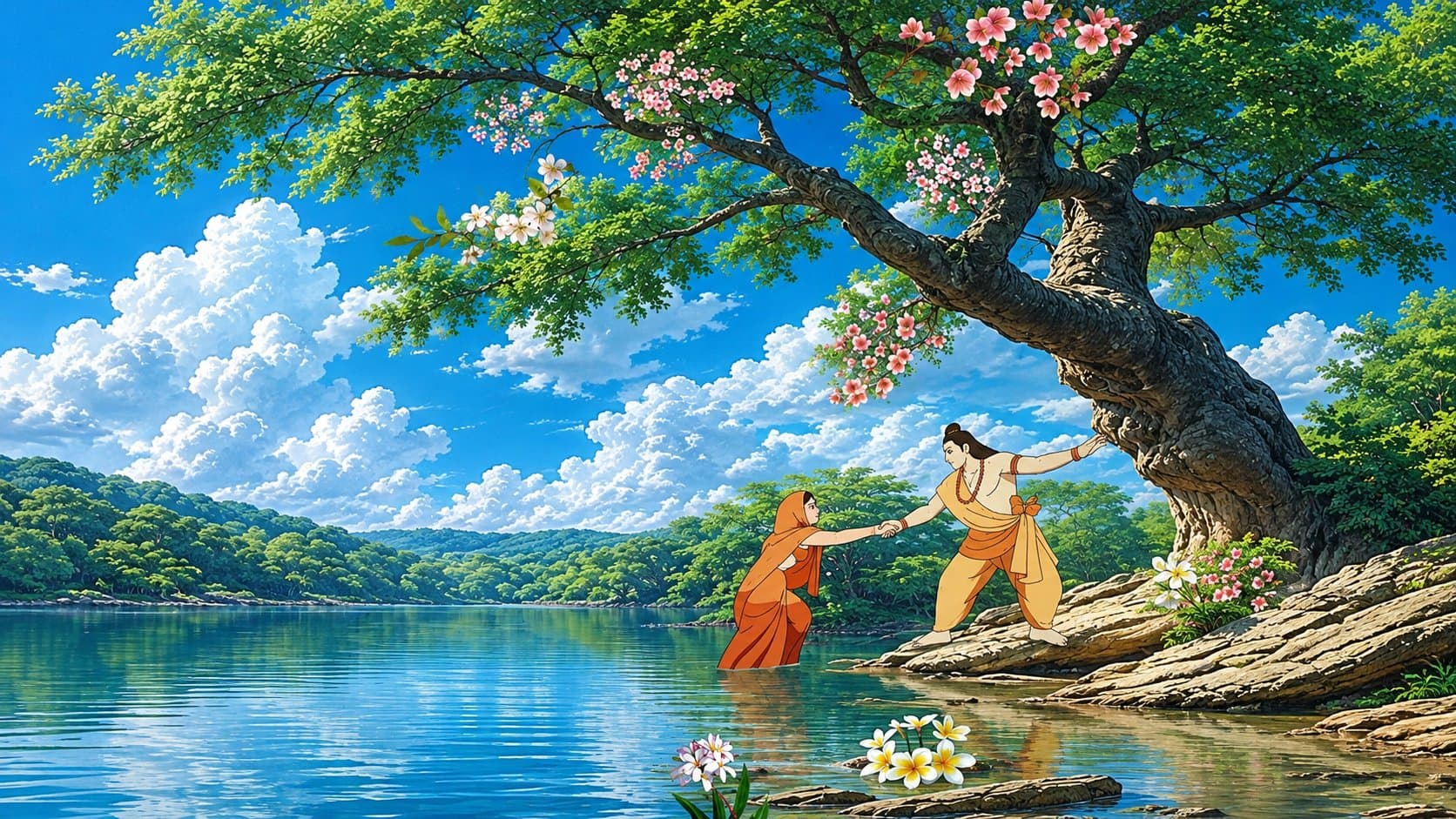
The swayamvar, the garden, the glance exchanged over flowers: those come to most of us from Tulsidas. Begun in 1574, some two thousand years after Valmiki by the usual dating, the Ramcharitmanas gives us the Phulwari, where Rama and Sita first see each other in Janaka's garden when she has come to worship Gauri, the goddess Parvati, in the passage around doha 227 of its Bala Kand34.5 It gives us the crowd of princes, the public contest and Sita's garland for the winner.3 It gives the story its romance, and it gives Indian weddings their template for the first look, the stage, and the sangeet skit in which the groom has to earn the bride. Both versions are real in the sense that matters: one is the record, the other is the retelling the country fell in love with.
What it still shapes: the idea that a wedding is a stage with a test on it. The modern version is the sangeet, where a Phulwari-style first meeting makes a natural set piece. If you are building one, the Journal's guide to a sangeet running order covers how to sequence it, and choreographers on Shaadiwaale list by city.
2. Four brides, one mandap, one day
The Ram Sita wedding was, strictly, a quadruple wedding. Once the bow was broken and Dasharatha had been summoned from Ayodhya, the sage Vishvamitra turned matchmaker.2 In sarga 72 of the Bala Kanda he proposes, with Vashishta beside him, that Janaka's younger brother Kushadhvaja give his two daughters to Bharata and Shatrughna, so that the two houses would be, in the translation's word, interlocked.6 Lakshmana was already to marry Janaka's second daughter, Urmila, offered alongside Sita at the end of the sarga before.7 Four grooms, four brides, and Vishvamitra's proposal that all four take their brides' hands, as the translation puts it, "in the light of one day."6
| Groom | Bride | Bride's father | Relationship to Sita |
|---|---|---|---|
| Rama | Sita | Janaka | Herself |
| Lakshmana | Urmila | Janaka | Younger sister |
| Bharata | Mandavi | Kushadhvaja | Cousin |
| Shatrughna | Shrutakirti | Kushadhvaja | Cousin |
The detail that gets lost is that two of the four brides were not Janaka's daughters at all. Mandavi and Shrutakirti were his nieces, and it was a sage, not a parent, who brokered their marriages.6 The wedding of the century was also a shrewd piece of dynastic planning, settled in a single conversation, and Janakpur remembers all four couples. Tradition identifies the town, in Nepal's Dhanusha district about 23 km from the Indian border, with Janaka's capital,8 and beside its Janaki Mandir stands the Vivah Mandap. On the four corners of its platform are four small temples, one for each couple, with only the names written on them to tell them apart.9 Even the bow is remembered at Dhanusha Dham, about 20 km north, where a fragment of it is said to have fallen.10
What it still shapes: the Indian habit of marrying siblings and cousins in one season, sometimes in one week, to a single guest list. It is the original multi-function wedding, and it is exactly the kind of logistics Shaadiwaale's planning tools were built for: one guest list with an RSVP for each function, one budget split across every event, and a checklist in which every task can be tied to a function and handed to whoever is helping.
3. The groom's side gave first
We have grown used to a story in which gifts flow one way at a wedding, from the bride's house outward. Valmiki tells it the other way round. On the morning after the matches were agreed, before any hand was held or fire lit, Dasharatha performed the godana, the gift of cows, on behalf of his four sons.6 The numbers in sarga 72 are not modest. One lakh cows in the name of each son, four lakh in all, every one a good milker with her horns cased in gold, her calf at her side and a bell-metal milking pail, given away to Brahmins along with, the text adds almost casually, a great many other kinds of wealth.6
It is worth pausing on where this happened. Not in Ayodhya, in the groom's own capital, where the generosity would have been seen by his own people, but in Mithila, the bride's city, at the lodgings where he was a guest.6 The groom's father arrived at his son's wedding and spent lavishly in his host's town. The baraat, in other words, came bearing shagun.
Tulsidas, who loved a procession, expands on the visit. In the Ramcharitmanas the baraat from Ayodhya is so large and so splendid that Janaka's hospitality in return becomes a set piece of its own, and the Ayodhya party ends up staying in Mithila for many days: every morning Dasharatha asks leave to go, and every morning Janaka, out of affection, keeps him (Bala Kand, the chaupais before doha 332).11 Janakpur still plays host. Every year at Vivah Panchami it receives hundreds of sadhus from India as the groom's wedding procession and treats them as wedding guests,12 and the barati from Ayodhya, Nepal Traveller notes, brings offerings of ornaments, clothes, sweets, fruit and flowers.13
What it still shapes: the shagun economy of an Indian wedding, in which both families give, and the giving is public. The modern inheritance is the gift envelope, the group gift and the wedding fund. Shaadiwaale's Shagun Registry was designed for exactly this two-way flow: a place where relatives on either side can promise a gift, or an amount, towards something the couple actually wants, instead of forty-two identical dinner sets.
4. The kanyadaan was a vow, not a handover
The single most quoted line of the Ram Sita wedding is Janaka's, and it is usually remembered wrong. The popular version is a father giving away a daughter. The Sanskrit at Bala Kanda 1.73.26 is more careful than that: iyam Sita mama suta sahadharmachari tava.14 This is Sita, my daughter, your partner in dharma. Not your property, not your charge. Your fellow traveller. The word sahadharmachari describes someone who walks the path of dharma alongside you, or, in the Griffith verse translation the edition quotes, "The duties of thy life to share," and Janaka uses it before Rama has so much as touched her hand.15 Only after it does he tell Rama to take her hand in his.14
Then comes a gloss almost no retelling keeps. In his commentary the edition's translator, Desiraju Hanumanta Rao, has Rama object that a marriage won with a broken bow fits none of the recognised forms, and Janaka reply that it is technically prajapatya, the form whose rule, in the Ashvalayana sutra he cites, is that the two practise dharma together; he never said he was donating Sita, Janaka adds, only asked Rama to take her.15 The exchange is the commentator's, not Valmiki's, but it explains the wording. In the verses, Vashishta has already set the fire on the altar with Vedic hymns (kindled, the translation adds, from two arani sticks), Janaka pours water sanctified with mantras into Rama's palms, and flowers fall from the sky14.15 He then gives Urmila to Lakshmana, Mandavi to Bharata and Shrutakirti to Shatrughna, and the four couples walk around the fire, the altar, the king and the sages, three times round the fire, while the apsaras dance and the gandharvas sing.14 The commentary adds that each couple then set up a fire of its own, and that the rites ran all day.15
What it still shapes: the pheras, the kanyadaan, and the sankalp your pandit will ask you to repeat in a language you may not speak. Some pandits translate as they go, so that the couple hears what a line like Janaka's actually promises. Shaadiwaale lists pandits by city, and it is worth asking any of them, at the booking stage, whether they explain the mantras during the ceremony or only perform them.
5. The bride's side roasted the groom, on purpose
If there is a single ritual that separates a north Indian wedding from a polite dinner, it is the gaari, the gaali geet: the songs in which the women of the bride's side mock the groom's party to their faces, in rhyme. The groom is hopeless. His mother is a scandal. His relatives boasted of elephants and a band and brought neither.16 Everyone laughs, nobody is allowed to be offended, and the feast goes on. Like every wedding song, they are sung only by women.16
Tulsidas puts the women of Janakpur to work at the wedding feast. In the Ramcharitmanas, as the Ayodhya party eats, the women sing gaari in sweet voices, naming the men and the women of the party one by one, and the king, hearing gaari so suited to the moment, laughs with all his company (Bala Kand, the chaupais before doha 329).11 A visiting king's whole party was being teased to its face by its hosts, and the king laughed. It is the moment the wedding stops being a treaty and becomes a family.
Mithila has never let go of the joke. Rama is a god there, but he is also the damaad, the son-in-law, and the women of Mithila, the travel writer Anuradha Goyal found in Janakpur, take pride in that, and in the right it gives them to tease him; the region's folk songs celebrate the relationship.9 Its wedding songs have travelled far beyond Mithila on the voice of Sharda Sinha, the Bihar folk singer honoured with the Padma Bhushan, who sang in Maithili, Bhojpuri and Magahi, and whose songs, News On AIR noted when she died in 2024, are bound up with Chhath and vivah geet.17
What it still shapes: every joota chupai, every sangeet roast, every aunt who stands up at the baraat dinner with a notebook. If your families have a gaari tradition, give it a slot and a microphone rather than letting it happen at the buffet. The Journal's sangeet running order gives each family its own set, and a few verses of gaari fit neatly into the bride's side's; the sangeet photos on the inspiration wall will help you plan the stage.
6. Madhubani painting began as wedding decor
One of the most recognisable folk arts in India, the one on the saree borders and the tote bags, tells its own origin as a wedding commission. In Mithila, the story goes that when the Ram Sita wedding was fixed, King Janaka asked for paintings to capture the moments of the marriage and had local artists decorate the town18.19 Whatever one makes of the date, the function survived. Until the 1960s Madhubani painting was not a product at all. It was something the women of Mithila painted on walls, and one of its forms was the kohbar, painted for a wedding on the walls of the kohbar ghar, the bridal chamber, to turn a family room into a consecrated one: a lotus for the bride and her fertility, a bamboo grove for the groom, and birds, fish, bees, snakes and flowers for the abundance of nature20.19
The outside world only noticed when the earthquake of 1934 brought down walls across the region and showed their painted insides to William G. Archer, the British official posted in Madhubani, and only bought it when the drought of 1966 to 1968 led Pupul Jayakar of the All India Handicrafts Board to send the artist Bhaskar Kulkarni to encourage the women to put their wall paintings on paper18.21 By then, if the legend is right, Mithila had been painting its weddings since Sita's. Climb to the museum on the first floor of the Janaki Mandir in Janakpur today and its walls are Mithila paintings, most of them of the rituals of the wedding that is said to have happened in that town.9
What it still shapes: the idea that wedding decor should mean something, and the long Indian memory for the hand-painted over the printed. A Madhubani-themed mandap or mehendi stage is an easy brief to hand a decorator, whether the venue is a Jaipur palace lawn or a Mumbai five-star. The decorators listed on Shaadiwaale can be filtered by city, and the mandaps and stages on the inspiration wall are a quick way to show them the scale you have in mind.
7. The muhurat was set under a god of fortune, and few book it today
The Ram Sita wedding had a muhurat, and Valmiki records who chose it. At the end of sarga 71 Janaka tells Dasharatha that the moon is in Magha today and that the wedding should be on the third day, under Phalguni in its later part, which the translation renders as Uttara Phalguni.7 In sarga 72 he repeats it to the sages, praising a wedding under the Phalguni stars, uttare divase, with Bhaga presiding: the Vedic god of wealth and of each person's fair share, linked with his brother Aryaman to the hope of a successful marriage6.22 That verse is the disputed one: uttare can mean later as well as Uttara, and the panchangs name Bhaga as the deity of Purva Phalguni and Aryaman as Uttara Phalguni's23,24 though one Vedic text gives Uttara Phalguni to Bhaga.22 Some commentators, Maheshvara Tirtha among them, allow Purva Phalguni; the translator follows Uttara Phalguni, a star the Bodhayana sutras list for weddings.6 It is the commentators' consensus, not a certainty.
And then the irony, twice over. Uttara Phalguni is one of the eleven nakshatras Drik Panchang lists as auspicious for a wedding, yet the same page notes that many astrologers avoid it, because Rama and Sita are believed to have married under it and their married life was full of hardship.25 A family whose pandit quietly steers them off Uttara Phalguni is, whether it knows it or not, steering round Sita's star.
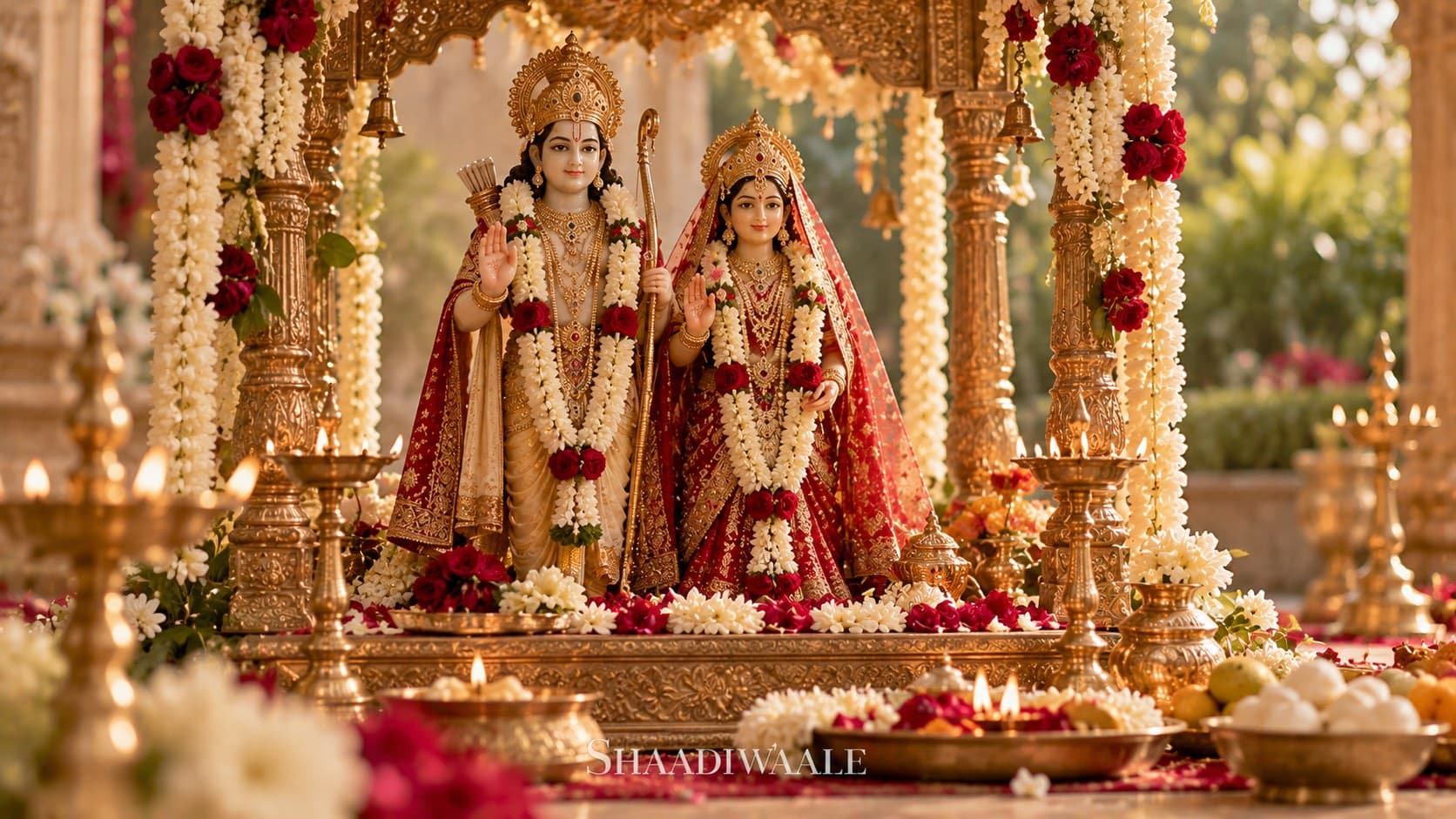
Then there is the date. Vivah Panchami, the fifth day of the bright half of Mangsir, or Margashirsha, falls on Monday 14 December in 20262627.12 Janakpur keeps a week of celebration that ends on the day, from the Phulbari lila, the tilak and the matkor to the dhanush yagya on the Barahbigha ground, the party from Ayodhya, a wedding performed with statues of Ram and Sita, and a nagar parikrama in which a couple dressed as Ram and Sita ride round the city on a decorated chariot12.13 Thousands of pilgrims usually come;13 if custom holds, hardly any of them will be marrying that day. Many families avoid Vivah Panchami for their own weddings, for a reason more tender than it sounds: the couple married on that day went on to fourteen years of exile, an abduction, a trial by fire and a long separation, and parents would spare their children that26.28 The most celebrated wedding date in India is also the one so many families will not book.
What it still shapes: the entire business of muhurat. The nakshatra, the tithi, the hour when the pheras must begin, the question of whether the wedding falls in a month the family avoids. Shaadiwaale's free Kundli Matching handles the compatibility side, a pandit will fix the muhurat, and the venue search lets you put your date to a venue before the family has fallen in love with it. The Journal's questions to ask before you book a venue is the sensible next read.
What the Ram Sita wedding still knows
Strip the Ram Sita wedding of its miracles and what remains is remarkably familiar. Two families who had never met, brought together by a go-between. A groom's side that travelled a long way and gave generously when it arrived. A bride's side that fed them, teased them and, if the legend is right, painted the town. A father who chose his words carefully at the moment of giving. A muhurat argued over by commentators. Four siblings married off on a single day because it made sense to. It is the Indian wedding, complete, with thousands watching and the logistics handled by sages.
The sages are harder to book now. The rest is still the same job, and it is the job Shaadiwaale exists to make calmer: every function, every family, one plan. If you are starting yours, the place to begin is Start planning, and if you would like a second opinion from someone who has done this before, ask our team: it is free, and it is the nearest thing we have to a modern Vishvamitra.
The same epic holds a second, very different wedding: read the wedding of Ravana and Mandodari alongside this one. For the longer story of why people marry at all, there is The Story of Weddings. And if your family keeps a gaari tradition of its own, or an aunt who still paints a kohbar, tell our team about it once the songs have been sung.
Frequently asked questions
Was the Ram Sita wedding a swayamvar?
Not in Valmiki's Ramayana. The Bala Kanda describes Sita as virya-shulka, a bride whose price was valour, and the condition was stringing Shiva's bow. Rama strung it and broke it, and the marriage was agreed without a contest among assembled suitors. The swayamvar with a crowd of princes, Sita's garland for the winner and the Phulwari meeting in Janaka's garden come to most readers from Tulsidas's Ramcharitmanas, begun in 1574.
Where did the Ram Sita wedding take place?
Tradition places it at Janakpur, in Nepal's Dhanusha district about 23 km from the Indian border, the town identified with Janaka's capital of Mithila. Beside its Janaki Mandir stands the Vivah Mandap, with four small temples at the corners of its platform, one for each couple, and Dhanusha Dham, about 20 km north, is where a fragment of Shiva's broken bow is said to have fallen.
When is Vivah Panchami in 2026?
Monday, 14 December 2026. Vivah Panchami falls on the fifth day of the bright half of Margashirsha, Mangsir in Nepal, and marks the anniversary of the Ram Sita wedding; Bhakti Bharat's calendar gives 3 December for 2027. Janakpur celebrates for about a week, ending on the day itself with a re-enacted wedding.
Who else got married at the Ram Sita wedding?
Three other couples married the same day under the same rites: Lakshmana and Urmila, Janaka's second daughter; Bharata and Mandavi; and Shatrughna and Shrutakirti. Mandavi and Shrutakirti were the daughters of Janaka's younger brother Kushadhvaja, and their marriages were proposed by the sage Vishvamitra in sarga 72 of Valmiki's Bala Kanda.
What did Janaka say at the kanyadaan?
Iyam Sita mama suta sahadharmachari tava: this is Sita, my daughter, your partner in dharma (Bala Kanda 1.73.26 in the valmikiramayan.net edition). He then asked Rama to take her hand and poured water sanctified with mantras into his palms. The verses name no form of marriage; the edition's translator, Desiraju Hanumanta Rao, explains in his commentary that it counts as prajapatya, the form in which the couple are to practise dharma together.
Why do families avoid getting married on Vivah Panchami?
Because the couple married on that date went on to exile, an abduction, the agni pariksha and a long separation, and many parents would rather not tie their children's wedding to that story. So Vivah Panchami is kept as a day of celebration rather than a wedding muhurat.
Which nakshatra was the Ram Sita wedding held in?
Uttara Phalguni, on the usual reading: in Valmiki's Bala Kanda Janaka names the later Phalguni star (1.71.24). A second verse (1.72.13) names Bhaga, whom the panchangs give to Purva Phalguni, so some commentators allow that reading, and Uttara Phalguni is the consensus rather than a certainty. It is on the panchangs' list of wedding nakshatras, but many astrologers avoid it because Rama and Sita are believed to have married under it.
How is Madhubani painting connected to the Ram Sita wedding?
Mithila tradition holds that King Janaka asked for paintings to capture the moments of his daughter's wedding. The kohbar, painted on the walls of the bridal chamber for a wedding, with a lotus for the bride and bamboo for the groom, is one of the art's five styles, and the painting moved onto paper only after the drought of 1966 to 1968. The museum on the first floor of the Janaki Mandir in Janakpur has Mithila paintings, most of them of the wedding rituals.
Share this guide
Send it to the family group, or keep it for later.
Questions about your wedding?
Our team answers questions about venues, vendors and the budget, free on WhatsApp.
About Shaadiwaale
Indian wedding planning in one place: venues and vendors with real prices, free kundli matching, invitations and tools to plan every function together.
Every function. Every family. One plan.
Notes
- Valmiki Ramayana, Bala Kanda, sarga 66, valmikiramayan.net edition, on sanskritdocuments.org. ↩
- Valmiki Ramayana, Bala Kanda, sarga 67, valmikiramayan.net. ↩
- Ramcharitmanas, Wikipedia. ↩
- Baag Taraag Pushpavatika, Wikipedia. ↩
- Ramayana, Encyclopaedia Britannica. ↩
- Valmiki Ramayana, Bala Kanda, sarga 72, valmikiramayan.net. ↩
- Valmiki Ramayana, Bala Kanda, sarga 71, valmikiramayan.net. ↩
- Janakpur, Wikipedia. ↩
- Janakpur Dham: venue of Ram Janaki wedding, Anuradha Goyal, IndiTales, 6 July 2023. ↩
- Janakpur heritage catalogue, Janakpur Sub-Metropolitan City, 2022. ↩
- Shri Sita-Ram vivah, vidai (Ramcharitmanas, Bala Kand, dohas 322 to 359, Hindi text and meaning), Ram charit manas blog, 18 October 2017. ↩
- Vivaha Panchami, when a city turns into a stage, Shyam Sundar Shashi, The Kathmandu Post, 23 November 2019. ↩
- Vivah Panchami: celebrating a divine union, Nepal Traveller, 20 August 2020. ↩
- Valmiki Ramayana, Bala Kanda, sarga 73, verses, valmikiramayan.net. ↩
- Valmiki Ramayana, Bala Kanda, sarga 73, prose and commentary, Desiraju Hanumanta Rao, valmikiramayan.net edition on sanskritdocuments.org, 2003, revised 2005. ↩
- Subversive humour and socio-sexual politics: women's gaari geet, Vishal Ranjan, In Plainspeak (TARSHI), 18 March 2024. ↩
- Veteran folk singer Sharda Sinha passes away in New Delhi, News On AIR, 6 November 2024. ↩
- Art of Mithila: a living tradition, The Kathmandu Post, 14 May 2016. ↩
- Madhubani art, Wikipedia. ↩
- Painting Is My Everything: large-print labels, Asian Art Museum, San Francisco, 2019. ↩
- Lakshmi, Aurogeeta Das, Sainsbury Centre, 2024. ↩
- Bhaga, Wikipedia. ↩
- Purva Phalguni Nakshatra, Drik Panchang. ↩
- Uttara Phalguni Nakshatra, Drik Panchang. ↩
- Auspicious Nakshatra for Marriage or Vivah Muhurat, Drik Panchang. ↩
- Vivah Panchami, Bhakti Bharat. ↩
- Panchang for 14 December 2026, Vedic Marga. ↩
- Vivah Panchami 2022: reasons why Hindu marriages are not held on Lord Ram and Sita's marriage day, Pundreeka Valli, Boldsky, 23 November 2022. ↩