Explainer
The Story of Weddings: Why and How Marriage Began Around the World
Nobody invented the wedding. It was assembled over four thousand years, from clay contracts, Vedic fire, Roman rings and a Victorian dress, and the Indian wedding never stopped performing the whole thing.
- The earliest recorded marriage contracts and ceremonies come from Mesopotamia, about four thousand years ago
- Hammurabi's code, of about 1780 BCE, says a woman taken without a marriage contract "is no wife"
- Under the Hindu Marriage Act 1955, where the rites include saptapadi, the seventh step makes a marriage binding
- Queen Victoria's white satin of 1840 popularised the white dress; "A Diamond Is Forever" dates from 1947
Traditions · 28 min read · By The Shaadiwaale team · Updated 25 October 2026
Nobody invented the wedding. That is the first thing to know, and the most surprising. There was no first couple who decided, one evening, to make it official in front of the tribe. What there was, roughly five thousand years ago in the river valleys where people first wrote things down,1 was a problem: two families were about to be joined, property was about to move, children were about to be born who would belong to someone, and everybody needed to agree on exactly what had been agreed. The wedding was the solution, and it is still in daily use. Everything else, the ring and the veil, the fire and the canopy, the seven steps and the white dress, arrived one civilisation at a time, each adding a layer to a ceremony that nobody has ever quite stripped back.
The history of weddings is therefore not a story about love. Love is in it, from the beginning, in Sumerian poems and Vedic hymns, but for most of human history it was not the reason. The historian Stephanie Coontz, quoted by The Week in 2012, put it in two sentences: "If love could grow out of it, that was wonderful. But that was gravy."2 The point was the contract. The second thing to know is that India's own wedding is one of the oldest scripts in the story, older than the Roman ring and the Christian sacrament, and one whose ancient rite a modern statute still names. When a pandit tells a couple they are not married until the seventh step, he is echoing the ancient household manuals, the Grihya Sutras, and a law passed in 1955.
This is the story in nine movements, from the first clay contracts to the diamond ring, with the Indian wedding threaded through it rather than tacked on. Where a claim is contested, we say so. Where an origin story is a legend, we say that too.
Quick answer: Weddings began as public contracts between families rather than celebrations of love. The earliest recorded marriage contracts and ceremonies come from Mesopotamia about four thousand years ago, where under the Code of Hammurabi a woman taken without a contract was "no wife" and a wedding without a feast was not legitimate. India's Rigveda (hymn 10.85) preserves a marriage hymn about three thousand years old, the Grihya Sutras set out the kanyadaan, panigrahana and saptapadi, and the Hindu Marriage Act of 1955 still makes a marriage binding at the seventh step wherever the saptapadi is part of the rites. Rome gave the West the ring on the fourth finger of the left hand; the medieval church counted marriage a sacrament by the early thirteenth century and, at the Council of Trent in 1563, required a priest and two or three witnesses; China's six rites, which took shape under the Zhou dynasty, run from the matchmaker to the fetching of the bride. Marrying for love became a mainstream ideal with the Enlightenment of the seventeenth and eighteenth centuries, and the white dress (Queen Victoria, 1840) and the diamond engagement ring ("A Diamond Is Forever," written for De Beers in 1947) are modern inventions.
In this article
- Before there were weddings
- Mesopotamia: the first contracts
- Egypt, Greece and Rome: the veil, the ring, the witnesses
- India: one of the oldest wedding scripts still in use
- China: the six rites
- The Abrahamic turn: ketubah, sacrament, nikah
- When love got in
- The invention of the modern wedding
- What never changed
1. Before there were weddings
Humans paired off long before anyone wrote a wedding down. Anthropologists argue about how far back pair-bonding goes and how exclusive it was, but the arithmetic is not in dispute: the oldest fossils of our species are about three hundred thousand years old,3 and the earliest writing we know of dates to around 3000 BCE.1 For almost all of human history, whatever people did to mark a match, nobody recorded it.
What the record catches, once it begins, is marriage as an arrangement between households. Once people farmed, herded and stored, a marriage moved wealth: land, animals, grain, tools, and the labour of the young woman or man who left one household for another. It also created obligations that outlived the couple. The children would inherit. The families would owe each other help in a bad harvest and loyalty in a feud. Coontz, the author of Marriage, a History, puts the purpose more bluntly than any law code. "The more I research marriage, the more I'm convinced it was invented to get in-laws," she told Connecticut Public Radio in 2020, adding: "It was a way of making connections with other people."4 A wedding turns strangers into kin, and it makes the terms of that transformation public enough that nobody can later deny them.
That last word is the key to the whole ceremony. A wedding is, before it is anything else, a witnessed event. Almost every one of the old forms in this story insists on the same thing: other people must see it. The Mesopotamians required a feast.5 The Romans required ten witnesses for their most traditional form of marriage.6 The Vedic rite put the fire itself in the witness's chair.7 The medieval church had every intended marriage announced in church so that anyone who knew of an impediment could say so.8 An English register office still asks for at least two witnesses,9 and an Indian marriage officer under the Special Marriage Act asks for three.10 The guests at your wedding are not decoration. They are the oldest part of the institution.
2. Mesopotamia: the first contracts
The earliest marriages we can actually read about took place in Mesopotamia, in what is now Iraq, about four thousand years ago,2 and they were paperwork first. A Mesopotamian marriage was a contract between two families, arranged by them, and the couple had often never met.5 The groom paid a bride price to the girl's father;5 the bride came with a dowry from her father's house that the law treated as hers, to be made good to her if the marriage ended.11 Without a contract, the woman a man lived with was not his wife, whatever he called her.5
The Code of Hammurabi, the Babylonian law code of about 1780 BCE,12 puts that rule in four words, "that woman is no wife",11 and spells out what happened when the arrangement went wrong. A suitor who backed out of an engagement forfeited his betrothal gift and bride price. A father who backed out paid the jilted suitor double the bride price. A rival who talked the father into breaking the engagement was barred from marrying the girl himself.5 Historians describe the marriage itself as five stages: contract, the exchange of dowry and bride price, a feast, the bride's move to her father-in-law's house, and consummation. If a step was skipped or done improperly, the marriage could be invalidated, and a wedding without a feast was not considered legitimate.5 The feast was the public act that made the contract real.
And yet the Mesopotamians also sang love songs. In the courtship of the goddess Inanna and the shepherd Dumuzi, she is urged towards a prosperous farmer and chooses the shepherd anyway, slipping out of the house to meet him under the stars; an Akkadian poem of lovers quarrelling over a suspected rival survives from around 1750 BCE; and a Sumerian statue of a seated couple from 2700 BCE shows him with his right arm around her shoulder, his left hand holding hers.5 Love was there. It simply was not what the wedding was for. The wedding was for the two fathers.
Indian readers will recognise more of this than they expect. The gifts that remain the bride's own (the stridhan that India's Supreme Court calls a woman's absolute property13), the engagement as a binding promise between families, the feast as the public proof, the bride's move to her in-laws' house: the skeleton of a Mesopotamian wedding in 1800 BCE is close to the skeleton of a north Indian wedding in 2026. One bone has been removed by law. Giving or taking dowry has been an offence in India since the Dowry Prohibition Act of 1961.14
3. Egypt, Greece and Rome: the veil, the ring, the witnesses
Egypt gave marriage its least ceremonial form. "There was no marriage ceremony in ancient Egypt," as the World History Encyclopedia puts it: a woman was married once she entered her husband's house with the goods agreed upon, and on divorce the dowry the groom had provided reverted to her for her support.15 The surviving contracts are strikingly fair to women by the standards of the age: one, from 263 BCE, promises the wife daily wheat, yearly clothing, monthly oil and half of everything her husband owns.16 The Egyptians are also, in the popular telling, the source of the wedding ring, braided from reeds and hemp;17 the story is everywhere and the evidence hard to find, so treat it as a story the ring tells about itself.
Greece added the two-stage wedding that every Indian family will recognise. First the engye, the betrothal, made by the bride's father or guardian with the relatives of both families as witnesses, at which the dowry was settled.18 Then the gamos, the wedding proper: a sacrifice, a ritual bath for the bride, a feast at her father's house, the lifting of the bride's veil (the anakalypteria),18 and after sundown a procession with torches, singing and dancing that took her to her new home,19 in a chariot driven by the groom.18 The gifts came the next day, at the epaulia.19 Betrothal, bath, feast, unveiling, procession to the groom's home: the roka, the haldi, the bhoj, the ghoonghat, the vidaai, in Attic Greek. If you are tempted to marry where the gamos began, our guide to planning your wedding in Greece has the paperwork.
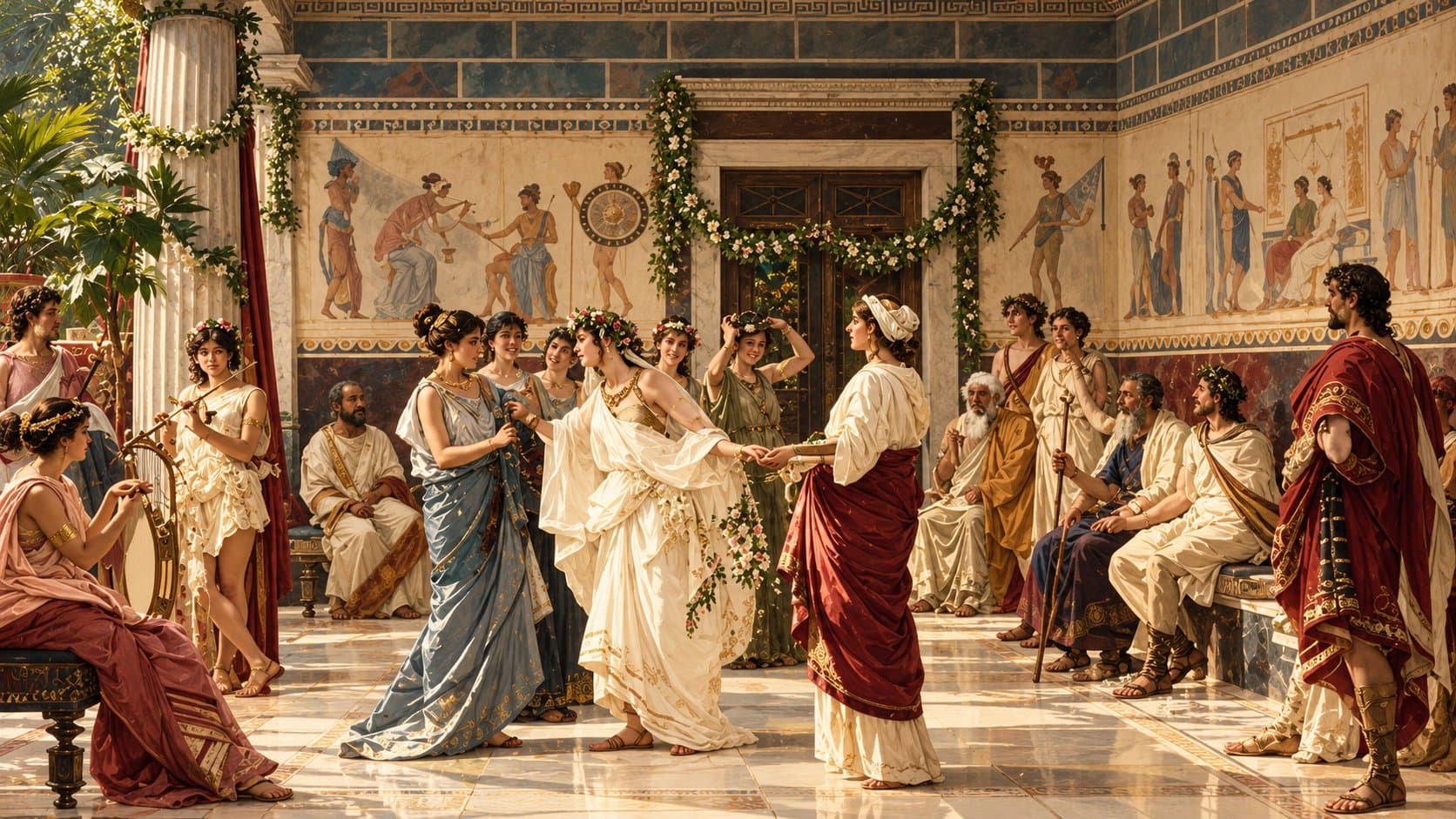
Rome is where the Western wedding gets its hardware. Romans wore the ring on the finger next to the smallest of the left hand because, Aulus Gellius reported, dissections in Egypt had found "a very fine nerve" running from it to the heart;20 an English church lawyer, Henry Swinburne, in a treatise published in 1686, later turned the nerve into a vein, the vena amoris.21 The betrothal ring was originally of iron.22 Roman brides wore a wedding wreath23 and a veil, the flammeum, whose colour, the classicist Karen Hersch argues, was a distinctive yellow; the torchlit procession to the husband's house was, in her reading, the most crucial part of the ceremony, and at some point the bride was carried across a threshold.24 The traditional patrician form, the confarreatio, was presided over by the Flamen Dialis and the pontifex maximus, centred on a shared cake of emmer wheat and needed ten witnesses:6 the ancestor, it seems, of every wedding since that has needed a cake, an officiant and a room full of people. For most Romans, though, marriage needed only consent and the legal right to marry,24 and the ceremony itself was elective,23 a distinction the Christian church would take centuries to reverse. The Romans took the public face of marriage seriously enough that, in the second century BCE, the censor Cato expelled a senator, Manilius, for embracing his wife "in open day before the eyes of his daughter"25.2
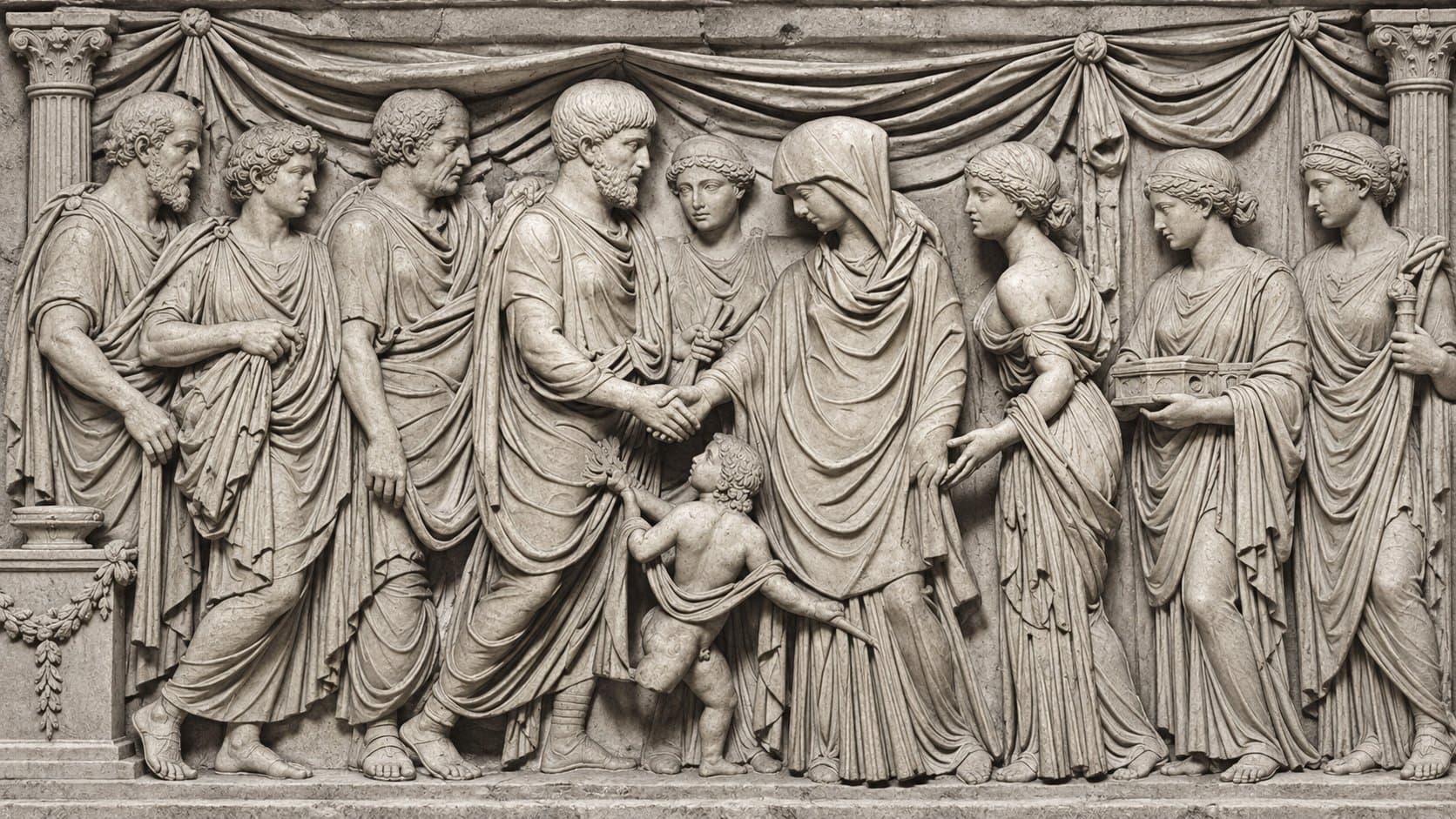
4. India: one of the oldest wedding scripts still in use
The Rigveda is usually dated to between about 1500 and 1000 BCE, and its tenth book is its youngest.26 In that book, as its eighty-fifth hymn, a poet set down the marriage of Surya, the daughter of the Sun, whom the god Savitar gives to Soma, with the twin Ashvins as groomsmen,27 and it is not a myth about gods so much as a liturgy that happens to use gods as its bride and groom. The hymn sends the bride to her new home, gives the groom words to say as he takes her hand, asks that she be blessed with ten sons, and makes her queen over her husband's father, mother, sisters and brothers.27 Its marriage verses are still central to the household rites built on them, and verses of the Rigveda are still recited at the rites of passage.26 There are older marriage contracts in the world, in Mesopotamia, but they are records. This is a liturgy, and families still hear it.
The Grihya Sutras, manuals of the domestic rites performed over the household fire,28 attributed to sages such as Apastamba, Baudhayana and Ashvalayana, turned the hymn into procedure, and in them are the three acts that remain the ritual core of a Hindu wedding:7 the kanyadaan, in which the father gives away his daughter, decked with ornaments; the panigrahana, in which the groom takes her hand, "I seize thy hand for the sake of happiness," and leads her round the fire; and the saptapadi, the seven steps, ending "Be friend with seven steps," after which the marriage is complete (Ashvalayana Grihya Sutra 1.6 and 1.7, in Hermann Oldenberg's translation).29 The fire, Agni, is the primary witness.7 The same sutra lists eight forms of marriage,29 and the Manusmriti ranks them, from the Brahma rite, a father's gift of his daughter to a man learned in the Veda, down to the Paishacha, "the most base and sinful".30 Between them they gave India a vocabulary it still uses for everything from the arranged match to the elopement: a gandharva marriage, "the voluntary union of a maiden and her lover",30 is a love marriage.
Two things about this history are unusual. The first is continuity. Section 7 of the Hindu Marriage Act, 1955, says that where the ceremonies include the saptapadi, the seven steps taken jointly by the bride and groom before the sacred fire, the marriage becomes complete and binding when the seventh step is taken.31 A modern Indian statute, in other words, names a rite from the Grihya Sutras as the moment a marriage is made. (The Act is also careful: it names no officiant, and a Hindu marriage may be solemnised by the customary rites and ceremonies of either party,32 so a community whose wedding has no seven steps marries just as validly by its own.) The second is that the Indian wedding kept its public, contractual, kin-making character long after the West had reframed marriage around the couple. The baraat; the milni, in which the two families' relatives meet in order of age, exchange garlands and try to lift each other off the ground;33 the shagun that flows in both directions; the week of functions that exist so that two families can watch each other closely before the deed is done: this is Mesopotamia's logic, done with better music.
It is also why the Ram Sita wedding in the Ramayana reads so much like a modern one. Valmiki's account has a condition set by the bride's father, who promises Sita to the man who can string Shiva's bow;34 a baraat that travels four days to reach Mithila;35 a go-between, Vishvamitra, who with Vasishtha proposes two more matches; the groom's father giving away four lakh cows in the bride's city;36 a kanyadaan in which Janaka calls his daughter Rama's partner in dharma; and a fire, circled three times.37 Our 7 unknown facts about the Ram Sita wedding has the detail, and the wedding of Ravana and Mandodari shows the same epic's other wedding, a fire and a hand in a forest. The point here is simpler: when Indians say their rituals are ancient, they are, for once, not exaggerating.
5. China: the six rites
In China, a complete set of six marriage rites, as procedural as a contract, gradually took shape under the Zhou dynasty.38 The Book of Rites, a collection of texts on the ceremonial of the Zhou,39 prescribes them, and a wedding that performed all six counted as complete.40 The sequence is still called the Three Letters and Six Rites (san shu liu li),38 and reading it next to an Indian wedding is an exercise in recognition.
First the proposal, carried by a matchmaker, whose job was to smooth over any conflict of interest between the families. Then the request for the bride's name and birth date, which went to a fortune-teller to see whether the match was auspicious. If it was, the matchmaker took the groom's family's betrothal gifts to the bride's house, with the betrothal letter, the wedding presents followed, and the bride's family countered with a dowry. A date was chosen by the almanac, the tung shing.38 And finally the fetching of the bride: the groom and his honour guard travelling to her house with a red sedan chair, to carry her to the ceremony,41 music and firecrackers on arrival, bows to heaven and earth, to the ancestors, to the parents and to each other, and then the banquet, called xi jiu, "joyful wine".38
Matchmaker, horoscope, betrothal gifts, auspicious date, baraat. There is no need to suppose that the Chinese and Indian weddings borrowed from each other; they seem to have arrived at the same answers because they were solving the same problem, which was how two families could commit to each other in public and make the promise stick. The horoscope deserves a note of its own. In both civilisations the reading of the couple's birth charts is not superstition layered on top of the wedding. It works as an old form of due diligence: a neutral third party, the astrologer, giving a family a respectable reason to say no. Shaadiwaale's Kundli Matching is its descendant.
Red, which many Indian brides share with Chinese ones, is the colour of the wedding in both. At a traditional Chinese wedding red is everywhere, because it "represents happiness and luck";41 in a Hindu family the bride is traditionally dressed in red, and a woman who dies before her husband may be dressed in her red bridal outfit for her funeral, while a widow wears light colours.42 The white wedding dress, when it arrives in this story, will be the exception, not the rule.
6. The Abrahamic turn: ketubah, sacrament, nikah
The three religions of the Book each made marriage something more than a contract, and each in a different way.
Judaism kept the contract and made it sacred. The ketubah, the written marriage document, sets out what the wife is entitled to receive on divorce or her husband's death, and is read before the groom and the witnesses and signed by them;43 at a traditional wedding it is then read aloud under the canopy, usually in the Aramaic original.44 The oldest preserved text, the Jewish Museum Berlin notes, comes from Egypt around 440 BCE,45 and among the papyri of the Jewish community at Elephantine is a "document of wifehood" of 449 BCE that lists what the bride brought and fixes the penalties for divorce.46 The ceremony under the chuppah, the canopy that stands for the couple's new home, with the ring ("Behold, you are consecrated to me with this ring"), the seven blessings and the breaking of the glass,44 gathered around that document. A Jewish wedding is Mesopotamia's contract with a liturgy attached, and the canopy is a cousin of the mandap.
Christianity did something stranger: for a long time it left the making of a marriage to the couple. The principle that a marriage is contracted "through the mutual, expressed consent" of the two was upheld, the Catholic Encyclopedia says, from the earliest times, and the church's part was the priest's blessing.47 When the Western empire collapsed in the fifth century, church courts took over,2 and over the following centuries the church slowly made the ceremony its own. By the early thirteenth century marriage was counted among the sacraments (a profession of faith of 1208 already lists it),47 and the Fourth Lateran Council of 1215 forbade clandestine marriages and ordered that every intended marriage be publicly announced in church by the priest, with a time fixed for anyone to object.8 Even then, an unwitnessed exchange of vows was "deplored but valid".48 It took the Council of Trent, in the decree Tametsi of 1563, to make a Catholic marriage valid only before the parish priest and two or three witnesses,49 with banns on three consecutive holy days,50 and even then only where the decree was promulgated.49 Much of the Western picture, still the default in film, of a wedding as a priest, witnesses and a church descends from that decree.
Islam returned marriage to the contract with unusual clarity. The nikah is a contract between bride and groom, drawn up orally or on paper; most schools of law require the consent of an adult bride; the mahr, a sum the groom gives the bride before the nikah, is for her exclusive use; and in Sunni law the contract is valid only before two witnesses, while Shia law recommends witnesses without requiring them.51 The walima, the marriage banquet offered by the groom,51 is the Mesopotamian feast again, the public act that tells the community it has happened. Many Indian Muslim weddings share the mehndi, whose long journey we trace in the history of mehndi, the baraat and the music of the weddings around them, which is why a Lucknow nikah and a Lucknow Hindu wedding can look more alike than different.
What the three traditions share, and what they handed to the modern world, is the idea that a marriage is not only between two families but before God, which raised the stakes of the vow and, in time, made the making and unmaking of marriages the business of courts.
7. When love got in
For most of this history, marrying for love was regarded as somewhere between eccentric and dangerous. In Greece there is no evidence that love ever played a significant role in choosing a lawful spouse.18 The Romans expelled a senator for embracing his wife in front of their daughter. The European aristocracy of the twelfth and thirteenth centuries saw the extramarital affair as the highest form of romance.2 Indian texts allowed the gandharva marriage of mutual desire but ranked it sixth of eight, well below the father's gift.30 "For thousands of years, love was almost considered a threat to marriage," Coontz told Connecticut Public Radio, because it could lead the young to defy the parents who were arranging their economic and political alliances.4 Love was fine. Love as the reason was not.
The change came in Europe in the seventeenth and eighteenth centuries, and it came from philosophy before it came from feeling. Enlightenment thinkers pioneered the idea that life was about the pursuit of happiness, and advocated marrying for love rather than for wealth or status.2 The novel, a new form, took up the argument. Samuel Richardson's Clarissa, published in 1747 and 1748, turns on a heroine whose entire family wants her to marry Roger Solmes, a man she finds unpleasant and will not have.52 The love match, in Coontz's words, "first triumphed in the early 19th century",53 and the Victorians inherited it as the respectable ideal.
The state moved in at the same time. In England, Lord Hardwicke's Marriage Act of 1753, in force from March 1754, required a wedding in a church after banns or a licence,54 conducted by a Church of England clergyman and entered in an official register signed by witnesses.55 It put a stop, in England and Wales, to the clandestine Fleet marriages performed in and around London's Fleet Prison, some of them in taverns;56 civil marriage followed with the Marriage Act of 1836.54 Marriage was becoming a thing the government kept track of, which is why your wedding today ends with a form.
India's version of this turn came later and is still under way. The Special Marriage Act of 1954 gave couples of different faiths a civil way to marry,10 the route our court marriage guide walks through, and the Hindu Marriage Act of 1955 made it a condition of a Hindu marriage that neither party has a spouse living.57 Bollywood then did for India what the English novel had done for England, with better songs. In Mughal-e-Azam (1960) the emperor forbids his son's romance and wins;58 in Dilwale Dulhania Le Jayenge (1995) the hero refuses to elope, insists on the father's blessing, and gets it as the train pulls out.59 Between the two, love against the family's objection became the national story. And yet the arranged marriage did not die; it adapted, into the "arranged-love" match in which families introduce and the couple decide. The pattern holds here too. Love did not replace the contract. It was added to it.
8. The invention of the modern wedding
Almost everything that reads as timeless about a modern wedding is younger than the railway.
The white dress is Queen Victoria's, or at least she made it the rule. When she married Prince Albert on 10 February 1840 she wore white satin trimmed with lace made in Honiton and Beer, in Devon.60 Royal brides before her had typically worn silver or gold, and most brides simply wore, and wore again, their best dress, often in russet or brown. White itself was not new, but the fashion magazines carried her picture, and by 1849 Godey's Lady's Book was presenting white as the bridal colour.61 In India, where a bride traditionally wore red and a widow light colours,42 the white gown arrived with Christian weddings; many Mangalorean Catholic couples, for instance, have taken to "Victorian style white weddings".62 The red lehenga has, so far, held.
The tiered cake descends, the food historian Carol Wilson writes, from the cake of wheat or barley broken over a Roman bride's head and the small spiced buns that medieval English couples stacked as high as they could and tried to kiss across. The white icing on Queen Victoria's cake in 1840 has been called royal icing ever since, and the multitiered British wedding cake dates from Prince Leopold's wedding in 1882.63
The diamond engagement ring is younger still. Diamonds were anything but the norm in American engagement rings in the early twentieth century.64 De Beers hired the Philadelphia agency N. W. Ayer in 1938, and in 1947 a young copywriter there, Frances Gerety, wrote "A Diamond Is Forever," which first ran in an advertisement in 1948; the suggested spend, meanwhile, grew from one month's salary to two and then three.65 A campaign of unusual patience persuaded America that an engagement required a diamond. The ring's finger is Roman; the stone is advertising.
The honeymoon is a word before it is a trip: hony moone appears in English in the 1540s, for the tenderness and pleasure of the newly wed, and one explanation is the moon itself, "no sooner full than it begins to wane." The sense of a holiday after the wedding is attested only from about 1800.66
The best man and the bridesmaids have folk origins that are told more often than they are proved. The story that the best man began as the groom's best swordsman, among the Goths, and the story that bridesmaids dressed like the bride to confuse vengeful spirits, are both repeated in popular histories67 and proved in none we could find. Rome's most traditional marriage needed ten witnesses;6 that much is on record, and the rest is the ceremony telling stories about itself.
The Indian wedding at its present scale is also modern. The rites are old; the destination, the stage, the choreographed sangeet and the drone shot are not. Hum Aapke Hain Koun..! (1994), which one critic called "a three-hour wedding video," is credited with "upping the ante on flamboyant weddings".68 The pre-wedding shoot and the haldi styled for the camera belong to the age of social media, in which, as Chinki Sinha wrote in Outlook in 2024, "optics is what matters," relatives hire choreographers to rehearse their dances, and a family wants "a destination wedding tag".69
None of this makes the modern wedding less real. The Mesopotamians added the feast; the Romans added the ring; the Victorians added the dress; we added the photographer. Every generation has believed it was performing an ancient rite and has quietly been inventing one.
9. What never changed
Strip the four thousand years back to the frame and the same six parts appear in every tradition in this story. A wedding is a public act (witnesses), a contract (something written or sworn), an exchange (gifts, dowry, bride price, shagun), a movement (one partner leaves a household for another), a feast (the community eats, and by eating, agrees), and a binding gesture that marks the exact moment it is done. Only the gesture varies. Everything else is Mesopotamia.
| Witnesses | Contract | Exchange | Movement | Feast | The binding moment |
|---|---|---|---|---|---|
| Mesopotamia, c. 1800 BCE | Families and community | Written; no contract, no wife | Bride price and dowry | Bride to father-in-law's house | Required for validity |
| Vedic India, from the Rigveda onward | Agni, the fire, and the assembly | Kanyadaan, given before the fire | Stridhan, the bride's own; shagun both ways | Bride to groom's home (vidaai) | The wedding bhoj |
| Classical Greece | Relatives at the engye | Betrothal settling the dowry | Dowry; gifts the next day (epaulia) | Torchlit procession to groom's house | At the bride's father's house |
| Rome | Ten witnesses (confarreatio) | Consent; oral betrothal with her father | Betrothal ring, iron at first | Procession; carried over a threshold | Shared emmer cake (confarreatio) |
| China, the six rites | Families, ancestors | Three letters, from the betrothal letter on | Betrothal gifts and dowry | Red sedan chair to the ceremony | Xi jiu, the wedding banquet |
| Judaism | Two witnesses sign | The ketubah, read aloud | The ketubah's sums for the wife; the ring | Under the chuppah, the new home | The wedding feast |
| Catholic Christianity after 1563 | Parish priest and two or three witnesses | Consent, spoken; banns published | The exchange of consent itself | To the couple's new home | The wedding feast |
| Islam | Two witnesses (Sunni law) | The nikah contract | Mahr to the bride | Rukhsati, the sending off | Walima, given by the groom |
The table also shows what India kept that others let go. Most Western weddings have lost the exchange (the dowry is gone, and the gift list is a shadow of it) and softened the movement (many couples already live together). The Indian wedding still performs all six, in full, over several days, which is why it is longer, costlier and, to its participants, more complete. It is not that Indian families are sentimental about ritual. It is that they never stopped doing the whole thing. Other places kept stranger pieces of it, from the Scottish blackening to the Greek custom of making the marital bed, and our 10 unexpected wedding traditions from around the world collects them, each with its Indian cousin.
What this means for your wedding
If you take one thing from four thousand years, take this: the parts of the wedding that feel like obligation, the guest list that will not shrink, the gifts in both directions, the week of functions, the moment the bride leaves, are not accretions on a simple ceremony. They are the ceremony. The couple's own words are the newest part of it. The witnesses, the feast and the exchange are the oldest, and the reason the whole thing works.
That is a useful way to plan. The guest list is the witness list, so the question is not how many but who must see it: the guest list tool keeps a separate RSVP for each function, so the pheras can have their own witnesses. The shagun that flows both ways is the exchange, and the Shagun Registry is only the latest form of a very old ledger. The feast is the feast; the caterers on Shaadiwaale know it is the part the community will judge. The movement needs a venue at each end and a way between them, which is what the venue search is for. And the binding moment needs a pandit who knows that, where the rites include it, the seventh step is the one the law counts.
Everything else, the drone, the dress, the stage, is yours to invent. Every generation has. If you would like someone to help you hold all six parts at once, our team will help, and it costs nothing to ask. The Mesopotamians would have called it a scribe. And if your family keeps a custom older than any in this story, tell our team about it; we would like to hear it.
Frequently asked questions
When did weddings start?
The earliest recorded marriage contracts and ceremonies come from Mesopotamia, roughly four thousand years ago. The Code of Hammurabi, from about 1780 BCE, sets penalties for broken engagements and says that a woman taken without a marriage contract "is no wife." Historians describe a valid Mesopotamian marriage in five stages: a contract, the exchange of bride price and dowry, a feast, the bride's move to her father-in-law's house, and consummation.
Why were weddings invented?
To make an alliance between two families public and binding. The historian Stephanie Coontz put it plainly in a 2020 radio interview: "The more I research marriage, the more I'm convinced it was invented to get in-laws." The witnesses, the contract, the exchange of gifts and the feast all exist to make the agreement impossible to deny later.
What is the oldest wedding ritual still performed?
No one can say for certain, but the Hindu wedding has a strong claim. Hymn 10.85 of the Rigveda, a text usually dated to between about 1500 and 1000 BCE, is a marriage hymn whose verses remain central to the household rites, and the kanyadaan, panigrahana and saptapadi described in the Grihya Sutras are still the core of the ceremony. Under Section 7 of the Hindu Marriage Act, 1955, where the rites include the saptapadi, the marriage is complete and binding when the seventh step is taken.
Where does the wedding ring come from?
Wearing the ring on the fourth finger of the left hand is a Roman custom: Aulus Gellius reported a belief that a fine nerve ran from that finger to the heart, which a seventeenth-century English lawyer later called the vena amoris, the vein of love. Roman betrothal rings were originally iron. A popular story traces the ring to Egyptian bands of reeds and hemp, but we could not find the evidence. The diamond engagement ring is modern: "A Diamond Is Forever" was written for De Beers in 1947 and first ran in 1948.
When did people start marrying for love?
As a mainstream ideal, in Europe in the seventeenth and eighteenth centuries, when Enlightenment thinkers advocated marrying for love rather than for wealth or status; the historian Stephanie Coontz writes that the love match "first triumphed in the early 19th century." Love existed within marriage long before that, but it was not the reason for it. In India the arranged match adapted rather than disappeared, into the match families introduce and the couple decide.
Why do Indian brides wear red and Western brides wear white?
Red is the traditional colour of the bride in Hindu families, and at Chinese weddings, where it stands for happiness and luck. White had been worn by some brides for centuries, but it became the Western bridal colour after Queen Victoria married Prince Albert in white satin and Honiton lace in 1840 and fashion magazines spread the look.
When did marriage become a religious ceremony?
In different ways in different faiths. The oldest preserved Jewish marriage contract, or ketubah, comes from Egypt around 440 BCE. The Christian church counted marriage among the sacraments by the early thirteenth century, and the Council of Trent's decree Tametsi (1563) made a Catholic marriage valid only before the parish priest and two or three witnesses. The Islamic nikah is a contract, with a mahr for the bride and, in Sunni law, two witnesses. A Hindu marriage has been a rite before the sacred fire since the Vedic hymns and the Grihya Sutras.
What do all weddings have in common?
Six things appear in every wedding tradition traced in this history: witnesses, a contract or sworn agreement, an exchange of gifts or property, the movement of one partner to a new household, a feast, and a binding gesture that marks the moment the marriage is complete. Only the gesture varies: the seventh step, the ring, the joined hands, the bows, the spoken consent.
Share this guide
Send it to the family group, or keep it for later.
Questions about your wedding?
Our team answers questions about venues, vendors and the budget, free on WhatsApp.
About Shaadiwaale
Indian wedding planning in one place: venues and vendors with real prices, free kundli matching, invitations and tools to plan every function together.
Every function. Every family. One plan.
Notes
- Cuneiform, an introduction, The British Museum, on Smarthistory. ↩
- How marriage has changed over centuries, The Week, 1 June 2012. ↩
- This is us: Earliest fossils of our species found in Morocco, Malcolm Ritter, Associated Press (via KATV), 7 June 2017. ↩
- Why love and marriage didn't always go hand in hand, Carmen Baskauf, Connecticut Public Radio, 14 February 2020. ↩
- Love, Sex, and Marriage in Ancient Mesopotamia, Joshua J. Mark, World History Encyclopedia. ↩
- Confarreatio, Wikipedia. ↩
- Hindu wedding, Wikipedia. ↩
- Fourth Council of the Lateran (1215): history and text, EWTN. ↩
- Marriages and civil partnerships in England and Wales, GOV.UK, in the UK Government Web Archive, May 2026. ↩
- Special Marriage Act, 1954, Wikipedia. ↩
- Law and Order in Ancient Babylonia, Macmillan Learning, from J. B. Pritchard, Ancient Near Eastern Texts (Princeton, 1969). ↩
- Hammurabi's Code of Laws, L. W. King's translation, Hanover College History Department. ↩
- Stridhan is wife's absolute property, husband holds no title over it: Supreme Court reiterates, LiveLaw, 25 April 2024. ↩
- Dowry Prohibition Act, 1961, section 3, Indian Kanoon. ↩
- Love, Sex, and Marriage in Ancient Egypt, Joshua J. Mark, World History Encyclopedia, 26 September 2016. ↩
- Marriage and Divorce in Ancient Egypt, Nathaniel Reich, The Museum Journal, Penn Museum, March 1924. ↩
- My Word: Ring connected to a vein of eternal love, Laurie Barber, The Northern Daily Leader, 10 May 2018. ↩
- Marriage in ancient Greece, Wikipedia. ↩
- The stages of the wedding, Foundation of the Hellenic World. ↩
- Aulus Gellius, Attic Nights 10.10, J. C. Rolfe's translation, Perseids. ↩
- Vena amoris, Wikipedia. ↩
- Anulus, Harper's Dictionary of Classical Antiquities, University of Missouri-Kansas City. ↩
- The world of marriage, Ann R. Raia and Judith Lynn Sebesta, Feminae Romanae. ↩
- Review of Karen K. Hersch, The Roman Wedding: Ritual and Meaning in Antiquity, John H. Oakley, Bryn Mawr Classical Review 2011.03.62, March 2011. ↩
- Plutarch, Life of Cato the Elder, 17, Bernadotte Perrin's translation, Lexundria. ↩
- Rigveda, Wikipedia. ↩
- Rig Veda, Book 10, Hymn 85: Surya's Bridal, Ralph Griffith's translation, IntraText. ↩
- Grihya sutra, Encyclopaedia Britannica. ↩
- Asvalayana Grihya Sutra, Hermann Oldenberg's translation, Hinduwebsite.com. ↩
- The Laws of Manu, chapter 3, G. Bühler's translation, IntraText. ↩
- Hindu Marriage Act, 1955, section 7(2), Indian Kanoon. ↩
- Hindu Marriage Act, 1955, section 7, Indian Kanoon. ↩
- Is that wrestling? Watch how Punjabi-Sikh weddings break the ice between families, Scroll, 15 February 2017. ↩
- Valmiki Ramayana, Bala Kanda, sarga 66, Desiraju Hanumanta Rao's translation, valmikiramayan.net. ↩
- Valmiki Ramayana, Bala Kanda, sarga 69, valmikiramayan.net. ↩
- Valmiki Ramayana, Bala Kanda, sarga 72, valmikiramayan.net. ↩
- Valmiki Ramayana, Bala Kanda, sarga 73, valmikiramayan.net. ↩
- Traditional Chinese marriage, Wikipedia. ↩
- Book of Rites, Wikipedia. ↩
- Chinese pre-wedding customs, Wikipedia. ↩
- Wedding, China Alive, University of Alberta. ↩
- Collection narrative: Hindu funeral dress, Bristol Museums. ↩
- Ketubbah, Encyclopaedia Judaica, on Encyclopedia.com. ↩
- Jewish wedding, Wikipedia. ↩
- Ketubah, Jewish Museum Berlin. ↩
- Document of wifehood, Brooklyn Museum 47.218.89, Digital Editions of Aramaic and Phoenician Sources, Ohio State University. ↩
- Sacrament of Marriage, Catholic Encyclopedia, New Advent. ↩
- Clandestinity (Catholic canon law), Wikipedia. ↩
- Tametsi, Wikipedia. ↩
- Banns of marriage, Wikipedia. ↩
- Marriage in Islam, Wikipedia. ↩
- Clarissa; or, The History of a Young Lady, Wikipedia. ↩
- The history of marriage, Stephanie Coontz, Omega Institute. ↩
- Clandestine Marriages Act 1753, Wikipedia. ↩
- The Marriage Act of 1753, Pat Rogers, The Grub Street Project, June 2023. ↩
- Fleet marriage, Wikipedia. ↩
- Hindu Marriage Act, 1955, section 5, Indian Kanoon. ↩
- Mughal-e-Azam, Wikipedia. ↩
- Dilwale Dulhania Le Jayenge, Wikipedia. ↩
- Wedding of Queen Victoria and Prince Albert, Wikipedia. ↩
- 1840: Queen Victoria's wedding dress, Summer Lee, Fashion History Timeline, Fashion Institute of Technology, 28 January 2020. ↩
- Attire of Mangalorean Catholics, Wikipedia. ↩
- Wedding cake: a slice of history, Carol Wilson, Gastronomica, 2005. ↩
- The history of diamond engagement rings, Erin Blakemore, National Geographic, 21 March 2024. ↩
- A tagline is forever, Giles Lury, The Marketing Society, 19 May 2014. ↩
- Honeymoon, Online Etymology Dictionary. ↩
- 21 surprising historical duties of the wedding party, Jen Doll, Mental Floss, 18 December 2016. ↩
- Hum Aapke Hain Koun, Indian Cinema, University of Iowa. ↩
- The big fat Indian wedding, Chinki Sinha, Outlook, 23 March 2024. ↩