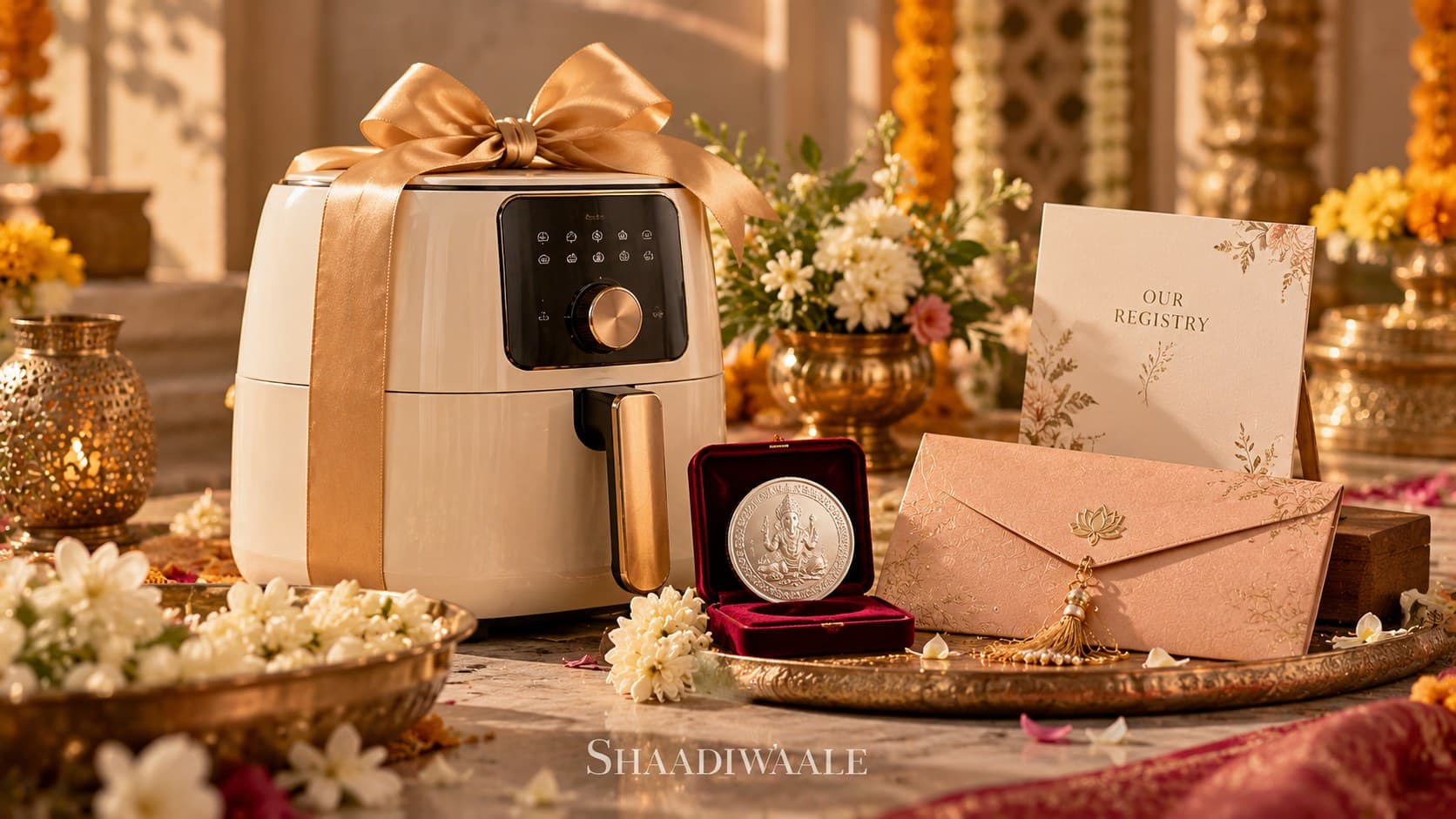
Guide
Wedding Gifts for the Couple in 2027: What to Give, What to Skip, and the Rules Nobody Mentions
The envelope, the extra rupee, the registry link in the family WhatsApp group and the tax rule almost nobody knows: a guide to wedding gifts for the couple, written for guests who would rather give well than give twice.
- Gifts the bride or groom receive on the occasion of their marriage are not taxed, whatever the value or the giver
- No one may receive ₹2 lakh or more in cash from one person for one occasion, and a wedding counts as one
- The 1985 Dowry Prohibition Rules ask the bride and groom to keep a signed list of the presents they receive
- Stridhan, the gifts to a bride at her marriage, is her absolute property, the Supreme Court restated in 2024
Guests and family · 20 min read · By The Shaadiwaale team · Updated 1 November 2026
An Indian wedding asks a great deal of its guests. There are the days of leave, the five outfits for five functions, the drive out to a farmhouse on the edge of the city and the sangeet that ends at two. And then, at the reception, there is the queue to the stage, a photograph with people you may have met that evening, and the small, unspoken question in your hand: is this the right gift? Most of us answer it at the last minute, in a mall or at a jeweller's counter, and many couples end the season with three pressure cookers and a cupboard of crystal they will never open.
It does not have to go that way. Wedding gifts for the couple have changed a good deal in the last few years, and the change is mostly good news. More couples now say what they would like, on a registry link shared in the family groups. Guests pool money for one large gift rather than ten small ones. The shagun envelope has a digital cousin. And a few plain rules, about tax, about cash and about keeping a list, matter far more than the colour of the wrapping paper.
This guide is for the weddings of 2027, and it makes one argument: the best wedding gift is the one the couple would have chosen for themselves, given in a way that makes their lives simpler, not busier. Everything else, from the extra rupee to the silver diya, follows from that.
Quick answer: The best wedding gifts for a couple in 2027 are the ones they have asked for: an item from their registry, a share of a group gift, or money towards a fund such as the honeymoon or a new home. If there is no registry, shagun in an amount that ends in one (₹1,101 or ₹5,101) is always correct, and close family often add silver, hallmarked gold or an heirloom. In the districts where hallmarking is compulsory, gold jewellery must carry a six-digit HUID hallmark1.2 Gifts the bride or groom receive on the occasion of their marriage are not taxed as income, whoever gives them3,4 but no one may accept ₹2 lakh or more in cash from one person for one occasion, so a large gift goes by bank transfer.5 Skip anything the couple must store, carry home from a destination wedding, or hang on a wall to please you. These are the rules as of October 2026, and this is information, not tax or legal advice.
In this article
- Start with what the couple wants
- Shagun: the envelope, the extra rupee and the QR code
- Gifts for the home they are building
- Gold, silver and heirlooms
- Funds, experiences and the honeymoon
- Group gifts, and how to run one
- Wedding gift ideas by relationship and budget
- What to skip
- The rules: tax, cash and the list of presents
- The art of asking, for the couple
1. Start with what the couple wants
The golden rule of gifting is to think of the person receiving, and wedding gifts are no exception, except that you are thinking of two people setting up one life, perhaps in a flat that is smaller than either of their parents' homes. The question is not what is beautiful but what they lack. If they have already lived on their own or with flatmates, they probably own a kettle and a set of plates. What they are short of tends to be the expensive basics they would not buy for themselves: a good mattress, proper cookware, a washing machine that does not walk across the floor.
The simplest way to find out is to ask, and the second simplest is to look for a registry. A wedding registry is a list the couple makes of the gifts, group gifts and funds they would welcome, shared as a single link, so guests can see what has already been promised and nothing is bought twice. Registries are, as The News Minute put it in 2019, "a popular concept in the US, but fairly new in India," and the idea of asking for gifts still does not sit well with some families.6 The answer to that is in the word itself: a registry is a courtesy to guests, who are spared the guessing, as much as a convenience to the couple.
If there is no registry and you cannot ask, ask someone who knows: a sibling, a cousin, the friend organising the sangeet. They will know whether the couple are moving cities, saving for a house or planning a long trip, and any of those answers is a better guide than a shop assistant.
What you can take from it: look for the registry link first, in the invitation or the family group; on Shaadiwaale it opens without an account, and guests simply say what they will bring (see how a registry looks).
2. Shagun: the envelope, the extra rupee and the QR code
Cash is the most Indian of wedding gifts, and to anyone raised elsewhere it can seem impersonal. It is not. Shagun, the auspicious gift of money in a decorated envelope, carries a blessing as much as a sum, and its customs are specific. The most familiar is the extra rupee: families give ₹101, ₹501 or ₹1,001 rather than a round hundred. The explanations vary. One is that an amount ending in zero suggests an ending, a settled account, while the extra rupee keeps the relationship open and promises a return gift at the next family occasion; another is that the one-rupee coin is metal, from the earth, and so a form of Lakshmi.7 That is why slipping in a coin, rather than a note, is thought especially auspicious.
Different regions keep the custom in their own way. In Tamil Nadu the custom is moi, a cash gift to the hosts of a function, weddings included. In January 2021, when the pandemic had shrunk guest lists, a Madurai family printed a QR code on their daughter's wedding invitation so that relatives and friends, many of whom could not come, could send their moi through Google Pay or PhonePe; the bride's mother said about 30 people used it.8
That small experiment is now ordinary. Digital shagun by UPI is convenient for guests abroad and for anyone who does not carry cash, and it leaves a record, which matters more than it seems (section 9). If you give this way, send a message at the same time, with your names and a line of blessing, so the couple know who it came from when they go through their phones a fortnight later. If you give an envelope, write your names on it. It is astonishing how many envelopes reach the stage anonymous.
What you can take from it: an amount ending in one, an envelope with your names on it, and for anything large, a bank transfer rather than a thick envelope; couples can put a fund on their Shagun Registry so that guests who prefer to give money know what it is for.
3. Gifts for the home they are building
The best home gifts are the ones a couple would choose on a good day with a generous budget: fewer, better things that they will use every week for twenty years. Think cast-iron and heavy-bottomed steel cookware, a good knife set (but see section 8), a mixer-grinder with real motor power, quality bedlinen in a plain colour, a set of glassware that survives the dishwasher. None of these is glamorous. All of them are the sort of purchase a young couple puts off.
Brass, copper and bell metal are the exception to the rule that the useful gift is the modern one. A brass urli for flowers, a pair of copper water pots or a kansa thali set reads as both traditional and personal, and, unlike the crystal, it is made to be used. Handmade pieces from a named craft or region, such as a painting from Mithila, a hand-block printed bedcover or a pair of pashmina shawls, also travel well across generations, as long as they suit the couple's taste rather than yours.
If you choose something for the home, keep the receipt and say so. A gift that can be exchanged is a gift that will be used.
What you can take from it: a couple's new home is the most practical place to spend a gift budget; the Invitations and gifts page lists makers of favours and hampers in our cities, and the couple's own registry may already say what the kitchen lacks.
4. Gold, silver and heirlooms
By custom, gold is the gift of close family, above all for the bride, and silver suits the many rituals that follow a wedding: a silver coin for the first puja in a new home, a diya, a small bowl for haldi and kumkum. Two practical points make these gifts safer for everyone.
First, the hallmark. Since 1 April 2023, gold jewellery and gold artefacts may be sold only with a hallmark that includes a six-digit alphanumeric HUID, a unique code stamped on each piece,1 in the districts where hallmarking is compulsory: 380 of them by March 2026, and the list keeps growing.2 For silver, hallmarking has so far been voluntary, but since 1 September 2025 every piece that is hallmarked must carry its own HUID too,9 and the Bureau of Indian Standards has been weighing whether to make silver hallmarking compulsory.10 Ask for the code, and keep the bill with the gift. These are the rules as of October 2026.
Second, ownership. Gifts made to a bride at the time of her marriage, by her husband, her parents or relatives on either side, are her stridhan, as the Supreme Court set out on 24 April 2024 in Maya Gopinathan v. Anoop S.B. In that judgment the court restated that stridhan is the woman's absolute property: it does not become joint property of husband and wife, and the husband has no title to it11.12 It is worth knowing if you are the giver, and worth saying out loud if you are the parent.
Heirlooms sit slightly apart. A grandmother's bangles or a father's watch is less a gift than a handing on, and it is best given privately, before the wedding or on the morning, with the story attached. Write the story down. In forty years it will matter more than the metal.
What you can take from it: buy gold and silver with the HUID and the bill, give them as gifts rather than as investment advice, and find a jeweller you trust through the jewellery page; for what families spend across the functions, read what an Indian wedding costs in 2026.
5. Funds, experiences and the honeymoon
The quietest change in wedding gifts is the move from things to time. Couples who already own a sofa would often rather have a week away, a series of cooking classes they can take together, or a contribution to the deposit on a flat. A fund lets several guests give towards one of these without anyone having to plan it.
On a registry, a fund is simply an amount towards a named goal: the honeymoon, the new home, the first year's furniture. Guests say what they will give and bring it to the wedding, by cheque, transfer or envelope, and the couple can choose whether others see how far the fund has come. It is cash, in other words, with a story attached, which is how shagun has always worked.
Experiences given outright need more care. Book something flexible (an open-dated voucher rather than a fixed weekend), check that the couple are not already travelling that month, and never give a trip that requires them to take leave they do not have. If you are invited to a destination wedding, remember that the journey itself has cost you, and the couple know it; a smaller gift with a warm note is perfectly correct.
What you can take from it: a honeymoon or new-home fund on the couple's Shagun Registry turns many small envelopes into one thing they will remember; if they are dreaming of the Aegean, our guide to a wedding in Greece covers the visas and the costs in rupees.
6. Group gifts, and how to run one
Friends from college, colleagues from one team, the cousins on one side of the family: groups like these can give a single large gift that none of them could give alone. Done well, a group gift is the most useful present a couple receives. Done badly, it is a fortnight of reminders in a WhatsApp group and one person quietly paying the difference.
Three rules keep it civil. Agree the gift and the total before anyone pays, so no one is surprised by the amount. Let one person collect the money, by UPI, with a list of who has paid, and close the collection a week before the wedding. And write one card from everyone, with every name on it, so the couple know exactly whom to thank.
A registry makes this simpler still. A group gift on a registry shows the total needed, and each guest says what share they will give, which saves the organiser a good deal of chasing.
What you can take from it: group gifts work best for the big-ticket items couples need and rarely buy for themselves; if the couple have a registry, the group gift may already be on it.
7. Wedding gift ideas by relationship and budget
There is no fixed amount for a wedding gift, and anyone who quotes one is guessing. What a family gives depends on the closeness of the relationship, the city, the custom on each side and what was given at the last wedding in the other family. The table below is our rough guide to the kind of gift that suits each relationship, not a rule, and the amounts are examples only.
| Relationship | Our suggestion | Shagun, as an example | Worth avoiding |
|---|---|---|---|
| Parents and grandparents | Gold or an heirloom, given privately; a fund towards the new home | Whatever the family's own custom is | Anything that sets the two families comparing |
| Siblings | A group gift with cousins; something for the home; a share of the honeymoon | ₹11,001 and up | A gift that outshines the parents' on the day |
| Close friends | A group gift from the friends; an experience; a registry item | ₹5,101 to ₹11,001 | Jokes the elders will see |
| Relatives | Silver for the puja; a registry item; shagun | ₹2,101 to ₹5,101 | Decor chosen to your own taste |
| Colleagues | Shagun, or a share of a team gift | ₹1,101 to ₹2,101 | Anything personal |
| Family friends of your parents | Shagun in your parents' name and yours | ₹1,101 to ₹5,101 | A gift without a card |
Two notes on the table. The amounts end in one for the reason in section 2, and the higher figures assume a close relationship and a city wedding; in many families the amount is set by what the other family once gave, and that history matters more than any table. And a registry, when there is one, overrides everything above.
What you can take from it: decide the kind of gift by the relationship and the amount by your own budget; if you are the couple setting your own budget, start with how to split one budget across five functions.
8. What to skip
Some gifts are best left at the shop for practical reasons. Anything large, at a destination wedding, means the couple must ship it home. Anything that needs a wall, a display cabinet or a particular kind of sofa imposes your taste on their home. Anything bought in duplicate, a second dinner set or a third mixer, ends up being given away. And anything without your names on it, envelope or box, becomes a small mystery the couple cannot solve.
Some gifts are avoided for reasons of belief rather than sense, and it is worth knowing them if you are giving across families. Some people hold that scissors and knives sever a relationship; others avoid giving a copy of the Mahabharata, believed in some homes to bring discord and divide a family, and opal, thought by some to be unlucky.13 These are superstitions, not rules, and families differ; when in doubt, ask someone on the couple's side.
Finally, skip the regift with the original card still inside, the gift that is really a hint (the cookbook titled for beginners), and anything that asks the couple to do something, like a voucher that expires in a month.
What you can take from it: when unsure, choose something the couple asked for or something they will use up; for where many wedding customs came from in the first place, read the story of weddings.
9. The rules: tax, cash and the list of presents
Three rules, all of them Indian law and all of them useful, sit behind wedding gifts. None is complicated, and they are seldom mentioned.
Tax. Gifts received by an individual on the occasion of their own marriage are not taxed as income in India, whatever their value and whoever gives them; the exemption that sat in section 56(2)(x) of the Income-tax Act, 1961 is now in section 92(3)(b) of the Income-tax Act, 2025, which came into force on 1 April 2026314.15 It applies to the bride and the groom, not to their parents,4 and gifts that arrive well before or long after the wedding can draw questions about whether they were given on the occasion of it.14 Other gifts from people who are not relatives as the Act defines them are taxed in full once their total passes ₹50,000 in a tax year3.16
Cash. Section 186 of the Income-tax Act, 2025, which took the place of section 269ST when the new Act came into force on 1 April 2026, bars anyone from receiving ₹2 lakh or more in cash from one person in a day, for one transaction, or for one event or occasion,5 and a wedding counts as one occasion.17 Under section 451 the penalty can equal the amount received,18 and advisers have long said the limit catches cash wedding gifts too: under the old section 269ST, "receiving Rs 2 lakh or more in cash from one person on such occasions invites a penalty," the chartered accountant Niyati Shah of 1 Finance told Business Standard in August 2025.4 A grandparent's generous envelope should therefore go by bank transfer or account payee cheque instead.
The list. The Dowry Prohibition Act, 1961 allows presents given to the bride or the groom at the time of a marriage without any demand, as long as they are entered in a list kept under its rules; where the presents come from the bride or her relatives, they must also be of a customary nature and not excessive for the giver's financial status.19 The 1985 rules under that Act ask the bride and the groom each to keep a written list of the presents they receive, at the time of the marriage or as soon as possible after, with a brief description of each present, its approximate value, the giver's name and any relationship, signed by both of them.20 In May 2024 the Allahabad High Court said that keeping such a list helps both families avoid false allegations later.21 It sounds unromantic. It is the most loving piece of paperwork a couple can do.
These are the rules as of October 2026; rules change, so check them with a tax adviser or a lawyer for anything large. This is information, not tax or legal advice.
What you can take from it: give large sums by bank, keep the bills for gold and silver, and if you are the couple, keep the list; for the legal side of the wedding itself, read our guide to court marriage in India.
10. The art of asking, for the couple
If you are the couple, everything above is easier when you tell people what you would like. It can feel awkward. It is far less awkward than a cupboard of crystal. The gentlest way is a registry: a short list of gifts at different prices, one or two group gifts for the things you really need, and a fund for the honeymoon or the home, shared once in the family groups and once on the invitation. Keep it short, keep a range of prices so that no guest feels small, and leave room for the aunt who will bring silver regardless.
Then say thank you, in writing, to every giver, within a few weeks. The list of presents you keep for section 9 doubles as your thank-you list, which is the best argument for keeping it.
What you can take from it: a registry and a thank-you list are the couple's half of the gift; your Shagun Registry sits in your Shaadiwaale plan, and because only you see each guest's promise, it gives the thank-you list a head start.
Give the gift they would have chosen
Wedding gifts for the couple are easier than the queue to the stage makes them feel. Ask what they want, or look for the list. If there is no list, give shagun that ends in one, with your names on the envelope. Give gold and silver with the hallmark and the bill, large sums by bank, and anything for the home with the receipt. Skip what needs storing, shipping or a wall. And if you are the couple, make it easy for everyone by saying what you would like, and keep the list of what arrives.
Shaadiwaale's Shagun Registry puts gifts, group gifts and funds behind one link that guests open without an account; no money moves through the site, and guests simply say what they will bring, so nothing is bought twice. Every Shaadiwaale wedding invitation website can carry a Shagun registry section with that link, and the planning tools keep the rest of the wedding in one place. If you would like help with any of it, ask our team, free.
The best wedding gift is the one the couple would have bought themselves. The second best is the one with your name on it.
Frequently asked questions
What is a good wedding gift for a couple in India?
A good wedding gift for a couple in India is whatever they have asked for: an item from their registry, a share of a group gift or money towards a fund such as the honeymoon. Without a registry, shagun in an amount ending in one (₹1,101 or ₹5,101) is always appropriate, and close family often add silver, hallmarked gold or an heirloom. Practical gifts for a new home, such as quality cookware or bedlinen, are welcome too, provided you keep the receipt so the couple can exchange them.
How much shagun should I give at a wedding in 2027?
There is no fixed amount. It depends on how close you are, the city, the customs of both families and what was given at earlier weddings between them. As a rough guide of our own, not a custom, ₹1,101 to ₹2,101 suits a colleague, ₹2,101 to ₹5,101 a relative and ₹5,101 to ₹11,001 a close friend, while siblings and parents may give more, or give gold. By custom, amounts end in one for luck. Any amount given with care and your names on the envelope is correct.
Why do people add one rupee to shagun?
Families add one rupee so that the amount ends in one, as in ₹101 or ₹501, rather than zero. A common explanation is that a round figure suggests an ending, while the extra rupee keeps the relationship open and promises a gift in return at a future occasion. Another is that the coin is metal, from the earth, and therefore a form of Lakshmi, which is why a coin, rather than a note, is thought especially auspicious.
Are wedding gifts taxable in India?
Gifts that the bride or groom receive on the occasion of their own marriage are not taxed as income in India, whatever the amount and whoever gives them. The exemption, earlier in section 56(2)(x) of the Income-tax Act, 1961, is now in section 92(3)(b) of the Income-tax Act, 2025, in force since 1 April 2026. It covers the couple, not their parents, and gifts that arrive well before or long after the wedding can draw questions. This is general information as of October 2026, not tax advice; check anything large with a tax adviser.
Can I give ₹2 lakh or more in cash as a wedding gift?
No. Section 186 of the Income-tax Act, 2025, which took the place of section 269ST when the new Act came into force on 1 April 2026, bars anyone from receiving ₹2 lakh or more in cash from one person for one event or occasion, and a wedding counts as one occasion. Under section 451 the penalty can equal the amount received. A large wedding gift should go by bank transfer or account payee cheque instead, which also leaves a clear record of who gave what. This is the rule as of October 2026.
Is it rude to give cash instead of a present at an Indian wedding?
No. Cash, as shagun, is one of the most traditional Indian wedding gifts, and many couples prefer it because they can spend it on what they need. Put it in an envelope with your names, choose an amount ending in one, and add a short blessing. For larger sums, use a bank transfer and send a message with your names at the same time. If the couple have a fund on their registry, giving towards it tells them what your money is for.
What should you not give as a wedding gift?
Avoid gifts the couple must store, ship home from a destination wedding or display to please you, and anything they already have. Some families avoid scissors and knives, believed to sever relationships, or a copy of the Mahabharata, believed in some homes to bring discord; these are superstitions, not rules, so ask someone on the couple's side if unsure. Never give an envelope or a box without your names on it.
Do Indian couples have wedding registries?
More and more do, though registries are still fairly new in India. A wedding registry is a list of gifts, group gifts and funds the couple would welcome, shared as one link so that guests can see what is already promised and nothing is bought twice. On Shaadiwaale's Shagun Registry, guests open the link without an account and say what they will bring, and no money moves through the site; the link can also sit on the couple's invitation website.
Share this guide
Send it to the family group, or keep it for later.
Questions about your wedding?
Our team answers questions about venues, vendors and the budget, free on WhatsApp.
About Shaadiwaale
Indian wedding planning in one place: venues and vendors with real prices, free kundli matching, invitations and tools to plan every function together.
Every function. Every family. One plan.
Notes
- No sale of gold jewellery without hallmark from April 1, Business Today, 4 March 2023. ↩
- Seven more districts added in 6th phase of mandatory hallmarking of gold jewellery, The Tribune (ANI), 12 March 2026. ↩
- Section 92 of the Income-tax Act, 2025, GST Gyaan (text of the Act). ↩
- Getting gifts at your child's wedding? It could trigger a tax headache, Business Standard, 28 August 2025. ↩
- Section 186: Mode of undertaking transactions, EZTax (text of the Income-tax Act, 2025). ↩
- Why wedding gift registries are gaining popularity among millennials, The News Minute, 27 September 2019. ↩
- Curious Case of The One Rupee: Why It's in Your Shagun Envelope, The Quint, 11 March 2015. ↩
- No cards, but 'codes': This Madurai wedding had a new virtual way to send gifts, The News Minute, 18 January 2021. ↩
- Mandatory HUID for silver jewellery: over 17 lakh articles hallmarked with HUID, govt mulls silver bullion hallmarking, Upstox News, citing the Ministry of Consumer Affairs, 4 December 2025. ↩
- Will silver hallmarking become mandatory? BIS assesses readiness of Indian market, Business Today, 5 June 2026. ↩
- Maya Gopinathan v. Anoop S.B. and another, judgment, Supreme Court of India (copy hosted by LiveLaw), 24 April 2024. ↩
- Stridhan Gifted To Woman Is Her Absolute Property; Husband Has No Control Over It: Supreme Court, Verdictum, 26 April 2024. ↩
- Don't gift these things if you believe in superstitions, Udayavani, 8 February 2021. ↩
- Wedding Gifts & Tax: What's Actually Exempt?, GoCredit (from The Economic Times), 24 April 2026. ↩
- Income-tax Act, 2025 comes into force from 1st April, 2026, Central Board of Direct Taxes, 1 April 2026. ↩
- Gift tax under the new Income-tax Act, 2025: tax-free gifts and relatives explained, Taxscan, 19 June 2026. ↩
- Section 186 of the Income Tax Act, 2025: Cash Receipt Limit, Ebizfiling, 31 July 2026. ↩
- Section 451: Penalty for failure to comply with provisions of section 186, EZTax (text of the Income-tax Act, 2025). ↩
- The Dowry Prohibition Act, 1961, India Code, Government of India. ↩
- The Dowry Prohibition (Maintenance of Lists of Presents to the Bride and Bridegroom) Rules, 1985, Ministry of Women and Child Development. ↩
- Helps avoid false dowry allegations: HC on why making list of wedding gifts given to bride is vital, ThePrint, 16 May 2024. ↩