Explainer
The History of Mehndi: How Henna Travelled From Ancient Egypt to the Indian Wedding
Where mehndi really comes from: what the evidence shows, from Egyptian mummies and ancient Ugarit to the Sanskrit mendhika, the Mughal courts and today's bridal designs, and which popular claims are only legend.
- Henna's oldest evidence is about 3,500 years old, from Egypt and the eastern Mediterranean
- The word mehndi comes from the Sanskrit mendhika
- Mehndi most likely spread widely in India from around the 12th century
- Black henna for skin is a modern chemical, not a tradition
Traditions · 16 min read · By The Shaadiwaale team · Updated 18 October 2026
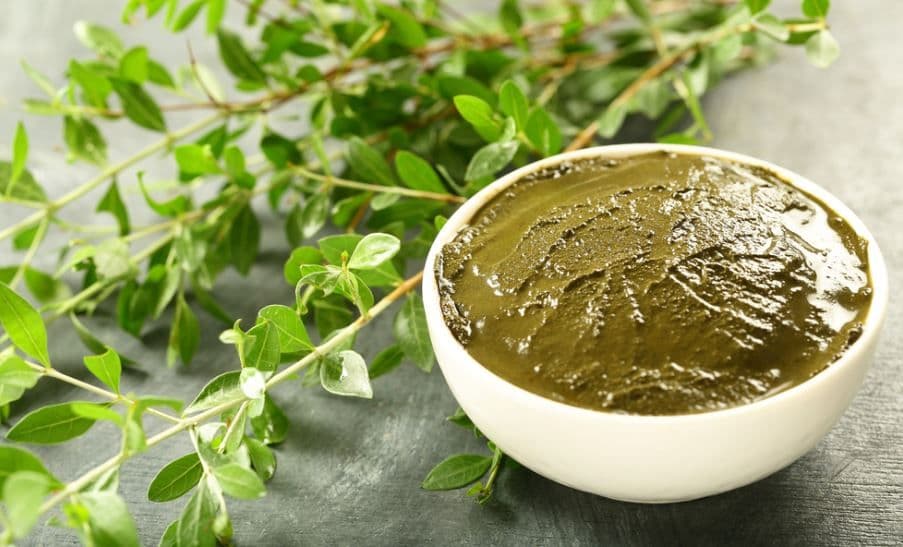
Every mehndi function has the same quiet moment. The paste is on, the bride can't move her hands, and someone older starts telling a story about how it was done when they got married. Leaves ground on a stone. No cones. A grandmother who swore by eucalyptus oil. That's history too, just the family-sized kind.
The bigger story is older than any family. Henna was colouring hair and skin thousands of years ago, far from India, and its story runs through Egypt, the Mediterranean, Arabia, Persia and the Mughal courts before it reaches our weddings. Some of that story is well documented. Some of it is guesswork that has been repeated so often it sounds like fact. This guide separates the two, and shows how a plant from hot, dry country became the most loved pre-wedding ritual in India.
Quick answer: Mehndi is the South Asian name for henna, a dye made from the leaves of the Lawsonia inermis shrub. Its use is at least 3,000 years old: henna was used on some Egyptian mummies, was traded in ancient Babylonia, and is linked to marriage in texts from ancient Ugarit, in today's Syria. In India, the word comes from the Sanskrit mendhika. Claims that henna was used in India by the 4th century CE are poorly sourced; the most cited view is that it became widespread from around the 12th century, and it was important at the Mughal court (1526 to 1857). The dense bridal designs and the cone are much more recent, and "black henna" for skin is a modern chemical product, not a tradition.
What's in this guide
- First, the plant: how henna stains skin
- The oldest traces: Egypt, the Mediterranean and the Near East
- Henna across the Islamic world, Africa and the Gulf
- How henna reached India, and what we actually know
- The Mughal years and the pattern language of mehndi
- How mehndi became a wedding tradition in India
- The modern era: cones, professional artists and a chemical shortcut
- A timeline of mehndi, with how sure we are about each part
- What this history means for your mehndi today
- Frequently asked questions
First, the plant: how henna stains skin
Before the history, the botany, because it explains why henna spread where it did.
Henna is a flowering shrub, Lawsonia inermis, that grows in hot regions. The Natural History Museum in London describes it as a plant believed to have originated in the Middle East and North Africa, which spread across Asia thousands of years ago.1 It likes heat and dry soil, which is one reason it became a crop in Rajasthan, the Gulf and North Africa, and why its traditions grew strongest in those places.
The colour comes from one molecule. Henna leaves contain lawsone, a red-orange dye whose chemical name is 2-hydroxy-1,4-naphthoquinone. A 2024 review in the journal Drug Design, Development and Therapy puts its share at roughly 0.5 to 1.5 percent of the leaf.2 That's a small amount, which is why fresh, good-quality powder matters so much.
Here's the clever part. Whole leaves don't stain. The dye is locked inside the plant and is only released slowly once the leaves are crushed and mixed into a paste. Lawsone then moves into the outermost layer of skin and bonds with keratin, the protein in skin, hair and nails, through a chemical reaction known as Michael addition.3 That bond is the stain.
Three things follow from this, and every generation of mehndi wisdom builds on them:
- The colour starts orange and darkens. The stain is bright orange when the paste comes off and deepens to reddish brown over about three days as it oxidises.4
- Thick skin stains darkest. Palms and soles have more keratin-rich skin, so they take the deepest colour.
- It fades as skin renews. Mehndi is not a tattoo. As the top layer of skin naturally sheds, the colour goes with it.
Why it matters: when people say henna "has been used for thousands of years", this is what made it possible. Anyone, anywhere, with a henna bush and a grinding stone could make a lasting red-brown mark without any other ingredients.
The oldest traces: Egypt, the Mediterranean and the Near East
The earliest evidence for henna is not in India. It comes from the eastern Mediterranean, Egypt and the old cities of the Near East, and it is a mix of physical traces, wall paintings and texts.
Egypt
Henna paste was used to stain some Egyptian mummies and their wrappings.1 One frequently cited example is the mummy of a royal woman, Henuttamehu, whose hair was reportedly dyed at the sides, "probably with henna", according to the anatomist G. Elliot Smith's catalogue of the royal mummies.4 The Natural History Museum also notes that Egyptians believed henna retained a person's spirituality.
Notice the careful wording, though. "Probably." "Some mummies." Identifying a dye that is about 3,500 years old is hard, and specialists are cautious about it. The safe statement is that henna was known and used in ancient Egypt, especially for hair and the body after death.
The Mediterranean: the wall paintings of Akrotiri
On the Greek island of Santorini, the Bronze Age town of Akrotiri was buried by a volcanic eruption. Its wall paintings, made before that eruption, show young women with red markings on their nails, palms and soles that some scholars read as henna.4 It is an interpretation, not a lab result. But it is an early hint of what henna would become almost everywhere: a mark of celebration on young women.
Ugarit and Babylon: the first link to marriage
The ancient city of Ugarit, on the coast of today's Syria, left behind clay tablets with a legend about the god Baal and the goddess Anath. Scholars point to it as the earliest text linking henna with marriage and fertility.4 Records from Babylonia, meanwhile, show henna being traded as a commodity.
So the very idea at the heart of a mehndi function, henna as part of preparing a bride, is older than almost any written record we have.
Why it matters: you will see claims that mehndi is "5,000 years old" or "began in India". Neither is well supported. "At least 3,000 years, beginning around the eastern Mediterranean, Egypt and the Near East" is the honest version, and it's impressive enough.
Henna across the Islamic world, Africa and the Gulf
For the next thousand years and more, henna spread along trade routes and became part of daily life across North Africa, Arabia, Persia and beyond.
- Arabia. Henna was well known in sixth-century Arabia, where it was also used in medicine.5 It is mentioned several times in the hadith, the recorded sayings of the Prophet Muhammad,1 which helped carry its use wherever Islam spread.
- The henna night. Across the region, a bride's henna evening became a fixture. In Morocco there is a pre-wedding henna night with female relatives.6 In Saudi Arabia, the henna night is known as Al-Ghumra.4 Turkey has its kına gecesi, the henna night before a wedding.
- Jewish communities. Yemenite and Moroccan Jewish families have their own bridal henna ceremonies, traditionally to ward off evil before the wedding.4
- Many faiths, one plant. The Natural History Museum notes that henna is a symbol of joy in Islam, Christianity, Judaism, Buddhism, Hinduism and Sikhism.
In 2024, UNESCO added "Henna: rituals, aesthetic and social practices" to its Representative List of the Intangible Cultural Heritage of Humanity. Its description could have been written about an Indian mehndi function: henna applied by women for adornment, on hands, feet and hair, accompanied by "chants, songs, proverbs and poems", at births and weddings, and "a symbol of joy".7 The nomination came from Arab states, but almost every line of it will feel familiar to an Indian family.
How henna reached India, and what we actually know
This is where most mehndi histories get careless. Let's go slowly.
The word: mendhika
The word mehndi comes from the Sanskrit mendhika, the name for the henna plant.5 That word travelled into Hindi, Urdu, Punjabi and other languages, which is why the same thing is spelt mehndi, mehendi and mehandi, and called mehedi in Bengali and mendi in Marathi. In the South it has its own names: maruthani in Tamil, gorintaku in Telugu, madarangi in Kannada and mylanchi in Malayalam.
A Sanskrit name tells us the plant was known in India, though nobody can say exactly when the word first appeared. And it doesn't, on its own, tell us when people began drawing designs with it.
The early evidence is thin, and debated
You may read that the Ajanta cave paintings prove mehndi was used in India by the fourth or fifth century. The honest version: some writers point to cave art in the Deccan as evidence that henna was in use by around the fourth century CE, but even Wikipedia flags that claim as needing a better source.5
There's a good reason for caution. Ancient India had another red decoration for hands and feet: alta, also called mahavar, a red dye made from lac. In a painting, reddened palms or soles could be either. Bengali brides still wear alta today, which shows how long the two traditions have run side by side.
Spreading widely from the 12th century
The most commonly cited view, though it rests on limited sources, is that mehndi likely became widespread in the subcontinent from around the 12th century CE, a spread often linked with the growing influence of Islam in the region.5 Henna arrived with its uses already established elsewhere: for hair and beard, for the hands of brides, and for celebrations.
Why it matters: "mehndi is purely Indian" and "the Mughals brought mehndi to India" are both too simple. The plant has a Sanskrit name, and the wider custom grew over centuries, carried along the same routes as trade, faith and fashion.
The Mughal years and the pattern language of mehndi
The Mughal Empire ruled much of India from 1526 to 1857, and the Natural History Museum notes that henna was important there.1 The Mughal courts were famous for their patterns: in carpets, textiles, inlaid marble, jali screens and miniature paintings. Whether or not those patterns were drawn on hands at the time, they likely shaped the vocabulary that mehndi artists use today.
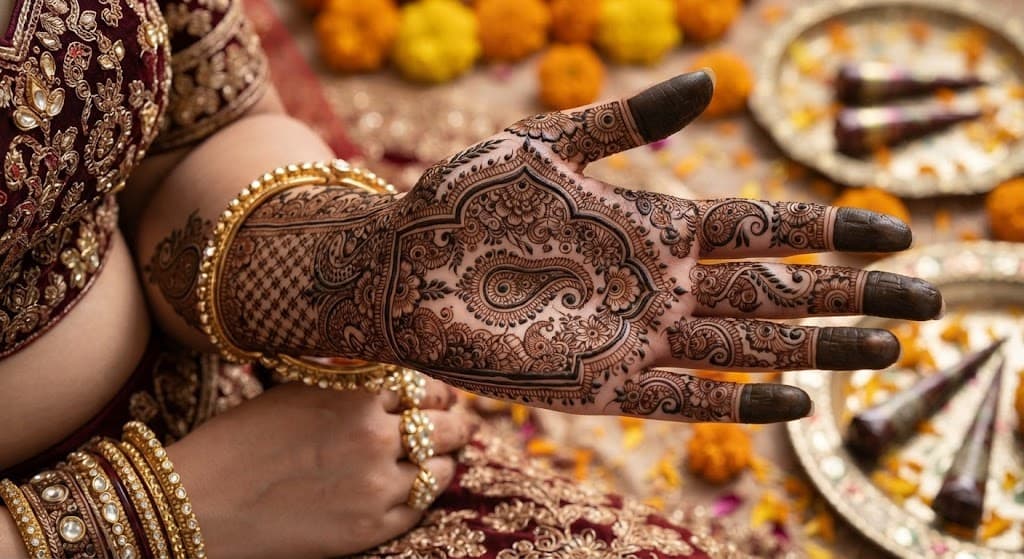
Look at a traditional design and you'll find the same shapes:
- The paisley. The teardrop motif known in India as ambi or kairi (from the word for mango) is of Persian origin, called boteh, and reached the wider world on Kashmir shawls. The English name comes from the Scottish textile town of Paisley.8
- The jaal. The net or lattice that fills so many bridal hands echoes the jali screens of Mughal and Rajput architecture.
- Arches and domes. Many bridal designs frame the palm with an arch, like a doorway or a jharokha window.
- Flowering vines. The bel, a trailing vine of leaves and flowers, appears across Mughal decorative art.
Rajasthan deserves its own mention. Rajput courts, desert henna crops and a deep culture of folk art made the region a heartland of mehndi. Jogendra Saksena's 1979 book, Art of Rajasthan: Henna and Floor Decorations, is one record of the region's henna art. It's no accident that "Rajasthani mehndi" still means dense, detailed, figure-filled bridal work. We explain those styles in Mehndi styles explained, and what each shape is said to mean in Mehndi motifs and their meanings.
How mehndi became a wedding tradition in India
Henna's link with brides is ancient, as Ugarit shows. In India it took on its own meanings, and every community made it its own.
One of the sixteen adornments
For many Hindu brides, mehndi is part of the solah shringar, the sixteen adornments of a bride, alongside sindoor, bangles, the bindi and the rest. The lists vary from family to family and region to region, but mehndi is on almost every list you will see today, which tells you how central it has become.
A gift from the groom's side
In many Punjabi families, the bride's mehndi is sent by her future mother-in-law, beautifully decorated.9 It's a small detail with a big meaning: the new family's blessing literally arrives on the bride's hands.
A family evening, across faiths
Muslim families across North India and Pakistan hold a mehndi of their own, sometimes called rasm-e-heena. In many Pakistani weddings, mehndi is the first day of the main wedding functions, with candles, sweets fed to the couple, and dances by both families, sometimes as a friendly contest.10 Sikh, Jain and Christian families in India have all made mehndi part of their pre-wedding days too.
The beliefs that grew around it
Over time, mehndi gathered sayings that every bride still hears. The darker the colour, the deeper the love,5 or in Punjabi families, the more the mother-in-law will love her.9 The groom's name hidden in the design for him to find. The bride excused from housework until her mehndi fades. We look at each of these, and what they mean, in Mehndi ceremony rituals and their meaning.
Festivals, too
Mehndi left the wedding long ago. It is applied for Karva Chauth, Teej, Diwali, Bhai Dooj, Navratri, Durga Puja, Raksha Bandhan and Vat Purnima, and for Eid al-Fitr, Eid al-Adha and Chaand Raat, the night before Eid.5
The modern era: cones, professional artists and a chemical shortcut
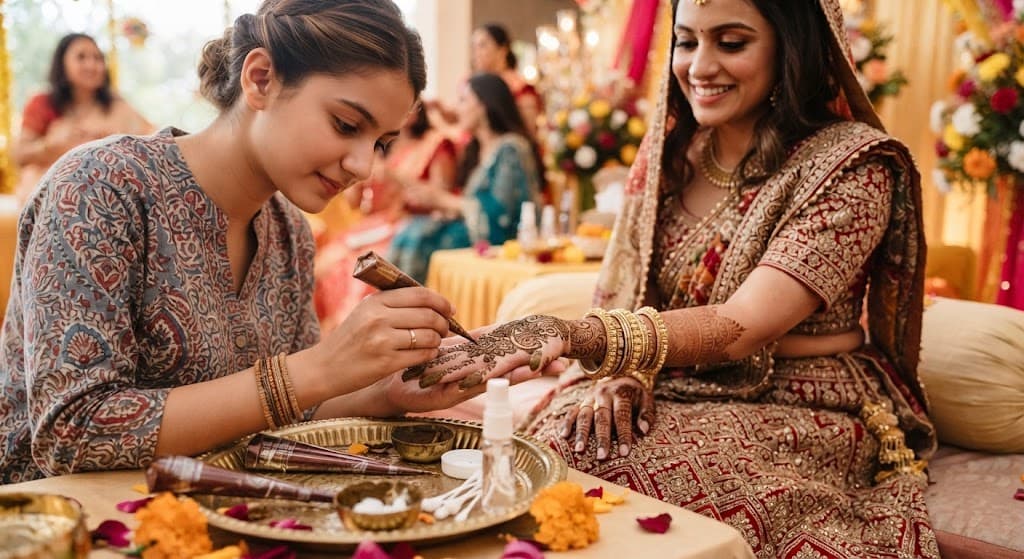
If your grandmother had mehndi, it may well have been leaves ground at home, or paste applied with a stick or a matchstick. A lot has changed since.
- The cone. A paste squeezed from a small plastic or paper cone made fine, even lines easy, and it is the main reason modern designs are so much more detailed and so much quicker to draw.
- The professional artist. Mehndi artists now work as businesses, with assistants for guests, bridal packages and portfolios on Instagram. Every big city has plenty to choose from. You can browse mehendi artists across India on Shaadiwaale, city by city.
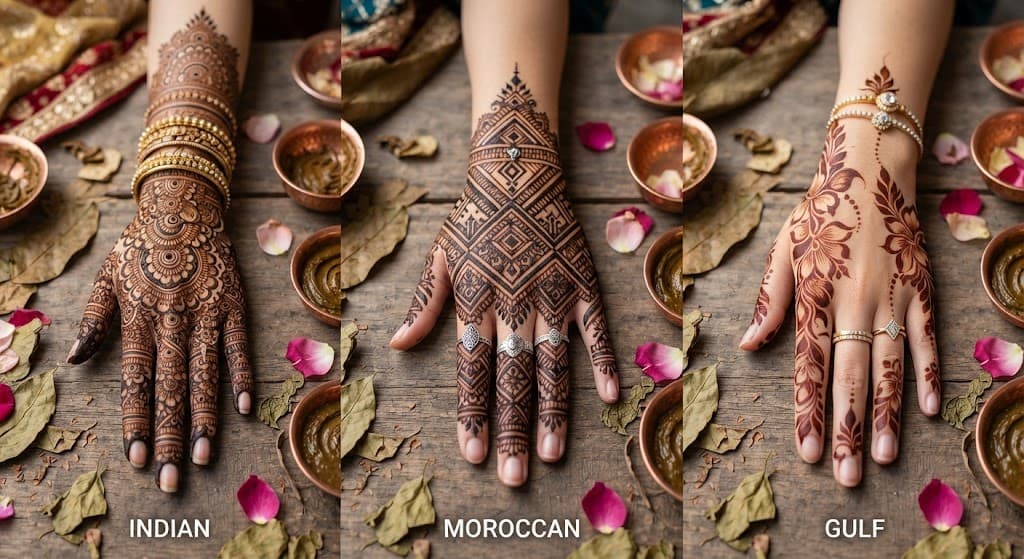
- New styles. Arabic, Indo-Arabic, Pakistani, Khafif and Moroccan influences sit alongside traditional Rajasthani work, and minimal designs, portraits of the couple and whole love stories drawn on the arms have all arrived in the last couple of decades.
- A dangerous shortcut. "Black henna" and "instant" cones promise a dark colour in minutes. Black henna is often blackened with a coal-tar hair dye containing PPD (p-phenylenediamine), which can cause dangerous skin reactions; in the United States, henna is approved only as a hair dye, and PPD is not permitted in cosmetics meant for the skin.11 Health Canada lists redness, itching, blisters, swelling and pain among the reactions, and gives three warning signs: a very dark black colour, a paste that sets very quickly, and little or no scent.12
That last point is the one bit of history worth repeating loudly. Natural henna has never been black. A jet-black stain in an hour is not an old secret; it is a modern chemical. Our complete guide to mehndi covers how to check your cones and stay safe.
A timeline of mehndi, with how sure we are about each part
| When | Where | What happened | How sure are we? |
|---|---|---|---|
| Bronze Age, more than 3,500 years ago | Akrotiri, Santorini | Wall paintings show women with red-marked nails, palms and soles, read by some scholars as henna | Debated: an interpretation of paintings |
| Ancient Egypt | Egypt | Henna paste used on some mummies and their wrappings; one royal mummy's hair probably dyed with henna | Well supported, with careful wording ("some", "probably") |
| Late Bronze Age | Ugarit, today's Syria | The Baal and Anath legend links henna with marriage and fertility | Well supported: a written text |
| Ancient | Babylonia | Henna traded as a commodity | Supported by records |
| 6th century CE | Arabia | Henna well known, used in medicine; later mentioned in the hadith | Well supported |
| Date unclear | India | The plant gets its Sanskrit name, mendhika; claims of henna in 4th century cave art in the Deccan | Word: established, but undated. Cave art: poorly sourced |
| From about the 12th century | Indian subcontinent | Mehndi becomes widespread | The most cited view, from limited sources |
| 1526 to 1857 | Mughal India | Henna important at court; Persian and Mughal patterns shape later designs | Agreed that henna mattered; design influence is an interpretation |
| 20th century | India and the diaspora | Cones, professional artists, mehndi functions as their own event | Well known |
| Recent decades | Worldwide | "Black henna" with PPD appears; health regulators warn against it | Well documented |
| 2024 | UNESCO | Henna rituals added to the Representative List of Intangible Cultural Heritage | Documented |
What this history means for your mehndi today
You don't need to know any of this to enjoy your mehndi. But a little history makes a few choices easier.
- Choose natural henna, always. For thousands of years, henna meant leaves, water and time. Ask your artist what is in the cone, and walk away from anything promising black in an hour.
- Ask about the old motifs. The paisley, the peacock, the lotus and the jaal all carry centuries of meaning. If an elder asks for a particular motif, there is usually a story behind it, and it's worth hearing before you decide. Mehndi motifs and their meanings explains each one.
- Blend traditions if you like. Mehndi has always borrowed: from Egypt, Persia, Arabia, the Mughals and every region of India. A Punjabi dhol and a Tamil grandmother's leaf paste can share one afternoon.
- Keep the family part. The oldest thing about mehndi isn't a design. It's women sitting together, singing and talking while the paste dries. Plan your function around that, and the rest follows.
When you are ready to plan, these help:
- Find mehendi artists in your city, for example in Jaipur, Delhi NCR or Lucknow.
- Save design ideas to a board on Inspiration to show your artist.
- Add the mehndi and the artist's trial to your wedding checklist.
Frequently asked questions
Where did mehndi originate?
Henna's earliest evidence comes from the eastern Mediterranean, Egypt and the Near East, more than 3,000 years ago. It was used on some Egyptian mummies, traded in Babylonia and linked to marriage in texts from ancient Ugarit. The plant itself is thought to have originated in the Middle East and North Africa. India gave it the Sanskrit name mendhika and made mehndi one of its best-known wedding traditions.
Is mehndi Indian or Arabic?
Both, and more. Henna was used in the Middle East and North Africa long before it became widespread in India, and Arab, Persian and Mughal influences shaped how it is used here. But the Indian mehndi function, the bridal designs and the regional traditions, from Rajasthani work to South Indian leaf paste, are distinctly Indian. Mehndi is best seen as a shared tradition with deep Indian roots.
Did the Mughals bring mehndi to India?
Not exactly. Most accounts say mehndi had already become widespread in the subcontinent from around the 12th century, long before the Mughal Empire began in 1526. Henna was important under the Mughals, and their patterns, like paisleys, jaal lattices and arches, likely influenced the designs artists draw today.
How old is mehndi?
The evidence for henna use goes back at least 3,000 years, to Bronze Age Egypt and the eastern Mediterranean. Claims of 5,000 or 9,000 years are often repeated online but are not well supported. In India, mehndi became widespread from around the 12th century CE.
Why is mehndi applied before marriage?
Henna has been linked with brides and fertility since ancient times, and in India it became a mark of joy, blessing and good luck. For many Hindu brides it is one of the solah shringar, the sixteen adornments. The mehndi function also brings the women of both families together before the wedding. Our guide to mehndi ceremony rituals and their meaning goes through each custom.
Is black henna a traditional kind of mehndi?
No. Natural henna stains orange to reddish brown, never jet black. The name "black henna" was once used for indigo, a plant dye for hair, but the black henna sold for skin today usually contains PPD, a chemical from hair dye, which can cause blisters, swelling and other serious skin reactions. It is a modern product, and health regulators in the United States and Canada warn against it.
When did henna become part of UNESCO's heritage list?
In 2024, UNESCO added "Henna: rituals, aesthetic and social practices" to its Representative List of the Intangible Cultural Heritage of Humanity, describing henna as a symbol of joy used at births and weddings.
Share this guide
Send it to the family group, or keep it for later.
Questions about your wedding?
Our team answers questions about venues, vendors and the budget, free on WhatsApp.
About Shaadiwaale
Indian wedding planning in one place: venues and vendors with real prices, free kundli matching, invitations and tools to plan every function together.
Every function. Every family. One plan.
Notes
- The henna plant: transcending time, religion and culture, Tammana Begum, Natural History Museum, London. The plant's origin and spread, Egyptian mummies, the hadith, henna in many faiths, the Mughal period. ↩
- Lawsone Unleashed: A Comprehensive Review on Chemistry, Biosynthesis, and Therapeutic Potentials, A. S. Nair and others, Drug Design, Development and Therapy, volume 18, 2024. Lawsone's chemistry and its share of the leaf. ↩
- Lawsone, Wikipedia, citing Jordão and others, "Lawsone in organic synthesis", RSC Advances, 2015. Binding to keratin by Michael addition. ↩
- Henna, Wikipedia. Egypt (G. Elliot Smith), Akrotiri (C. Doumas, 1992), Ugarit (J. C. de Moor, 1971), Babylonia, Jewish and Gulf traditions, indigo once called black henna, the stain darkening over three days. ↩
- Mehndi, Wikipedia. The Sanskrit mendhika, early Indian evidence (flagged as needing a better source), the 12th century spread, festivals, wedding beliefs. ↩
- Moroccan wedding henna: a timeless tradition, Arabia Weddings. The Moroccan henna night. ↩
- Henna: rituals, aesthetic and social practices, UNESCO Intangible Cultural Heritage, inscribed 2024. ↩
- Paisley (design), Wikipedia. The Persian boteh, ambi and kairi, and the name from Paisley in Scotland. ↩
- Punjabi wedding traditions, Wikipedia. The mehndi sent by the future mother-in-law; the saying about the mother-in-law (citing K. Myrvold, 2004). ↩
- Weddings in Pakistan: process and religion, Intersections, Duke University. The mehndi as the first day of the wedding functions. ↩
- Temporary tattoos, henna/mehndi, and "black henna": fact sheet, US Food and Drug Administration, content current as of 15 October 2024. ↩
- Black henna temporary tattoos, Health Canada. ↩