Guide
Types of Mehndi Designs: Indian, Arabic, Pakistani, Khafif, Moroccan and Modern Styles Explained
Rajasthani, Arabic, Indo-Arabic, Pakistani, Khafif, Moroccan and the modern styles: how to tell them apart in seconds, what each one suits, and how to brief your artist.
- Three questions identify any mehndi style: coverage, line weight and motifs
- Arabic, Khafif and minimal designs are quickest; Rajasthani and Pakistani take longest
- White and glitter henna are body paints, not henna
- Name the style and placement, and bring two or three references
Outfits and beauty · 14 min read · By The Shaadiwaale team · Updated 20 October 2026
Scroll through mehndi designs for ten minutes and they start to blur. Peacocks, vines, dots, lattices, flowers the size of a coin, flowers the size of a palm. Then your artist asks, "Arabic or Indian?" and you're not sure.
Here's the good news. Almost every design you will ever see comes from a handful of styles, the main types of mehndi designs, and each one has a few giveaway features. Once you can spot them, choosing gets much easier: you can tell your artist what you want in one sentence, guess how long you'll be sitting, and know whether the design will suit your outfit and your hands. This guide explains every major style, how to tell them apart, and how to pick the right one for a bride, a guest, a groom or a festival.
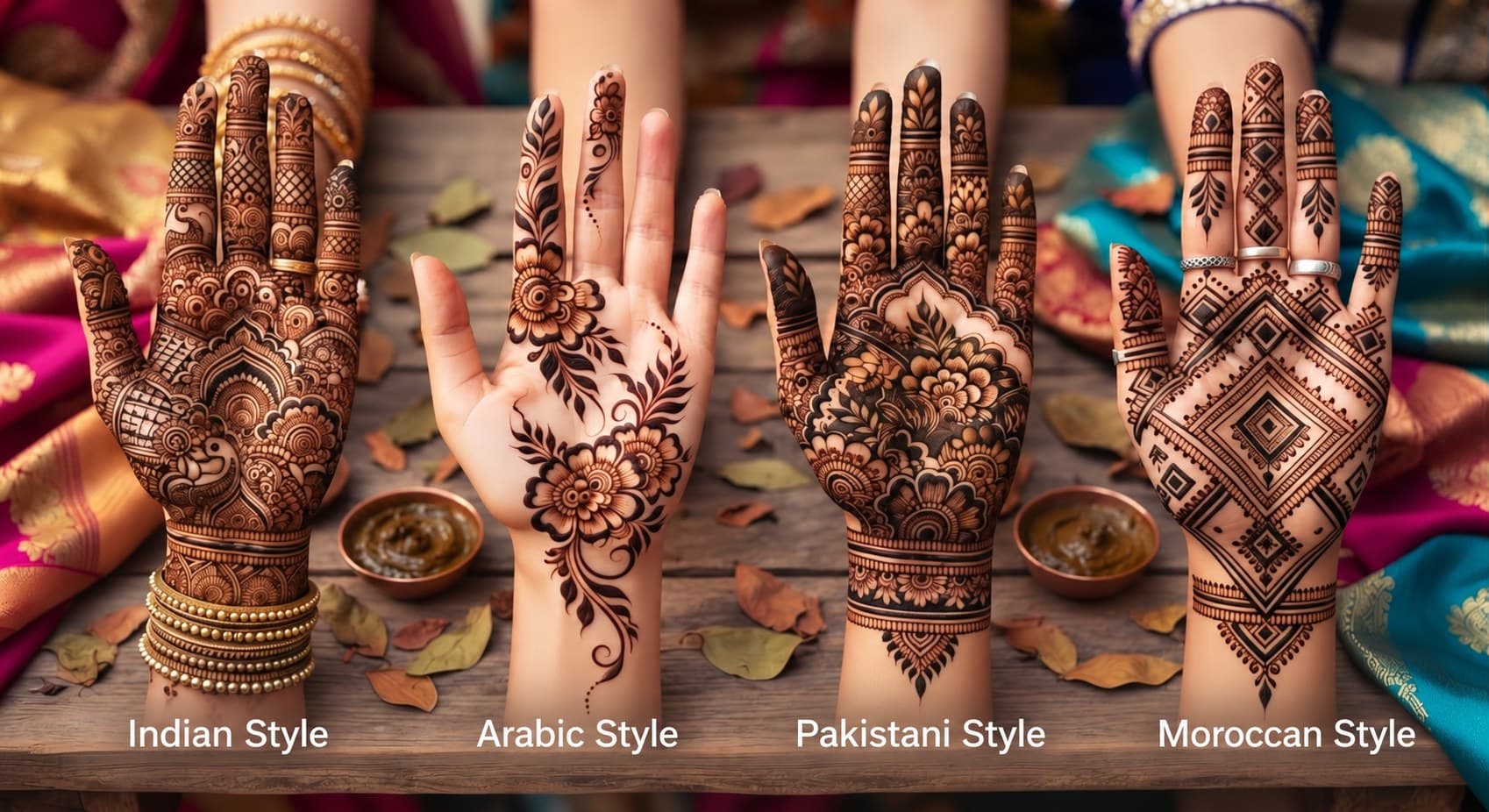
Quick answer: The main types of mehndi designs are traditional Indian (dense, detailed, often with figures, as in Rajasthani and Marwari work), Arabic (bold flowing vines in a diagonal trail with lots of open skin), Indo-Arabic (Indian motifs in an Arabic layout), Pakistani (very fine, lace-like lines and shading), Khafif (a light Gulf style with bold outlines, big shaded flowers and open skin), Moroccan (geometric lines, diamonds and dots), and modern styles such as minimal, mandala, lace glove, portrait and tattoo-style designs. Styles differ in three ways: how much skin is covered, how thick the lines are, and which motifs they use. White and glitter "henna" are body paints, not henna.
What's in this guide
- How to tell mehndi styles apart in seconds
- All the types of mehndi designs at a glance
- Traditional Indian mehndi: Rajasthani, Marwari and South Indian
- Arabic mehndi
- Indo-Arabic mehndi
- Pakistani mehndi
- Khafif mehndi
- Moroccan mehndi
- Modern styles: minimal, mandala, lace glove, portrait and tattoo-style
- White and glitter "henna"
- How to choose a style
- How to brief your artist
- Frequently asked questions
How to tell mehndi styles apart in seconds
Forget the names for a moment. Ask three questions of any design.
- Is there more paste or more skin? Traditional Indian and Pakistani designs cover most of the hand. Arabic, Khafif and minimal designs leave a lot of bare skin on purpose.
- Are the lines fine or bold? Pakistani work uses very fine lines and tiny fillings. Arabic and Khafif use thick outlines and bold, shaded shapes.
- What are the motifs? Figures, peacocks, elephants and lattices point to traditional Indian. Big flowers and leaves on a trailing vine point to Arabic. Straight lines, diamonds and dots point to Moroccan.
Two or three answers usually give the style away. Mixed answers? It's probably a fusion, like Indo-Arabic, which is completely normal. Most modern bridal work blends styles.
All the types of mehndi designs at a glance
How long a design takes depends on the artist, the hand and how much is covered, so the time column compares styles with each other rather than giving hours. Ask your artist for an estimate for your exact design.
| Style | Coverage | Lines | Signature features | Time to apply, compared | Best for |
|---|---|---|---|---|---|
| Traditional Indian (Rajasthani, Marwari) | Full: palm, back, fingers, often to the elbow | Fine to medium | Figures, peacocks, elephants, doli, jaal lattice, mirror symmetry | Longest | Brides who want the classic look |
| South Indian traditional | Palm and fingertips | Solid shapes | A round centre on the palm, filled fingertip caps, fresh leaf paste | Quick | Festivals, family occasions, children |
| Arabic | Partial, a diagonal trail | Bold | Large flowers and leaves on a flowing vine, shading, open skin | Quick to medium | Guests, modern brides, anyone short on time |
| Indo-Arabic | Partial to full | Medium | Indian motifs inside an Arabic-style trail | Medium | Brides who want detail without full coverage |
| Pakistani | Full, like lace | Very fine | Tiny fillings, hatching, shading, layered borders | Long | Brides who love fine detail |
| Khafif | Light, lots of skin | Very bold outlines | Big shaded flowers, leaves, filled petals, simple fingertips | Quick | Eid, guests, minimal brides |
| Moroccan | Bands or panels | Straight, medium | Diamonds, triangles, chevrons, dots, grids | Medium | Guests who want something different |
| Minimal | Small | Fine | One or two motifs, fingertip caps, fine bands | Quickest | Office-going brides, guests, festivals |
| Mandala (gol tikki) | Palm centre | Fine to medium | A round motif in the middle of the palm, matching fingertips | Quick | Children, guests, festivals |
| Lace glove | Hand and fingers | Fine | A net or lace pattern that ends in a scalloped edge at the wrist | Medium | Modern brides and bridesmaids |
| Portrait and story | Full, usually bridal | Fine | The couple, scenes, places, dates, pets | Longest | Brides who want something personal |
| Tattoo-style | Small to medium | Fine | Single-line drawings, small symbols, words | Quick | Grooms, guests, minimal looks |
Traditional Indian mehndi: Rajasthani, Marwari and South Indian
When most families say "proper bridal mehndi", this is what they mean.
Rajasthani and Marwari
Rajasthan has long been a heartland of mehndi, and its style is the most detailed of all. Jogendra Saksena's 1979 book, Art of Rajasthan: Henna and Floor Decorations, is one record of the region's henna art. A Rajasthani bridal design typically fills the palm, the back of the hand and every finger, often all the way to the elbow, with the same treatment on the feet. Look for:
- Figures. The bride and groom (dulha and dulhan), often one on each hand so they face each other when the palms are held together. The doli or palki (palanquin), the baraat, musicians with shehnai and dhol.
- Animals. Peacocks, elephants with raised trunks, parrots and fish.
- Structure. Arches over the palm like a jharokha window, bands across the wrist, and a jaal (net) lattice filling the gaps.
- Two textures. Bharwa means "filled": shapes packed solid with paste, which gives a dark, rich look. Jaal is the opposite: an open net of fine lines. Many bridal designs mix the two.
Marwari designs share much of this vocabulary and are known for their density and symmetry. Both take a long time, so book an artist with real bridal experience and plan your day around the sitting.
South Indian traditional
Before cones and Instagram, many South Indian families made mehndi from fresh leaves, ground on a stone at home: maruthani in Tamil, gorintaku in Telugu, madarangi in Kannada, mylanchi in Malayalam. The classic design is simple and striking: a round shape in the middle of the palm and the fingertips dipped or capped in paste. The leaf paste gives a deep, warm orange-red. Many South Indian brides now have a cone-drawn bridal design too, but the round palm and filled fingertips are still loved for festivals and family occasions.
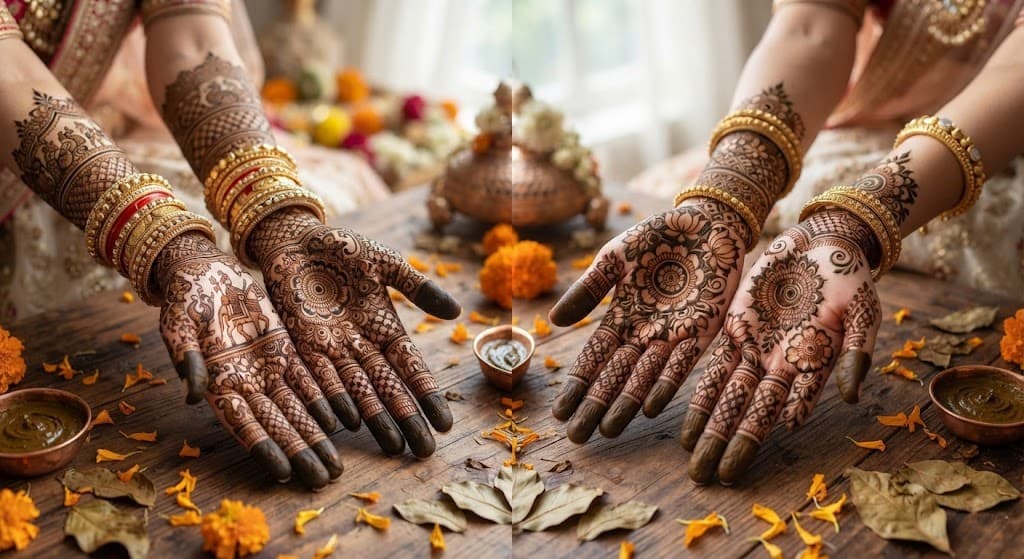
Why it matters: traditional Indian mehndi rewards patience. If you want it, choose your artist for their bridal portfolio, not their speed, and keep the rest of the day light.
Arabic mehndi
Arabic mehndi is one of the most requested styles in India, and for good reason. It looks elegant, it suits almost everyone, and it's quick.
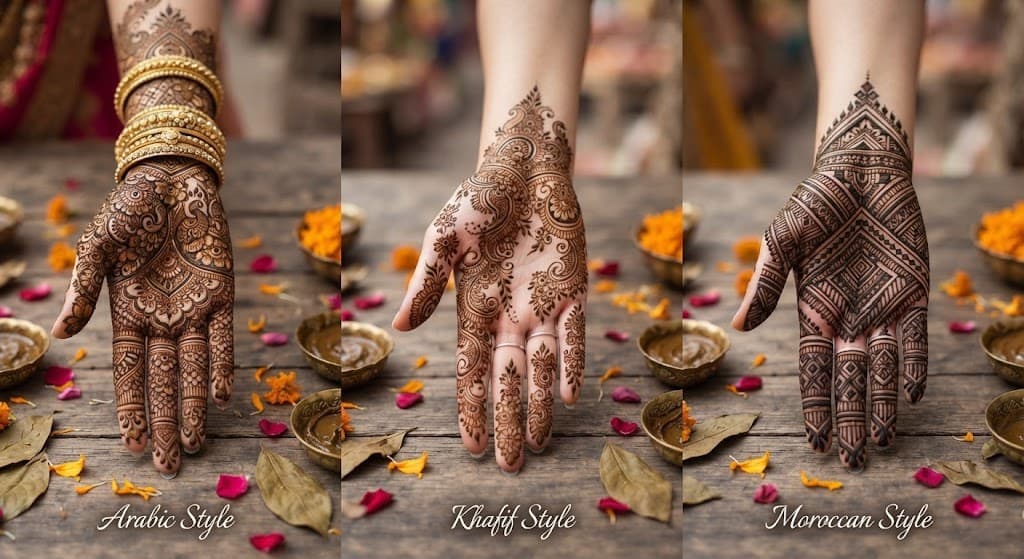
Its signature is the trail: a flowing line of large flowers and leaves that starts at one fingertip, usually the index finger, and sweeps diagonally across the back of the hand toward the wrist. Around it, plenty of bare skin. The flowers are bold and often shaded with a lighter fill or dots, and the outlines are thick enough to read from across a room.
What to know:
- It's open by design. The empty skin is part of the look. Don't ask your artist to "fill it in" unless you want a different style.
- It suits long fingers. The diagonal trail makes fingers look longer and slimmer.
- It's quick. Guests can get a beautiful Arabic trail in a few minutes, which keeps the queue moving.
- It photographs well. Bold lines stay clear in photos, even from a distance.
Indo-Arabic mehndi
Indo-Arabic is the bridge between the two biggest styles. It keeps the Arabic layout, a trail with open skin, but fills the flowers and vines with Indian details: a small peacock in a petal, paisleys along the vine, a jaal panel inside a big leaf.
It's a favourite with brides who want detail and meaning without sitting for the full Rajasthani experience, and with bridesmaids and close family who want something a step up from a guest design.
Pakistani mehndi
Pakistani mehndi is all about fineness. The lines are very thin, the fillings tiny, and the shading careful, so that a full hand looks almost like lace or embroidery. You'll see:
- Fine hatching and crosshatching inside shapes
- Layered borders and bands across the wrist
- Indian and Arabic elements mixed, all drawn at a much finer scale
- Fingers filled with delicate patterns rather than solid caps
It's a bridal favourite in Pakistan and North India, and increasingly elsewhere. It takes time and a very steady hand, so look closely at an artist's real photos (not just edited Instagram posts) to check their lines stay fine and even.
Khafif mehndi
Khafif is a Gulf style; the word means "light" in Arabic. It is designed to look striking with very little paste. Picture large flowers and leaves with bold, dark outlines, petals filled solid or shaded, and wide stretches of bare skin between them. Fingers are often just outlined or lightly decorated.
Why people love it:
- Instant impact. A Khafif design reads clearly from across a room.
- It's quick. With so much open skin, it's one of the fastest styles to apply.
- It suits modern outfits. It pairs beautifully with pastel lehengas, gowns and Western wear at a reception.
Khafif is especially popular for Eid and for guests at a mehndi function, and many minimal brides choose it for the back of the hand. The henna traditions of the Gulf and the wider Arab world were added to UNESCO's list of the Intangible Cultural Heritage of Humanity in 2024, which describes henna as "a symbol of joy".1
Moroccan mehndi
Moroccan henna has its own long tradition, with a henna night before the wedding where female relatives gather around the bride.2 Its look is easy to spot: geometry. Straight lines, diamonds, triangles, chevrons, dots and grids, arranged in bands or panels, often with a strong central line down a finger or across the hand. In Morocco, geometric designs are said to stand for unity and protection.
In India, Moroccan mehndi is a choice for guests and brides who want something different from the usual florals. It also mixes well with minimal styles: a single Moroccan band on two fingers looks crisp and modern.
Modern styles: minimal, mandala, lace glove, portrait and tattoo-style
The last twenty years have added a whole family of newer styles. Most borrow from the classics, but each has its own feel.
Minimal
One or two small motifs, a few fingertip caps, a fine band around a finger. Minimal mehndi leaves most of the hand bare and takes the least time of any style. It's popular with brides who want mehndi that still looks good at the office a week later, and with guests at every function.
Mandala, also called gol tikki
A single round motif, like a flower seen from above, in the centre of the palm, often with matching fingertips. It's quick, symmetrical and works on any hand size. It's a classic choice for children, festivals and guests. We explain what the circle is said to mean in Mehndi motifs and their meanings.
Lace glove
A fine net or lace pattern that covers the back of the hand and fingers and ends at the wrist in a scalloped edge, so it looks like a lace glove. Bridesmaids love it, and it photographs beautifully.
Portrait and story
Here the hands become a picture book: the couple at the varmala, the city where they met, a pet, the wedding date, even a caricature of the groom. It's the most personal style and usually the longest, because faces need a very skilled artist. Look for real portraits in the artist's portfolio before you book, and agree on the scenes well before the day.
Tattoo-style and Instagram mehndi
Single-line drawings, small symbols, initials, a crescent moon on a finger, a word in Devanagari or Urdu. These designs borrow from fine-line tattoo art. They're quick, they suit grooms and minimal brides, and they look great in close-up photos.
White and glitter "henna"
White "henna" and glitter mehndi look beautiful with pastel outfits, gowns and reception looks, but they are not henna at all. They are body-safe paints or cosmetic adhesives applied in a henna-like design, sometimes with glitter or crystals pressed on top. They sit on the skin rather than staining it, last a day or two, and come off with oil or soap.
Three things to know:
- Ask what's in it. Use only products made for skin, and do a small patch test if your skin is sensitive.
- It's for one evening. Plan it for the function you want it at, not days before.
- It is not black henna. Black henna is something else entirely, and best avoided. It is often blackened with PPD, a hair-dye chemical that can cause dangerous skin reactions.3 Health Canada's warning signs are a very dark black colour, a paste that sets very quickly, and little or no scent.4 Natural henna leaves a brown, orange-brown or reddish-brown stain, never black.4
How to choose a style
There is no "best" style, only the one that fits your hands, your outfit, your function and your patience. This table is a shortcut.
| If you want... | Consider | Why |
|---|---|---|
| The full traditional bridal look | Rajasthani, Marwari or Pakistani | Dense coverage, figures and meaning in every corner |
| Bridal detail without the longest sitting | Indo-Arabic | Indian motifs, but with open skin |
| Something quick and elegant as a guest | Arabic, Khafif or a palm mandala | Bold shapes that take minutes, not hours |
| Mehndi that still looks neat at work next week | Minimal or tattoo-style | Small designs fade gracefully |
| Something personal | Portrait and story | Your own scenes, names and places |
| Something different | Moroccan or lace glove | Geometry and lace instead of florals |
| A look for a pastel reception outfit | White or glitter body paint | Matches light colours; lasts the evening |
| Mehndi for a child | A small mandala or simple shapes on the palm | Quick and easy to keep still for |
A few more things to weigh:
- Your outfit. A heavily embroidered lehenga can carry a dense design. A light, pastel outfit often looks better with an airier style.
- Your hands. Long fingers suit diagonal Arabic trails. Smaller hands can look lovely with one bold mandala or a Khafif flower.
- Where it shows. The back of the hand appears in almost every photo; the palm stains darkest. Many brides choose a dense palm and a lighter back.
- The stain. Fine lines (Pakistani) and bold lines (Khafif) both stain well with good natural paste. Very fine detail on the back of the hand can come out lighter, because that skin is thinner.
- Mixing is fine. A Rajasthani palm with an Arabic back, dense hands with minimal feet, a Khafif flower on a mandala palm. Good artists blend styles all the time.
How to brief your artist
Once you know the style, the brief is easy.
- Name the style and the placement. "Rajasthani, full hands to the elbow, feet to the ankle" tells the artist more than twenty photos.
- Bring two or three references, not twenty. Say what you love about each one: the peacock here, the lattice there.
- List any motifs that matter. The groom's name, a family symbol, the wedding date, a pet.
- Ask for a time estimate and a trial. A small trial a few weeks before shows the artist's lines and the real colour of their paste.
- Check the paste. Ask whether it is natural henna, and what else is in it. Walk away from anything that promises black in an hour.
Look for artists whose portfolios show the style you want. You can browse mehendi artists on Shaadiwaale by city, for example in Mumbai, Hyderabad or Ahmedabad, and save the designs you like to a board on Inspiration to show them. For the bigger picture, from the ceremony to aftercare, read our complete guide to mehndi. To understand where these styles came from, read the history of mehndi.
Frequently asked questions
What are the main types of mehndi designs?
The main types are traditional Indian (including Rajasthani, Marwari and South Indian), Arabic, Indo-Arabic, Pakistani, Khafif and Moroccan, plus modern styles such as minimal, mandala, lace glove, portrait and tattoo-style designs. White and glitter "henna" are body paints that copy henna designs.
What is the difference between Arabic and Indian mehndi?
Indian mehndi covers most of the hand with detailed patterns, figures and lattices, and takes a long time. Arabic mehndi uses bold flowers and leaves in a diagonal trail across the hand, with lots of bare skin, and is much quicker. Indo-Arabic combines the two.
What is Khafif mehndi?
Khafif is a Gulf style of henna; the word means "light" in Arabic. It uses bold, dark outlines, large shaded flowers and leaves, and plenty of open skin, so it looks striking with little paste and is quick to apply.
Which mehndi style is the quickest?
Minimal designs, a palm mandala, a simple Arabic trail and Khafif designs are the quickest. Traditional Rajasthani, Pakistani and portrait designs take the longest. Ask your artist for an estimate for your exact design.
Which mehndi style is best for a bride?
It depends on how much time you have and the look you want. Rajasthani, Marwari and Pakistani styles give the full traditional bridal look. Indo-Arabic gives detail with less sitting. Minimal and Khafif suit brides who want something light and modern.
Is Pakistani mehndi different from Indian mehndi?
Yes. Both can cover the whole hand, but Pakistani mehndi uses much finer lines, tiny fillings and shading, so it looks like lace. Traditional Indian designs are often bolder, with filled (bharwa) shapes, figures and lattices.
Is white henna real henna?
No. White "henna" is a body-safe paint or cosmetic adhesive drawn in a henna-like pattern. It sits on the skin, doesn't stain, and lasts a day or two. Natural henna only stains orange to reddish brown.
What is the difference between bharwa and jaal mehndi?
Bharwa means "filled": shapes are packed solid with paste for a dark, rich look. Jaal means "net": an open lattice of fine lines. Traditional bridal designs often use both.
Share this guide
Send it to the family group, or keep it for later.
Questions about your wedding?
Our team answers questions about venues, vendors and the budget, free on WhatsApp.
About Shaadiwaale
Indian wedding planning in one place: venues and vendors with real prices, free kundli matching, invitations and tools to plan every function together.
Every function. Every family. One plan.
Notes
- Henna: rituals, aesthetic and social practices, UNESCO Intangible Cultural Heritage, inscribed 2024. ↩
- Moroccan wedding henna: a timeless tradition, Arabia Weddings. The Moroccan henna night and the meaning given to geometric designs. ↩
- Temporary tattoos, henna/mehndi, and "black henna": fact sheet, US Food and Drug Administration, content current as of 15 October 2024. ↩
- Black henna temporary tattoos, Health Canada. Warning signs of black henna; natural henna's colour. ↩