Explainer
Mehndi Ceremony Rituals and Their Meaning: What Happens, Why, and How Every Family Does It
Who sends the mehndi, who puts on the first dot, why the groom's name is hidden and what a dark colour is said to mean: every ritual of the mehndi ceremony explained, community by community.
- In many Punjabi families, the bride's mehndi is sent by her future mother-in-law
- An elder often places the first dot on the bride's palm as a blessing
- The mehndi is held a day or two before the wedding so the colour can deepen
- Dark colour, deep love: a much-loved saying, not a prediction
Functions · 16 min read · By The Shaadiwaale team · Updated 18 October 2026
On paper, a mehndi ceremony is simple. Someone draws a design on the bride's hands with henna paste, everyone else gets a smaller one, there's food and music, and the paste dries. In practice, it's one of the most ritual-rich afternoons of an Indian wedding. Who brings the mehndi. Who puts on the first dot. Why the groom's name is hidden. Why the bride isn't supposed to lift a finger until the colour fades. Why every aunty has an opinion about how dark it will turn out.
Each of those little customs has a meaning, and most families follow them without anyone explaining why. This guide does the explaining. It walks through the mehndi ceremony ritual by ritual, says what each one is believed to mean, shows how Punjabi, Rajasthani, Gujarati, Muslim, Bengali, South Indian and other families celebrate it differently, and helps you decide which traditions to keep, blend or reinvent for your own wedding.
Quick answer: The mehndi ceremony (mehndi rasam, mehndi raat or rasm-e-heena) is a pre-wedding function, usually one or two days before the wedding, where the bride's hands and feet are decorated with henna and family and friends get smaller designs. Its meaning is threefold: mehndi is one of the bride's sixteen traditional adornments (solah shringar) and a sign of joy and good luck; it is a blessing from both families, and in many Punjabi homes the bride's mehndi is sent by her future mother-in-law; and it gives the women of the family, and now often the men, a slow, happy afternoon together before the wedding rush. Customs such as hiding the groom's name, believing a dark stain means a loving marriage, and excusing the bride from housework until it fades are playful traditions layered on top.
What's in this guide
- The meaning of the mehndi ceremony
- The rituals, step by step
- What each ritual means, at a glance
- Community by community
- The groom's side of the mehndi
- Sayings, beliefs and little superstitions
- The modern mehndi: what has changed and what hasn't
- An example timeline for the day
- Keeping the meaning when you plan
- Frequently asked questions
The meaning of the mehndi ceremony
Ask why the mehndi happens and you'll get four kinds of answer. All of them are true at once.
Adornment: one of the sixteen
For many Hindu brides, mehndi is part of the solah shringar, the sixteen adornments that complete a bride's look, along with sindoor, the bindi, bangles, the mangalsutra and the rest. The list differs between regions and families, but mehndi is on almost every version. Putting it on is part of becoming a bride.
A blessing and a sign of good luck
Henna has been linked with brides, joy and fertility for thousands of years, from ancient texts in the Near East to henna nights across North Africa and the Gulf; UNESCO describes it as "a symbol of joy" used at births and weddings.1 In Indian families, mehndi is considered auspicious, a mark of happiness on hands that are about to begin a new life. That's why the first touch is often given by an elder, as a blessing.
"It cools you down"
In many Indian homes, henna is thought of as cooling, and older relatives will tell you the mehndi calms the bride before the big day. UNESCO notes that henna is also used for medicinal purposes, including the treatment of certain skin diseases.1 There's no good scientific evidence that henna paste calms wedding nerves. But sitting still for a few hours, being fed by your sisters and laughed at by your cousins, very likely does.
Bringing the families together
This might be the most important meaning, and it's the one people talk about least. The mehndi is one of the few functions where every generation sits in the same room doing the same thing. The bride can't use her hands, so everyone comes to her. Friends tell stories, elders bless her, the two families get to know each other over songs and food. UNESCO's description of henna traditions says they "enhance social bonds", which is a formal way of saying exactly this.
Why it matters: when you plan the mehndi, plan for that feeling first. The rituals below are what give the afternoon its shape.
The rituals, step by step
Every family does it differently, but most mehndi ceremonies follow a similar arc.
1. The mehndi arrives
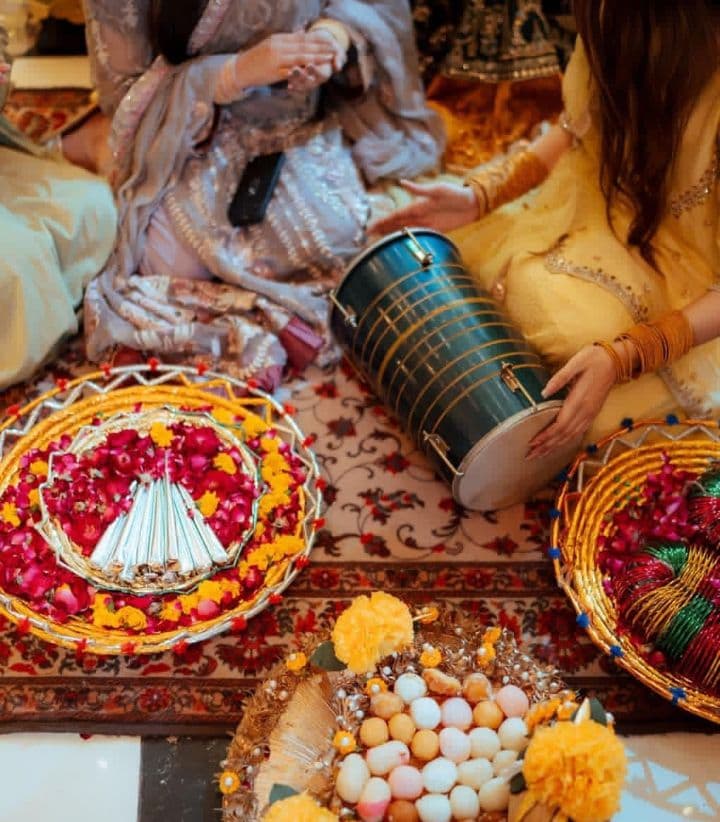
In many Punjabi families, the bride's mehndi is sent by her future mother-in-law, beautifully decorated.2 It might come in a decorated thaal (tray) with sweets, bangles or a new outfit. In some Muslim families in North India and Pakistan, the mehndi arrives on decorated trays, often with candles. The meaning is simple: the new family's blessing arrives, literally, to be put on the bride's hands.
2. A short prayer
Many Hindu families begin the mehndi, like every wedding function, with a short prayer to Ganesha, the remover of obstacles, so the day starts on an auspicious note.
3. The first dot
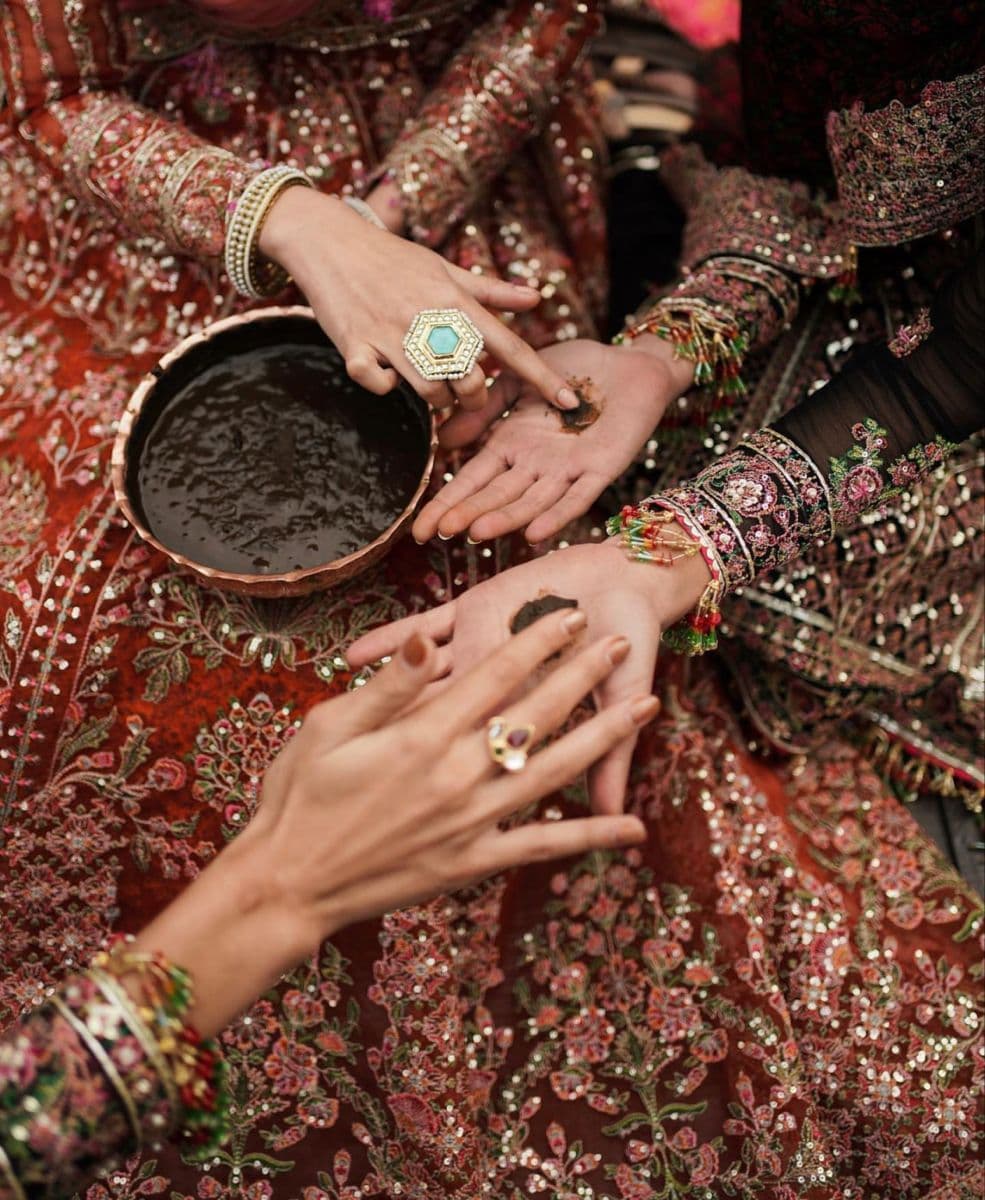
Before the artist begins, an elder places the first dot or a small design on the bride's palm. It is often the mother or grandmother, or a married woman of the family whom everyone thinks of as lucky. It's a blessing more than decoration, and it's one of the most touching moments to photograph.
4. The bride's sitting
Then the long part. The bridal artist works on the hands, often to the elbows, and the feet, sometimes for most of the day. Because it takes so long, many artists start with the bride before guests arrive. The bride sits on cushions or a low seat, sometimes on a decorated swing (jhoola), often in a light, easy outfit. We explain the bridal styles and how to choose one in Mehndi styles explained, and the motifs and what they mean in Mehndi motifs and their meanings.
5. Feeding the bride
With wet paste on both hands, the bride can't eat by herself, so her sisters, cousins and friends feed her. It's a small, funny, loving ritual, and it fits the meaning of the day perfectly: for once, she is looked after by everyone.
6. Songs, dholak and dancing
The music is not background, it's part of the ceremony. Women of the family sing traditional wedding songs on the dholak: suhag songs in Punjab, mehndi songs in Rajasthan, folk songs in every region. Teasing songs about the groom's family are a fixture. Then come the Bollywood favourites, the dances practised for weeks, and in many families a friendly contest between the bride's side and the groom's.
7. Guests get their mehndi
Assistant artists set up at tables or on floor cushions and give smaller designs to family and friends: mothers and sisters first, then everyone else. Often the unmarried girls of the family are especially keen, because a dark stain is said to bring good luck in finding a partner.
8. Hiding the groom's name
Somewhere in the bridal design, the artist hides the groom's name or initials, tucked into a petal or a vine.3 Later, often on the wedding night or in front of the whole family, the groom has to find it. Some families say whoever finds it first will have the upper hand in the marriage.
9. Sealing and waiting
Once the design is done, the paste is left to dry and then dabbed with a mix of lemon juice and sugar, which helps it stay on the skin longer. The bride keeps it on for as long as she can, often overnight. Henna stains orange at first and darkens to reddish brown over about three days,4 which is why the mehndi is usually held a day or two before the wedding.
10. The colour reveal
The next morning the dried paste is scraped off, and everyone gathers round to judge the colour. The darker it is, the louder the teasing about how much the groom, or the mother-in-law, loves her.
What each ritual means, at a glance
| Ritual | What happens | Who usually does it | What it is believed to mean |
|---|---|---|---|
| The mehndi arrives | The groom's side sends the bride's mehndi, often on a decorated tray | The groom's mother or family | The new family's blessing and welcome |
| A short prayer | A prayer to Ganesha | The family, often with the bride | An auspicious start, free of obstacles |
| The first dot | The first dot on the bride's palm | An elder or a married woman of the family | A blessing from the family's elders |
| The bride's sitting | The bridal design on hands and feet | The bridal artist | One of the sixteen adornments; becoming a bride |
| Feeding the bride | She is fed while her hands dry | Sisters, cousins and friends | Love and care from her own people |
| Songs and dholak | Folk songs, teasing songs, dances | The women of both families, then everyone | Joy, and the two families getting to know each other |
| Guests' mehndi | Smaller designs for family and friends | Assistant artists | Everyone shares in the celebration; luck for unmarried girls |
| The hidden name | The groom's name or initials in the design | The artist hides it; the groom finds it | A playful test of attention; a bond between the couple |
| Sealing and waiting | Lemon and sugar, the paste left on overnight | The artist, then the bride | Patience: the colour is worth waiting for |
| The colour reveal | The paste comes off and the colour is judged | The bride, with the whole family watching | The famous saying: dark colour, deep love |
Community by community
Every community in India has made the mehndi its own. These are broad patterns, not rules; neighbours from the same community often do it differently, so ask your elders what matters to your family.
Punjabi and Sikh
The mehndi is often the last big function before the wedding and is frequently blended with the sangeet.2 The bride's mehndi is sent by her future mother-in-law, and artists visit both homes, decorating the women of the family, the groom's hands and the bride's hands and feet. Expect dhol, boliyan (playful folk couplets), giddha and a lot of noise. The famous saying here is that the darker the mehndi, the more the mother-in-law will love her new daughter-in-law.2 The same night, or the next, there may be a jaggo: a late-night procession of singing and dancing through the neighbourhood.
Rajasthani and Marwari
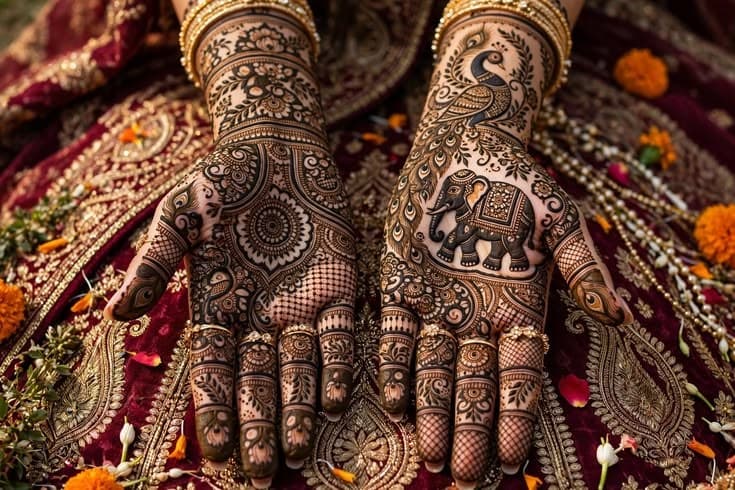
Mehndi is a serious art in Rajasthan, and the bridal design is often the most detailed of any community: figures, peacocks, elephants and jaal lattices up to the elbows. Women of the family sing traditional mehndi songs while the artist works. The function is usually at home and centred on the bride, with the women of both families close by.
Gujarati
The mehndi is often an evening affair, sometimes called mehndi raat, and may be combined with garba or dandiya, so it doubles as a dance night. The pithi (the Gujarati turmeric ceremony) is a separate ritual, and in many families it traditionally comes after the mehndi. If your family's order allows, holding the pithi first helps the colour, because fresh mehndi doesn't like turmeric scrubs and washing.
Maharashtrian
Often a smaller, close-family gathering a day or two before the wedding. The halad (turmeric) ceremony is an important ritual in many Maharashtrian homes, and the mehndi sits alongside it.
North Indian Muslim and Pakistani
The mehndi, sometimes called rasm-e-heena, is often a full evening of its own. In many Pakistani weddings it's the first day of the main wedding functions: candles are lit, the couple sits on a stage with sweets in front of them, family members come up one by one to feed them a sweet and give money, and then the dance performances begin, sometimes as a friendly contest between the two families.5 It's often preceded by dholki nights, when the women gather to sing to the dholak, and in some families by the mayun, when the bride is dressed in yellow. In some families each side holds its own mehndi.
Bengali
Traditionally, Bengali brides wear alta, a red dye painted on the feet and the edges of the hands, rather than a henna design; the turmeric ceremony, gaye holud, is the bigger pre-wedding ritual. Many Bengali brides now also have a mehndi function, often a relaxed evening with friends.
Tamil, Telugu, Kannada and Malayali
In the South, mehndi has a homelier history. Families traditionally ground fresh henna leaves (maruthani in Tamil, gorintaku in Telugu, madarangi in Kannada, mylanchi in Malayalam) on a stone and applied the paste at home, often as a round on the palm with filled fingertips. Cone designs and a separate mehndi function have become common in recent years. In Kerala, especially among Muslim families, the mylanchi night before the wedding has its own songs and gathering.
Christian and inter-community weddings
Many Christian brides in India now hold a mehndi evening as part of the wedding week. And when two communities marry, the mehndi is often where traditions blend most happily: a Punjabi dhol and a Tamil grandmother's leaf paste can share one afternoon.
The groom's side of the mehndi
The mehndi used to be mostly about the bride. Not any more.
- The shagun dot. In many families, the groom gets a small dot or motif of mehndi on his palm as a blessing, even if nothing more.
- His own design. Many grooms now have a simple design: the bride's initials, the wedding date, a mandala or a band on one hand. It photographs beautifully next to the bride's.
- His family's mehndi. In Punjabi homes, artists often visit the groom's house too, and the women of his family celebrate with their own songs. In some Muslim families, each side holds its own mehndi.
- Finding his name. The groom's big moment comes later, when he hunts for his name in the bride's design.
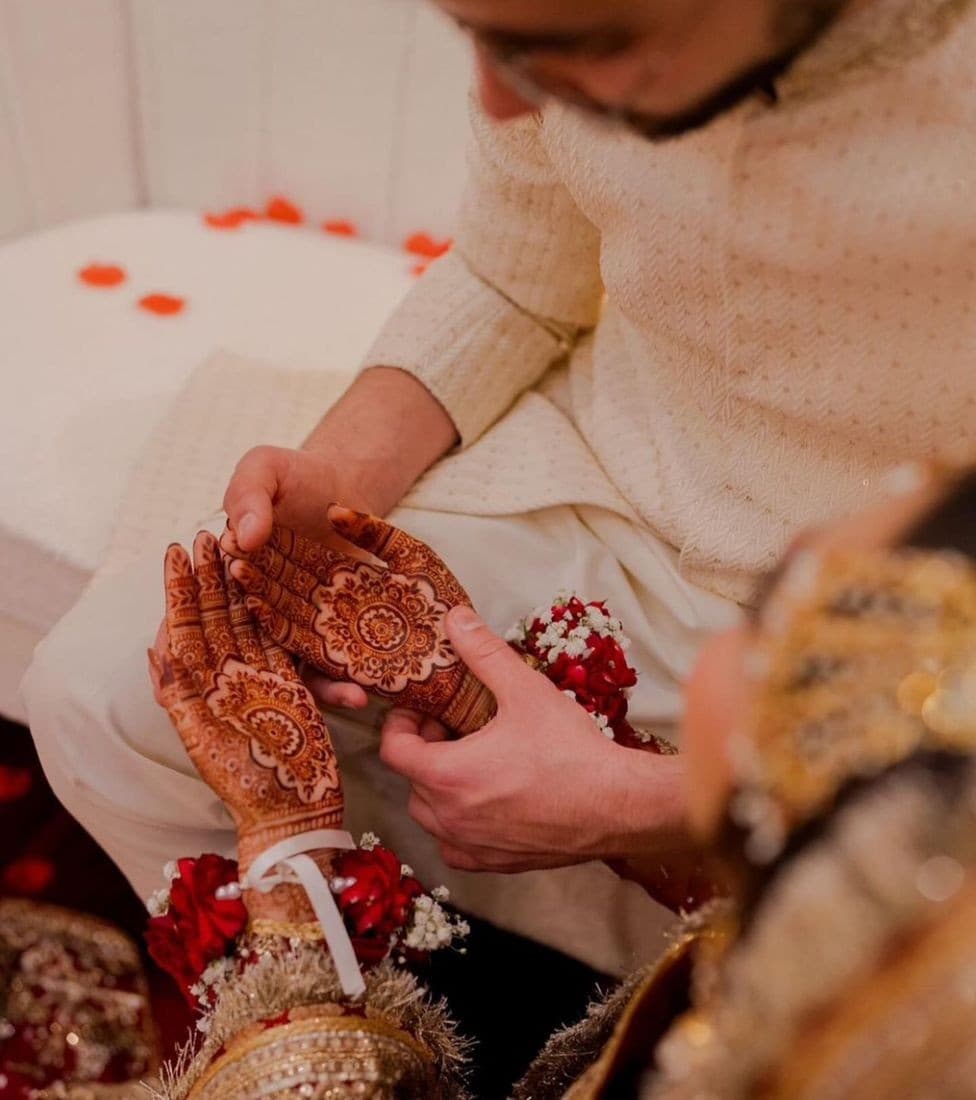
What to wear? The groom's mehndi look is the most relaxed of the week: a coloured kurta, a Nehru jacket or bandi, and sleeves that roll up. Our guide to the groom's wardrobe covers outfits for every function.
Sayings, beliefs and little superstitions
These are the lines every bride hears. Nobody really believes them, and everybody repeats them.
- "The darker the mehndi, the deeper the love." The most famous one. In Punjabi families, it's the mother-in-law's love being measured instead.2 In truth, the colour depends on the paste, the skin and how long the paste stays on.
- "No housework until it fades." A new bride is excused from household chores until her mehndi fades: a playful rule that gives her a little rest.
- "Keep it on as long as you can." Partly superstition, partly good science: the longer the paste stays, the more dye moves into the skin.
- "Whoever finds the name first wins." If the groom finds his name quickly, some say he'll have the upper hand in the marriage. If not, the bride does.
- "A dark stain brings luck." Unmarried girls who get mehndi at a wedding are teased that a dark stain means they'll be next.
Why it matters: these sayings are part of the fun. Just don't let them push anyone towards "black henna" or instant cones for a darker colour. Black henna is often blackened with PPD, a hair-dye chemical that can cause dangerous skin reactions.6 Natural henna, time and warmth are the only safe secrets.
The modern mehndi: what has changed and what hasn't
The mehndi has grown from an afternoon at home into, often, a full production. A few changes worth knowing:
- Joint and co-ed mehndis. Many couples now hold one mehndi for both families, especially at destination weddings, with men getting designs too.
- Themes and decor. Floral swings, Moroccan lanterns, boho floor seating, marigold canopies. The mehndi has become a decor event in its own right, and it shows in the budget: our guide to what a wedding really costs explains how extra functions add up.
- Combined functions. Haldi in the morning and mehndi after lunch, or mehndi in the afternoon and sangeet at night. If you combine haldi and mehndi and your family's customs allow, do the haldi first: turmeric scrubs and washing fade fresh mehndi.
- A menu for guests. Instead of every guest choosing from hundreds of photos, many hosts offer a short menu of designs, which keeps the queue moving.
- Professional artists. Bridal artists now come with a team, a portfolio and packages. Book early in wedding season.
What hasn't changed is the heart of it: the first dot, the songs, the feeding, the teasing and the long wait for the colour.
An example timeline for the day
This is an example, not a rule. Every family's day looks different, and your artist will tell you how long your bridal design will really take.
| Example time | What happens |
|---|---|
| Morning | The bride eats, dresses in something easy, and sets up a comfortable seat in good light |
| Late morning | A short prayer; an elder places the first dot; the bridal artist begins with the hands |
| Midday | Lunch for family (the bride is fed); the artist moves to the feet while the hands dry |
| Early afternoon | Guests arrive; assistant artists start guest designs; the dholak comes out |
| Afternoon | Songs, dances and games; the bridal design is finished and photographed |
| Evening | The groom's family visits or calls in, teasing about the hidden name begins; dinner |
| Night | The paste is sealed with lemon and sugar and kept on overnight |
| Next morning | The paste comes off; the colour reveal |
Keeping the meaning when you plan
A few practical ways to keep the rituals meaningful rather than rushed:
- Decide which rituals matter to each family. Ask both mothers before you plan the day. One might care about the mehndi being sent from the groom's side; the other might want the first dot from a grandmother.
- Give the bride's sitting a protected slot. Everything else fits around it. Book an experienced bridal artist early, and ask for an honest time estimate.
- Plan the guest queue. Ask the artist how many guest designs each assistant can do in an hour, and match it to the number of guests who want mehndi. Keeping your guest list on Shaadiwaale's guest list tool helps you count.
- Write the rituals into your checklist. The trial, the thaal, the first dot, the photographer's shot list: add them to your wedding checklist.
- Send a proper invitation. A mehndi invitation tells guests the time, the dress code and whether to come hungry. You can make one in the invitation studio and send it on WhatsApp.
- Find the right artist. Browse mehendi artists on Shaadiwaale in cities such as Chandigarh, Lucknow, Ahmedabad or Kochi.
For everything else, from aftercare to safety, read our complete guide to mehndi, and for where it all began, the history of mehndi.
Frequently asked questions
What is the meaning of the mehndi ceremony?
The mehndi ceremony is a pre-wedding ritual where the bride's hands and feet are decorated with henna. It marks one of her sixteen traditional adornments, brings blessings and good luck, and gathers both families for a relaxed afternoon of songs, food and teasing before the wedding.
Why is mehndi applied before marriage?
Mehndi is considered auspicious and a sign of joy, and for many Hindu brides it is part of the solah shringar, the sixteen adornments. Henna has been linked with brides for thousands of years across many cultures. Practically, it's applied a day or two before the wedding because the colour takes about three days to darken fully.
Who applies the first mehndi on the bride?
In many families an elder, such as the mother or grandmother, or a married woman of the family, places the first dot or small design on the bride's palm as a blessing, before the artist begins.
Who sends the mehndi to the bride?
In many Punjabi families, the bride's mehndi is sent by her future mother-in-law, decorated on a tray. In some Muslim families, the mehndi arrives on decorated trays, often with candles. Other families simply arrange it themselves through the artist.
Why is the groom's name hidden in the bride's mehndi?
It's a playful tradition: the groom has to find his name or initials hidden in the design. Some families say whoever finds it first will have the upper hand in the marriage. It also makes a lovely photo.
Does a dark mehndi mean my husband will love me more?
It's a much-loved saying, not a prediction. The colour depends on the quality of the henna, the skin (palms stain darkest), warmth and how long the paste stays on. Use natural henna and keep it on for as long as you can.
Does the groom have a mehndi ceremony?
Often, yes. In many families the groom gets a small shagun dot or a simple design, and in many Punjabi families, and some Muslim families, the groom's side holds its own mehndi celebration. Joint mehndis for both families are also popular now.
How many days before the wedding is the mehndi ceremony held?
Usually one or two days before the wedding, so the colour has had time to deepen by the wedding day. Natural henna starts orange and deepens to reddish brown over about three days.
Share this guide
Send it to the family group, or keep it for later.
Questions about your wedding?
Our team answers questions about venues, vendors and the budget, free on WhatsApp.
About Shaadiwaale
Indian wedding planning in one place: venues and vendors with real prices, free kundli matching, invitations and tools to plan every function together.
Every function. Every family. One plan.
Notes
- Henna: rituals, aesthetic and social practices, UNESCO Intangible Cultural Heritage, inscribed 2024. Henna as a symbol of joy at births and weddings; songs and poems; social bonds; medicinal uses. ↩
- Punjabi wedding traditions, Wikipedia. The mehndi sent by the future mother-in-law; mehndi and the sangeet; the jaggo; the mother-in-law saying (citing K. Myrvold, 2004). ↩
- Mehndi, Wikipedia. The hidden name; the dark colour saying; mehndi at weddings. ↩
- Henna, Wikipedia. The stain darkening over about three days. ↩
- Weddings in Pakistan: process and religion, Intersections, Duke University. The mehndi as the first wedding function; candles, sweets and dances; dholki and mayun. ↩
- Temporary tattoos, henna/mehndi, and "black henna": fact sheet, US Food and Drug Administration, content current as of 15 October 2024. ↩