Ideas
Karwa Chauth Mehndi Designs 2026: 12 Ideas, From the Moon and Sieve to Minimal
Karwa Chauth 2026 is on Thursday, 29 October. Twelve mehndi designs that tell the story of the day, from the moon and sieve to a tiny moon on one finger, what each motif means, and when to apply for a dark colour by the puja.
- Karwa Chauth 2026 is on Thursday, 29 October
- The moon, the sieve, the karva and the couple tell the story of the day
- Apply natural henna on 27 or 28 October for a dark colour by the puja
- Never use black henna or instant cones, least of all on children
Traditions · 9 min read · By The Shaadiwaale team · Updated 18 October 2026
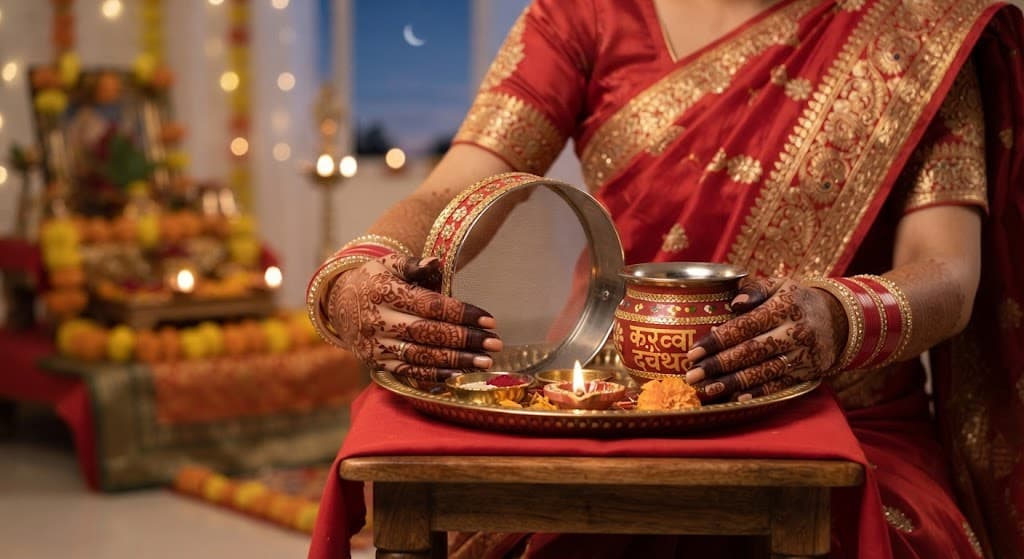
For many married women in North India, Karwa Chauth mehndi is one of the most special mehndi occasions of the year. The fast is long, the evening is beautiful, and the hands that hold the puja thali and the sieve deserve to look their best. Newly married women often go all out for their first one.
The best Karwa Chauth mehndi designs do more than look pretty. They tell the story of the day: the karva, the sieve, the moon, and the moment you finally see your husband's face. Here are twelve ideas, from a full storytelling hand to a tiny moon on one finger, plus when to apply it so the colour is at its best by moonrise.
Quick answer: Karwa Chauth 2026 is on Thursday, 29 October. The most loved Karwa Chauth mehndi designs tell the story of the fast: the moon, the sieve (chhalni, or channi in Punjabi) you look through, the karva pot the festival is named after, diyas from the evening puja, and the couple. Choose a full storytelling design for your first Karwa Chauth, a moon and sieve on the palm for something classic, or a small moon on a finger if you're short on time. Apply natural henna one or two days before, on 27 or 28 October, so the colour has deepened by the evening puja.
What's in this guide
- Karwa Chauth 2026: the date, the day and the mehndi
- The Karwa Chauth motifs and what they mean
- 12 Karwa Chauth mehndi designs to try
- How to get a dark colour by puja time
- Booking an artist for Karwa Chauth week
- Frequently asked questions
Karwa Chauth 2026: the date, the day and the mehndi
Karwa Chauth falls on Thursday, 29 October 2026 in India1.2 It is the fourth day after the full moon, and it's observed mainly in North and West India, from Delhi, Punjab and Haryana to Rajasthan, Uttar Pradesh and Madhya Pradesh.3
The day itself has a beautiful shape:
- Before dawn, the sargi. A meal eaten before sunrise. In Punjab it is traditionally sent or given by the mother-in-law.3
- All day, the fast. Married women fast from sunrise to moonrise for their husband's long life, usually without food or water.
- In the evening, the puja. Women dress in their finest, sit together with their puja thalis and hear the katha, the Karwa Chauth story (in many families, the tale of Queen Veeravati).
- At moonrise, the sieve. In many families, a woman looks at the moon through a sieve (some use a plate of water or a dupatta), then at her husband's face, and he gives her the first sip of water to break the fast.
And the mehndi? Traditionally, women apply mehndi to themselves and each other on the day itself;3 many now apply it a day or two earlier, so the colour is deeper by the evening. Moonrise times differ by city. In Jaipur, for example, the moon rises at about 8:25 pm on 29 October, though panchangs differ by a few minutes,1 so check your own city's time when you plan the evening.
The Karwa Chauth motifs and what they mean
Most Karwa Chauth designs are built from the same handful of motifs. Mix two or three of them, or tell the whole story across both hands. Meanings vary from family to family, so treat these as the usual ones, not rules.
| Motif | What it stands for | Where it looks best |
|---|---|---|
| Moon (chand), usually drawn full and round | The moment the fast ends | Centre of the palm, or the tip of a finger |
| Sieve (chhalni or channi) | Looking at the moon, then at your husband | Around the moon, as a mesh or a circle of dots |
| Karva (pot) | The festival itself; karva means a small earthen pot | The wrist, or the base of the palm |
| Diya and puja thali | The evening puja | Fingers, or a round centrepiece |
| The couple | You and your husband, often you holding the sieve | One on each palm, facing each other |
| Stars and small vines | The night sky, and a love that keeps growing | Fillers and fingers |
Want the deeper story behind the moon and other motifs? Read Mehndi motifs and their meanings.
12 Karwa Chauth mehndi designs to try
1. The full story, on both hands
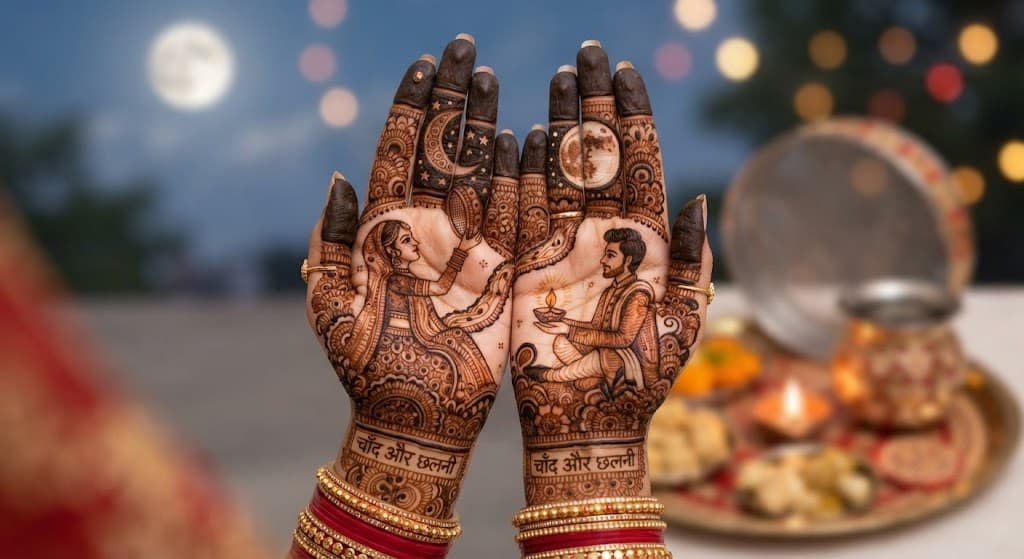
The classic Karwa Chauth design: the moon on one palm, a woman holding the sieve on the other, the karva at the wrist, and diyas and vines filling the fingers. It's the most detailed option and the most meaningful. Best for your first Karwa Chauth, and worth booking an experienced artist for.
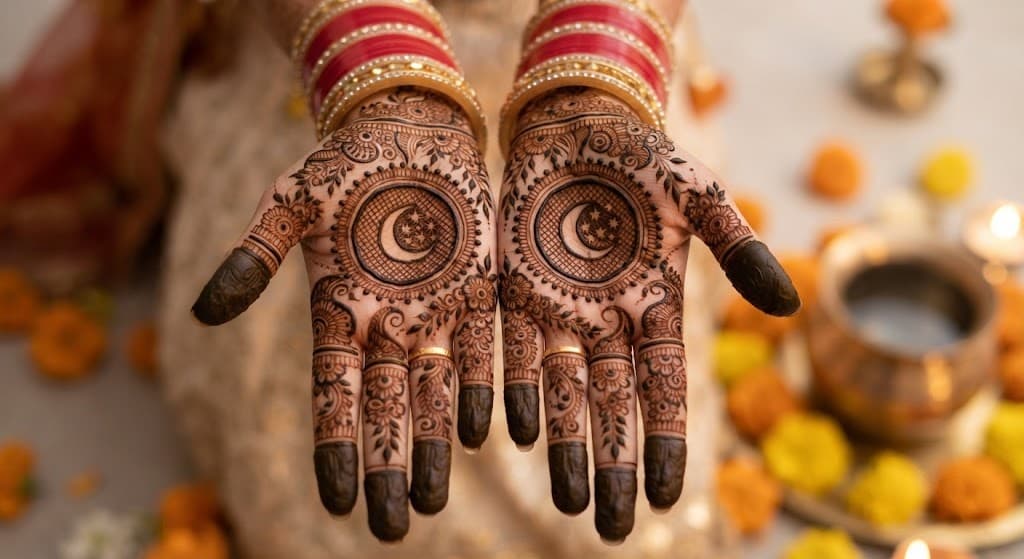
2. Moon and sieve as the centrepiece
A large round moon in the middle of the palm, wrapped in a sieve pattern like a mandala, with matching fingertip caps. It's simple, symmetrical and instantly recognisable. A good choice if you want meaning without sitting for hours.
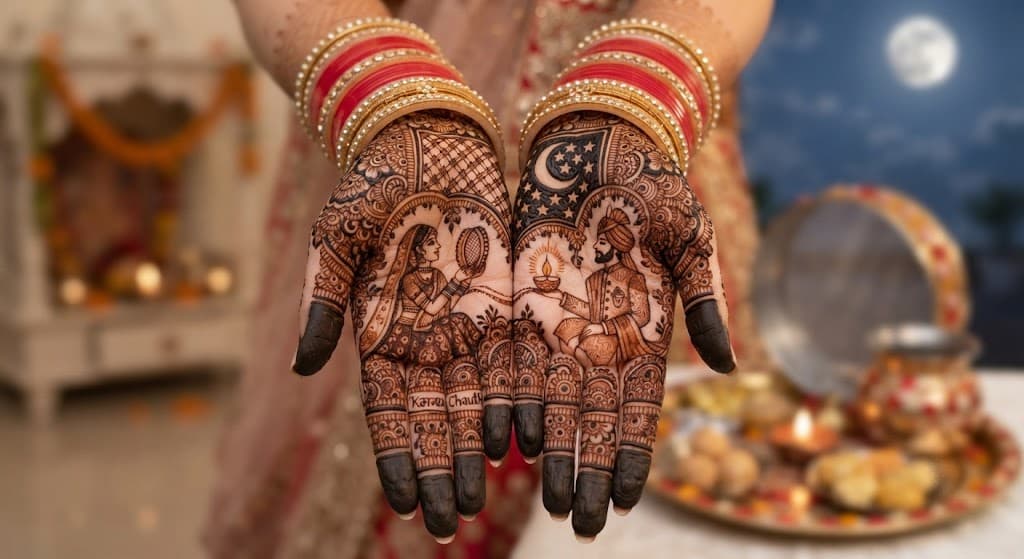
3. The couple, meeting across two palms
You on one palm holding the sieve, your husband on the other, drawn so that you face each other when you join your hands. It photographs beautifully at moonrise. Many newly married women add the wedding date in a band at the wrist.
4. Karva and diyas on the back of the hand
A karva pot at the wrist with a trail of diyas and leaves running up to the fingers. The back of the hand shows in every photo of you holding the thali, so this is where a lot of women put their effort.
5. Arabic trail ending in a moon
A bold Arabic floral trail across the back of the hand, finishing with a small moon on the index finger. Quick, elegant and easy to wear to work the next day. If you like this look, our guide to types of mehndi designs explains Arabic and the other styles.
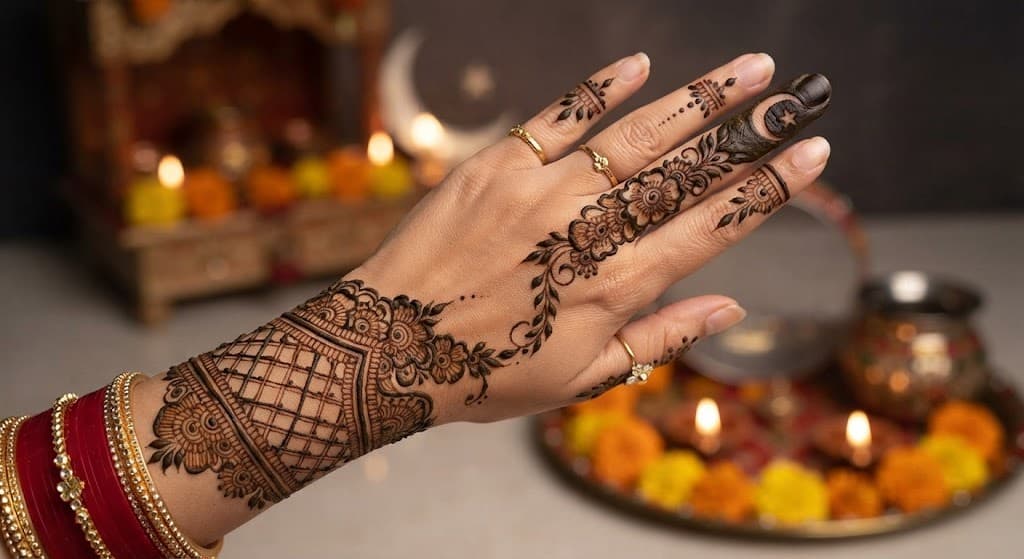
6. A tiny moon on the ring finger
The minimal option: a small moon and a few dots on the ring finger, maybe a fine band on the wrist. It takes minutes and suits women who don't usually wear mehndi, or who have a busy day before the puja.
7. The puja thali as a mandala
The thali drawn as a round centrepiece: a diya in the middle, a ring of small karvas and flowers around it, and a sieve pattern on the edge. A lovely alternative to a plain mandala.
8. Your first Karwa Chauth
Newly married? Many women treat their first Karwa Chauth like a second bridal mehndi: full hands, the couple, the wedding date, and your husband's name hidden somewhere for him to find at moonrise. Some add the words करवा चौथ (Karwa Chauth) in Devanagari at the wrist.
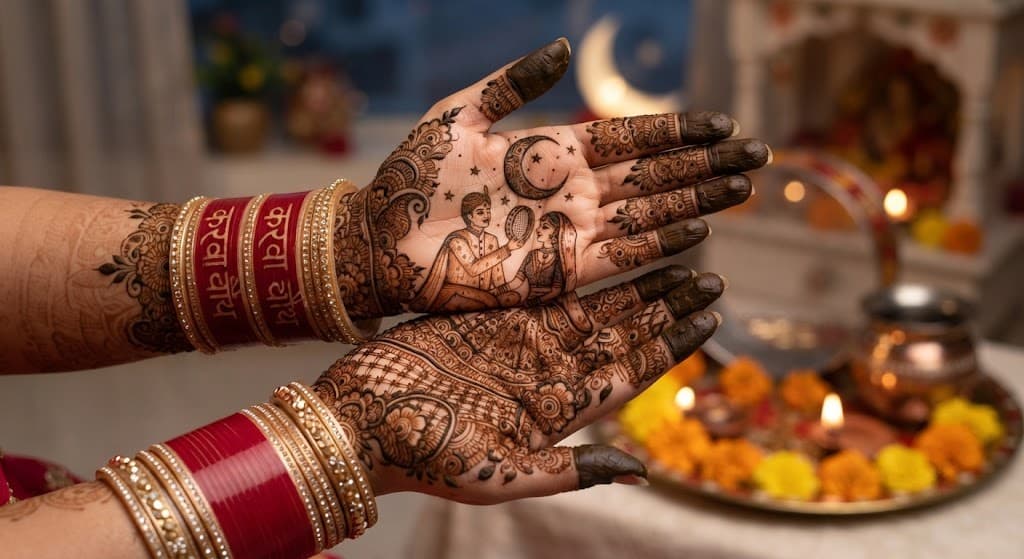
9. His initial inside the moon
A simple, romantic idea: draw the moon on the palm with your husband's initial inside it, or tucked into the sieve. It's quick, and it's the first thing he'll look for.
10. Moons on the feet
Many women decorate their feet for Karwa Chauth too. Try a payal (anklet) pattern of tiny moons and dots across the top of the foot, with filled toes. Do the feet first, so they're dry before you need to walk.
11. Lotus and moon on the back of the hand
A lotus at the wrist with a vine rising to a moon on the middle finger. The lotus is often read as purity and new beginnings, and the moon as the end of the fast, so it's a design with a quiet meaning on both ends.
12. Little moons for daughters
Young children don't usually fast, but they love joining in. A small moon and a star on a little palm, or a smiley moon, takes a minute. Keep it small, and never use black henna or "instant" cones on children.
How to get a dark colour by puja time
Natural henna stains orange first and darkens to reddish brown over about three days.4 That's why timing matters more than any trick.
- Apply one or two days before. For 29 October, that means the evening of 27 or 28 October. Same-day mehndi will still be orange at moonrise.
- Use natural henna. Ask your artist what's in the cone. Paste that promises black in an hour often contains PPD, a hair-dye chemical that can cause dangerous skin reactions.5 Health Canada's warning signs are a very dark black colour, a paste that sets very quickly, and little or no scent.6
- Keep it on. Leave the paste on for as long as you can, ideally overnight, and dab it with lemon and sugar once it's dry.
- Scrape, don't wash. Scrape the dried paste off rather than washing it, and keep your hands away from water for a few hours afterwards.
- Stay warm. Many artists say warmth helps the colour develop, so avoid sitting under the air-conditioning while it develops.
Our complete guide to mehndi has more on dark colour, aftercare and safety.
Booking an artist for Karwa Chauth week
Karwa Chauth week is a busy time for mehndi artists, and markets fill with mehndi stalls. If you want a particular artist, book now.
- Book a group. Sisters-in-law, neighbours and friends often book one artist together at home. Ask whether they charge per person, per hand or per design, and how long each person takes.
- Ask about the paste. Natural henna, freshly made, and what else is in it.
- Share your design. Send two or three references and the motifs you want, so the artist can plan the time.
Find mehendi artists in your city, for example in Delhi NCR, Chandigarh, Jaipur or Lucknow, and save designs you like to a board on Inspiration to show them.
Diwali comes ten days later, on Sunday 8 November: our Diwali mehndi designs has twelve more ideas, and what to do if your Karwa Chauth colour hasn't faded yet.
Frequently asked questions
When is Karwa Chauth in 2026?
Karwa Chauth 2026 is on Thursday, 29 October in India. Women fast from sunrise to moonrise, and moonrise times differ by city, so check your local time for the evening. Outside India, check a local panchang, as the date can differ.
When should I apply mehndi for Karwa Chauth?
Apply it one or two days before, on the evening of 27 or 28 October for Karwa Chauth 2026. Natural henna starts orange and takes about three days to darken, so applying it early means a deeper colour by the evening puja.
Which mehndi design is best for Karwa Chauth?
The most popular designs tell the story of the day: the moon, the sieve, the karva pot, diyas and the couple. For your first Karwa Chauth, a full storytelling design is a favourite. For something quick, a moon and sieve on the palm or a small moon on the ring finger looks lovely.
What do the moon and sieve mean in Karwa Chauth mehndi?
They show the end of the fast. At moonrise, many women look at the moon through a sieve, then at their husband's face, and he gives them water to break the fast. Drawing the moon and sieve in mehndi is a way of carrying that moment on your hands.
Can unmarried girls apply Karwa Chauth mehndi?
Yes. In some places unmarried women keep the fast too, and anyone can enjoy Karwa Chauth mehndi. Small moon, star and floral designs suit girls and young women.
How do I make my Karwa Chauth mehndi darker?
Use natural henna, apply it a day or two early, keep the paste on overnight, seal it with lemon and sugar, scrape it off instead of washing, and keep your hands out of the cold. Avoid "black henna" and instant cones, which can contain chemicals that harm the skin.
Share this guide
Send it to the family group, or keep it for later.
Questions about your wedding?
Our team answers questions about venues, vendors and the budget, free on WhatsApp.
About Shaadiwaale
Indian wedding planning in one place: venues and vendors with real prices, free kundli matching, invitations and tools to plan every function together.
Every function. Every family. One plan.
Notes
- Karva Chauth in Jaipur, Ved Panchang. The date of Karwa Chauth 2026 and the moonrise time in Jaipur. ↩
- Karwa Chauth 2026 date and time, Drik Panchang. The date, checked against a second panchang. ↩
- Karva Chauth, Wikipedia. When and where it is observed, the sargi, the fast, the karva, the evening puja and katha, the sieve and the moon, and mehndi on the day. ↩
- Henna, Wikipedia. The stain darkening over about three days. ↩
- Temporary tattoos, henna/mehndi, and "black henna": fact sheet, US Food and Drug Administration, content current as of 15 October 2024. ↩
- Black henna temporary tattoos, Health Canada. ↩