Ideas
Minimal Mehndi Designs 2026: 40 Ideas for Brides and Everyone Else
40 minimal mehndi designs for brides, sisters, bridesmaids, guests and engagements, with what makes a design minimal, how to keep it bridal and traditional, and how to plan it so the colour is dark on the day.
- 40 designs: bridal, family and bridesmaids, guests, engagement, everyday, grooms and feet
- Minimal is about negative space: one idea, fine lines, placed like jewellery
- Keep it bridal with symmetry, one area of detail and a hidden initial
- Always natural henna: never black henna or instant cones
Outfits and beauty · 17 min read · By The Shaadiwaale team · Updated 20 October 2026
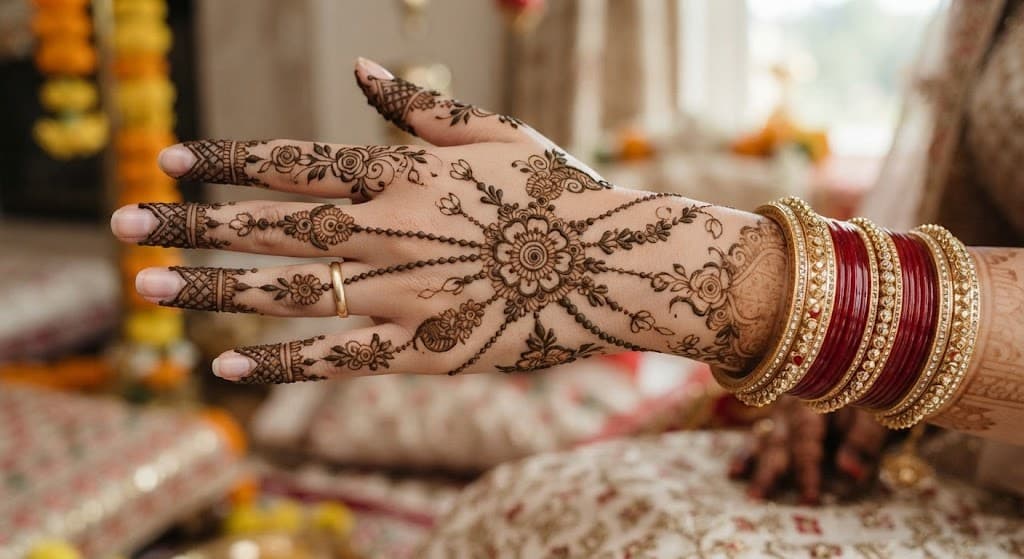
Some brides want their hands covered to the elbow. Others want a fine band at the wrist, a single line up the ring finger and a small motif in each palm, and nothing more. Neither is more correct. But the second choice, the minimal one, is harder to get right than it looks, because when there is so little on the skin, every line shows.
This guide has 40 minimal mehndi designs, for brides first and then for sisters, bridesmaids, guests, engagements, grooms and everyday wear. It explains what makes a design minimal, why many brides choose it, how to keep a minimal design feeling bridal and traditional, how to match it to your outfit and jewellery, and how to brief your artist so the finished hands look deliberate rather than unfinished.
Quick answer: Minimal mehndi designs are henna designs that use one or two small motifs, fine lines and a lot of bare skin, often arranged like jewellery: a hairline cuff, a single trail on the ring finger, a small palm rosette, capped fingertips or an initial. Minimal bridal mehndi keeps a bride's design light while keeping its meaning, and suits pastel outfits, statement rings and brides who want their hands to look clean in photographs. Because there is so little paste, a dark colour matters: apply it two days before and leave the paste on for hours. Use natural henna only.
What's in this guide
- What makes a mehndi design minimal?
- Why brides are choosing minimal mehndi
- Minimal mehndi designs at a glance
- Minimal bridal mehndi designs
- Minimal designs for sisters, mothers and bridesmaids
- Minimal designs for wedding guests
- Minimal designs for the engagement and roka
- Minimal designs for work and everyday
- Minimal mehndi for grooms
- Minimal feet mehndi
- Keeping tradition in a minimal design
- Making minimal mehndi look bridal
- Minimal mehndi with your outfit and jewellery
- Planning minimal bridal mehndi, step by step
- Briefing your artist
- Colour and aftercare for minimal designs
- Staying safe
- Frequently asked questions
What makes a mehndi design minimal?
A minimal design is defined less by what is on the skin than by what is left off it. Designers call the bare skin around and between the lines negative space, which means the space the design leaves empty on purpose. In a minimal design, the negative space is part of the design, not a gap waiting to be filled.
Most minimal designs share four things:
- One idea. A single motif, or two that answer each other, such as a band at the wrist and a ring on one finger.
- Fine lines. A thin, even line from a fine-tipped cone, with little or no heavy filling.
- Jewellery logic. Many minimal designs sit where jewellery would: bands like bangles, chains like a haath phool, the hand ornament that joins a bracelet to a ring, and rings on the fingers.
- Symmetry or deliberate balance. With so little on the skin, the eye notices if something is off-centre by accident.
Minimal is related to simple, but it is not the same. There is no official definition of either, and the words overlap, but as we use them, our guide to simple mehndi designs is about designs that are easy and quick to draw, and minimal is about how much is drawn. A minimal design can be quick, but fine line work leaves nowhere to hide, so a minimal bridal design still deserves an experienced artist and an unhurried sitting.
Why brides are choosing minimal mehndi
We know of no survey that counts how many brides choose minimal mehndi, but magazines and artists have been describing the shift for several years. In 2022, Vogue India profiled a mehendi artist, Prabhleen Kaur, whose minimalist, contemporary patterns "champion the use of negative space to dramatic effect", in the writer's words.1 Three years later, Elle India's roundup of designs trending in 2025 pointed to modern-day brides, celebrity brides among them, opting for minimalist designs.2 And in a May 2026 report from the UAE ahead of Eid al-Adha, Khaleej Times heard from henna artists that their younger clients prefer minimal, elegant patterns to very heavy traditional styles, with jewellery-style motifs in high demand.3
Brides choose it for different reasons. These are some of the most common:
- The outfit. Pastel lehengas, light chikankari and gowns can be overwhelmed by dense mehndi.
- The jewellery. A statement ring, a delicate haath phool or a stack of bangles shows better against open skin.
- The photographs. Clean lines read clearly in close-ups of the ring, the hands and the varmala.
- Life after the wedding. A light design fades gracefully and looks tidy back at work a week or two later.
- Comfort. A shorter sitting leaves more time and energy for the rest of a long day.
None of this means full bridal mehndi is going away. Full bridal hands remain the classic choice, and our bridal mehndi designs cover the whole range. Minimal is simply one well-loved choice among many.
Minimal mehndi designs at a glance
Here are seven of the designs below, with rough sitting times for both hands. Treat them as a starting point; your artist will give you a real estimate.
| Design | Where it goes | Rough sitting | Pairs well with | Good for |
|---|---|---|---|---|
| Five-chain haath phool | Back of the hand | About an hour | Rings on every finger | Brides |
| Palm medallion | Centre of each palm | About an hour | Bangles and a chura | Brides who want tradition |
| Hands-together heart | Both palms | Under an hour | Any outfit | Brides, couples |
| Ring finger trail | Ring finger | Under half an hour | An engagement ring | Engagement, roka |
| Initial charm | Wrist | Under half an hour | A thin bracelet | Bridesmaids |
| One-flower back | Back of the hand | A few minutes | Any outfit | Guests |
| Watch-strap line | Wrist | A few minutes | A watch | Work and everyday |
Minimal bridal mehndi designs
A minimal bridal design still needs to feel like a bride's. These twelve keep the skin open while holding on to meaning, detail or symmetry. The time after each is a rough guide for both hands: quick means half an hour or less, medium an hour or two.
- Five-chain haath phool. A small flower at the middle of the back of the hand, with five fine chains running to a ring on each finger, and a thin band at the wrist. It looks like jewellery and frames real rings beautifully. Time: medium.
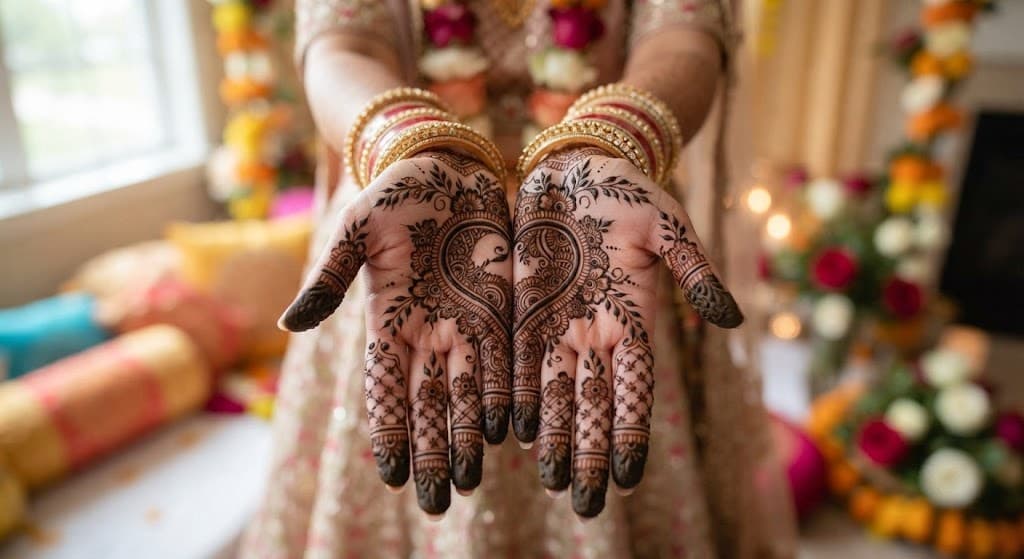
- Palm medallion. One detailed rosette in the centre of each palm, with capped fingertips and nothing else. All the fine work goes into the medallion. Time: medium.
- Initial in the lotus. A small lotus in one palm with the groom's initial hidden among its petals, and a matching lotus without the initial on the other. Time: quick to medium.
- Mirrored wrist cuffs. Matching fine cuffs on both wrists, each with a single small drop hanging towards the palm. Time: quick.
- Ring finger trail. A dotted trail with tiny leaves on both sides of the ring finger, ending in a small flower at the base of the finger. Time: quick.
- Date on a finger. The wedding date in small numerals along the side of the index finger, with a dot either side. Time: quick.
- Lace edge cuffs. A scalloped lace border at each wrist and lace caps on the fingertips, with the rest of the hand bare. Time: medium.
- Single peacock feather. One long feather sweeping from the wrist across the palm, its eye near the base of the fingers. Time: quick to medium.
- Doli outline. A tiny line drawing of a doli, the covered palanquin in which a bride traditionally leaves for her husband's home, in the centre of one palm, with a matching small motif on the other. Time: quick to medium.
- Knuckle bands. Fine bands across the knuckles of every finger, like a stack of thin rings. Time: quick.
- Minimal Arabic bride. One fine Arabic trail on the back of each hand, mirrored so the hands match when held together. Time: quick to medium.
- Hands-together heart. Half a heart on each palm, so that a whole heart appears when the hands are held side by side. Time: quick to medium.
Minimal designs for sisters, mothers and bridesmaids
The bride's family often want something that echoes her design without competing with it. Minimal designs do that well. Every one of them takes half an hour or less for both hands.
- Sister's echo. The bride's main motif, drawn small on the back of the hand. Time: quick.
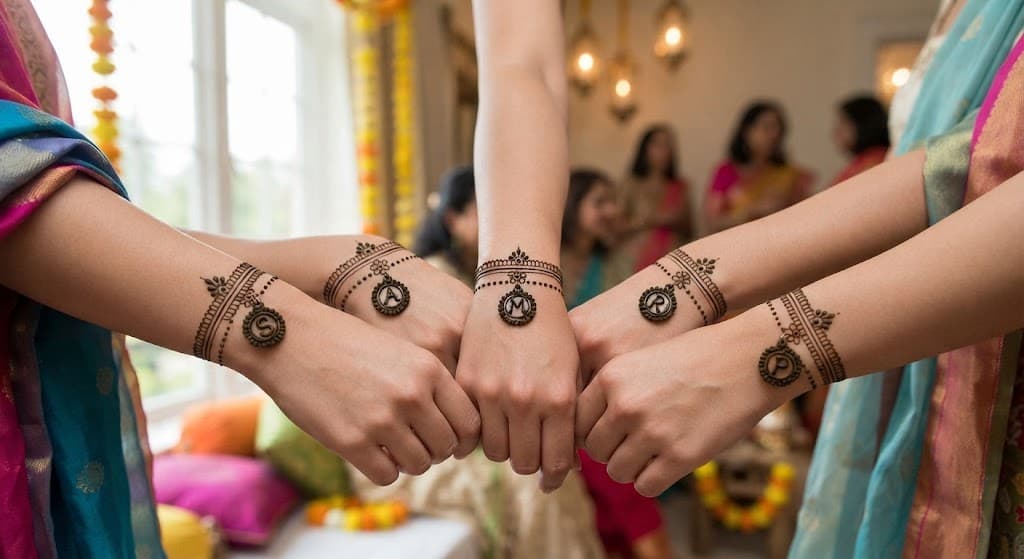
- Bridesmaid bands. The same fine band on every bridesmaid's wrist, so they look like a set in photographs. Time: quick.
- Mother's lotus. A single lotus in one palm, with capped fingertips on both hands. Time: quick.
- Cousin's fingertips. Capped fingertips with one fine dotted line down the middle finger. Time: quick.
- Initial charm. Each bridesmaid's own initial on the wrist, hanging from a fine band like a charm on a bracelet. Time: quick.
- Matching moons. A tiny crescent on the side of the same finger for every sister. Time: quick.
Minimal designs for wedding guests
Guests at a mehndi function often have only a few minutes with the artist. These are quick, neat and easy to wear with any outfit.
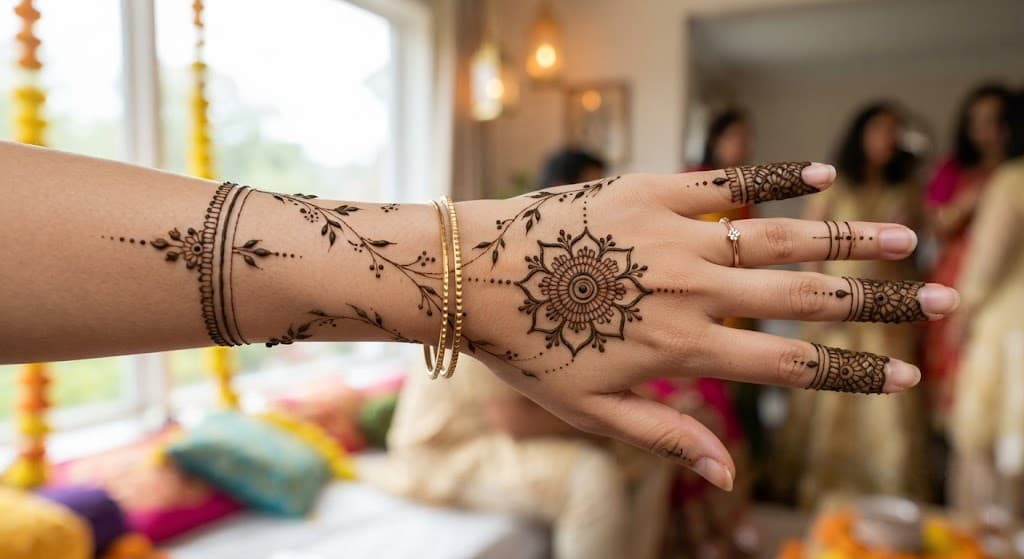
- One-flower back. A single fine-line flower on a short stem, placed just below the knuckles. Time: quick.
- Dotted cuff. Two rows of dots around the wrist, nothing more. Time: quick.
- Leaf on the side. One leaf along the side of the index finger, visible when you hold a glass. Time: quick.
- Three dots and a line. A short line down the middle finger with three dots below it, for a crisp, graphic look. Time: quick.
- Mandala quarter. A quarter of a fine mandala tucked into the corner of the palm, below the little finger. Time: quick.
- Thumb ring. A fine band with one dot at the base of the thumb. Time: quick.
Minimal designs for the engagement and roka
At an engagement, all eyes are on one finger. Minimal designs keep it that way.
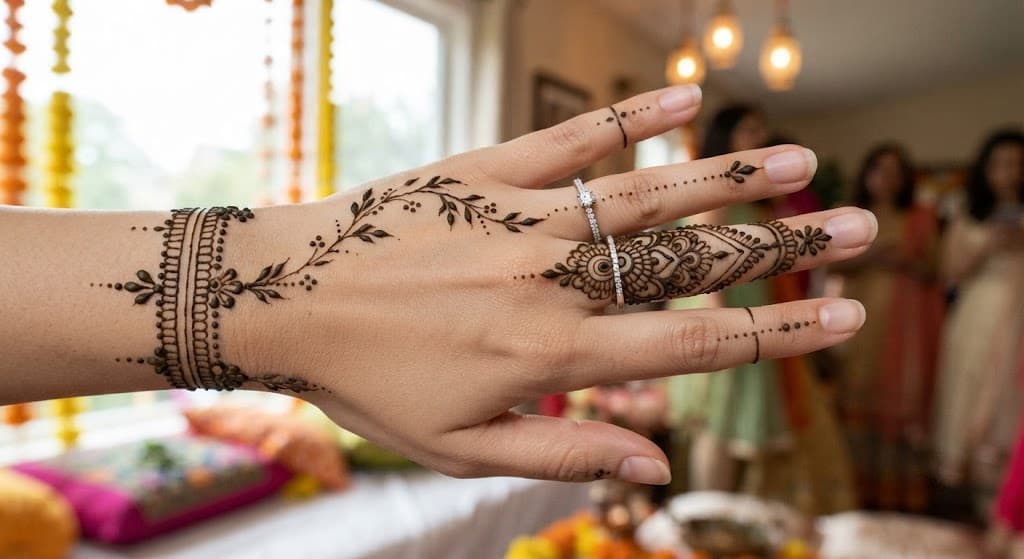
- Ring frame. Two fine lines on either side of the ring finger, leaving the space where the ring sits bare. Time: quick.
- Two initials. Both your initials, joined by a tiny heart, on the side of the ring finger. Time: quick.
- Promise vine. A fine vine running from the ring finger across the back of the hand to the wrist. Time: quick.
- Petal ring. A ring of tiny petals at the base of the ring finger, like a flower the ring sits in. Time: quick.
Minimal designs for work and everyday
Minimal designs are the easiest mehndi to wear back to work or college. Choose places you can show or hide.
- Watch-strap line. A fine band at the wrist, under where a watch strap sits. Time: quick.
- Inner finger dots. A line of dots on the inner side of the fingers, seen only when you open your hand. Time: quick.
- Sleeve-edge band. A thin band just above the wrist bone, at the edge of a full sleeve. Time: quick.
- Single star. One small five-pointed star on the back of the hand, below the knuckle of the little finger. Time: quick.
- Knuckle seeds. A tiny teardrop on each knuckle, all pointing towards the fingertips. Time: quick.
- Half-moon caps. A thin crescent across each fingertip instead of a full cap. Time: quick.
Minimal mehndi for grooms
Mehndi is applied on the groom as well as the bride at many mehndi functions,4 and minimal designs suit most grooms.
- Thin initial. The bride's initial in fine lines in the centre of the palm. Time: quick.
- Palm circle line. A single thin circle in the palm, open in the middle. Time: quick.
- Single band. One fine geometric band around the wrist. Time: quick.
Minimal feet mehndi
Soles and palms have the thickest skin, so the soles take some of the darkest stains,5 and even on the top of the foot a little goes a long way. Our feet mehndi designs have 50 ideas.
- Toe-ring line. A fine band on the second toe, where a toe ring would sit, and capped big toes. Time: quick.
- Ankle thread. A single dotted line around the ankle, like a fine anklet. Time: quick.
- Instep motif. One small motif on the top of each foot, matching the bride's palms. Time: quick.
Keeping tradition in a minimal design
For many families, a bride's mehndi is not only decoration. Customs vary widely, and in some families full hands are expected. A minimal design does not have to drop the meaning; it can carry it in fewer lines.
- Keep one traditional motif. A doli, a lotus, a peacock feather or a small kalash, the pot of plenty, drawn finely, keeps the link to tradition. Our guide to mehndi motifs and their meanings explains what each is said to stand for.
- Hide the groom's name. An initial hidden in a motif works as well in a minimal design as in a full one, and it is easier to find.
- Split the difference. Fuller palms with minimal backs, or minimal hands with traditional feet, can satisfy everyone.
- Talk to your family early. If your grandmother is expecting full hands, it helps to show her photographs of the design you have in mind well before the mehndi, rather than on the day.
Making minimal mehndi look bridal
The line between a minimal bridal design and a guest's design is in the details.
- Symmetry. Make the two hands match, or mirror each other exactly. The artist Prabhleen Kaur said in a Vogue India profile, "I like a sense of symmetry when I create mehendi",1 and in a minimal design symmetry does much of the work.
- One area of fine detail. Put the detail in one place, such as a palm medallion or a haath phool centre, and keep everything else very light.
- Hands and feet as one set. Repeat the same motif on the feet so the whole look is planned, unless it is a sacred symbol, which many families keep off the feet.
- A darker colour. With so little paste, a pale stain looks unfinished. The timing and aftercare below matter more than usual.
- Clean edges. End bands and cuffs with a crisp line, not a fade.
Minimal mehndi with your outfit and jewellery
Minimal mehndi works best when it is planned with what you will wear.
- Pastel lehengas and light fabrics. Fine bands and a single motif keep the look soft.
- A statement ring. Frame the ring finger, or leave it completely bare, so the ring is the centre of attention.
- A chura or many bangles. Keep the wrist clear, or end the design just below the bangles, so the two do not compete.
- A haath phool. Either wear the real one and keep the back of the hand bare, or draw a mehndi haath phool and skip the jewellery.
- Western outfits and gowns. Geometric bands, a single flower or knuckle bands suit clean lines.
Khaleej Times reported jewellery-style motifs and wrist-length designs with finer detailing in high demand among UAE henna clients in 2026;3 many minimal designs borrow from jewellery in the same way.
Planning minimal bridal mehndi, step by step
A minimal design still needs the same planning as any bridal mehndi. Our bridal mehndi designs guide has the full timeline; here it is with the minimal points added.
- Three to four months before: book your artist. Look specifically for minimal work on real hands, and book early for a busy winter date.
- Three to four weeks before: patch test and trial. Use the artist's own paste, watch the test spot for two weeks, and try out the fine-line motif you have in mind on one hand.
- Two weeks before: fix the design. Agree every element, where it sits and where it stops, and the spelling and script of any initial or date.
- Two to three days before the mehndi: finish your grooming. Waxing, threading and manicures come before the paste, not after, with a gentle scrub the day before.
- Two days before the wedding: the sitting. Arrive with clean, dry hands and feet, with no cream or oil.
- That evening and night: keep the paste on. Seal it lightly and leave it on for as long as you can, overnight if possible.
- The next morning: lift it off, do not wash it off. Then keep water away for a while, and let the colour darken by the wedding day.
Briefing your artist
A minimal design is only as good as its lines, so choose and brief your artist with care.
- Ask to see minimal work on real hands. A portfolio of full bridal hands does not show how clean their fine lines are.
- Bring three to five reference photos. Point out exactly what you like: the band, the spacing, the bare skin.
- Agree the placement. Say where each element goes and where the design stops, on each hand and foot.
- Ask for a fine tip. Minimal designs need a fine, steady line from a well-made cone.
- Allow enough time. A short sitting is not a rushed one. Fine, symmetrical work takes care.
You can find mehendi artists on Shaadiwaale in cities such as Delhi NCR, Bengaluru, Pune and Kochi.
Colour and aftercare for minimal designs
With so little on the skin, a pale stain shows more, so give a minimal design every chance to stain well.
- Apply it two days before. Henna stains are orange when the paste comes off and darken over about three days,5 so two days before the wedding is best and one day at the latest.
- Keep the paste on. Four to six hours is the minimum, and more time on the skin means a deeper, longer-lasting colour.5
- Seal it gently. A light dab of lemon and sugar over the dry paste helps it stay on;5 with fine lines, dab rather than wipe.
- Scrape, do not wash. Lift the dry paste off and keep water away from your hands for a while afterwards.
- Expect a gentle fade. The stain holds its peak for a few days, then fades bit by bit with the skin's outer layer, usually over one to three weeks.5 In our experience, open designs look tidier than dense ones while they fade.
Staying safe
However little you have, make it natural henna, and say no to black henna and "instant" cones. The dark colour of black henna often comes from PPD, an ingredient the FDA links to dangerous skin reactions in some people.6 Watch for Health Canada's three signs, a very dark black colour, a paste that sets very fast and little or no scent; a reaction to PPD may appear 1 to 14 days after contact.7 Brides should try a dot of their artist's own paste a few weeks before the wedding and watch it for two weeks, as our bridal guide explains. Doctors reporting a serious case in a WHO journal advise against henna for babies in general and for anyone with G6PD deficiency at any age.8
Frequently asked questions
What is a minimal mehndi design?
A minimal mehndi design uses one or two small motifs, fine lines and a lot of bare skin, often placed where jewellery would sit: a cuff, a ring line, a palm rosette or capped fingertips. The bare skin is part of the design, so the few lines that are there need to be clean and well placed.
Is minimal mehndi suitable for a bride?
Yes. It suits brides who want their hands light, especially with pastel outfits and statement rings. To keep it bridal, put fine detail in one place, such as a palm medallion or a haath phool, make the hands match, echo the motif on the feet and hide the groom's initial. Plan for a dark colour, since there is little paste.
How long does minimal bridal mehndi take?
Usually much less than full bridal mehndi: from about half an hour to two hours for both hands, depending on the detail. Fine, symmetrical work still takes care, so do not book it as a rushed slot. Ask your artist for an estimate based on your reference photos, and add time for the feet.
What is the difference between minimal and simple mehndi?
There is no official definition, and the words overlap, but as we use them, simple mehndi is about how easy and quick a design is to draw. Minimal mehndi is about how little is drawn: one idea, fine lines and open skin. They often overlap, but a minimal bridal design with fine symmetrical lines can be harder to draw well than a simple guest design.
Can I hide the groom's name in a minimal design?
Yes, and he may even find it more easily. Hide his initial among the petals of a small lotus, inside a palm medallion or in a band at the wrist. Agree the spelling and the script with your artist beforehand, and keep it small so it does not dominate the open design.
Will minimal mehndi look good in wedding photographs?
Yes, if the lines are clean and the colour is dark. Minimal designs show clearly in close-ups of the ring, the hands and the varmala, and they do not compete with jewellery. Apply it two days before, keep the paste on for hours and keep water away afterwards, so the stain is deep on the day.
How do I make minimal mehndi darker?
Leave the paste on for four to six hours as a minimum, more if you can, and seal it with a light dab of lemon and sugar. Lift the dry paste away instead of washing it, then keep your hands dry for a while. Have it applied two days before the day itself, since the stain takes about three days to darken fully.
What jewellery goes with minimal mehndi?
Almost any, which is part of its appeal. A statement ring looks best with a framed or bare ring finger; a chura or bangles look best with a clear wrist; a haath phool looks best on a bare back of the hand. If you draw a mehndi haath phool instead, keep real jewellery simple.
Share this guide
Send it to the family group, or keep it for later.
Questions about your wedding?
Our team answers questions about venues, vendors and the budget, free on WhatsApp.
About Shaadiwaale
Indian wedding planning in one place: venues and vendors with real prices, free kundli matching, invitations and tools to plan every function together.
Every function. Every family. One plan.
Notes
- 'I like a sense of symmetry when I create mehendi', says Prabhleen Kaur, Asia Samachar, 13 March 2022, excerpted from Vogue India (Arushi Sinha, 11 March 2022). A mehendi artist whose minimalist patterns use negative space; her quote on symmetry. ↩
- From Arabic to minimalist: 10 stunning mehendi designs trending in 2025, Elle India, Tanvee Khanna, 16 September 2025. Modern brides opting for minimalist designs. ↩
- Hengua to minimalistic motifs: UAE henna artists reveal top designs for Eid Al Adha, Khaleej Times, Nasreen Abdulla, 26 May 2026. Younger clients preferring minimal, elegant patterns; jewellery-style motifs and wrist-length designs with finer detailing in high demand. ↩
- Mehndi, Wikipedia. Mehndi applied on the bride and groom. ↩
- Henna, Wikipedia. Palms and soles with the thickest skin; the stain orange at first and darkening over about three days; paste on for at least four to six hours; sealing with lemon and sugar; fading within one to three weeks. ↩
- Temporary tattoos, henna/mehndi, and "black henna": fact sheet, US Food and Drug Administration. Black henna and PPD. ↩
- Black henna temporary tattoos, Health Canada. Warning signs of black henna; reactions 1 to 14 days after contact. ↩
- Life-threatening haemolysis induced by henna in a Sudanese child with glucose-6-phosphate dehydrogenase deficiency, Eastern Mediterranean Health Journal (WHO), volume 23, 2017. Henna to be discouraged in infants in general and in G6PD-deficient people of any age. ↩