Ideas
Feet Mehndi Designs 2026: 50 Simple, Arabic, Bridal and Leg Ideas
50 feet and leg mehndi designs, from dotted toes to full bridal feet, with the seven basic layouts, the traditions behind them, what to wear on your feet and how to sit, dry and walk without smudging.
- 50 designs: simple, payal, Arabic, toes, sole, leg, bridal, festival and for grooms
- Choose the layout first, and choose it for the shoes you will wear
- Soles take one of the deepest stains, so plan to sit while the paste dries
- Always natural henna: never black henna or instant cones
Outfits and beauty · 17 min read · By The Shaadiwaale team · Updated 20 October 2026
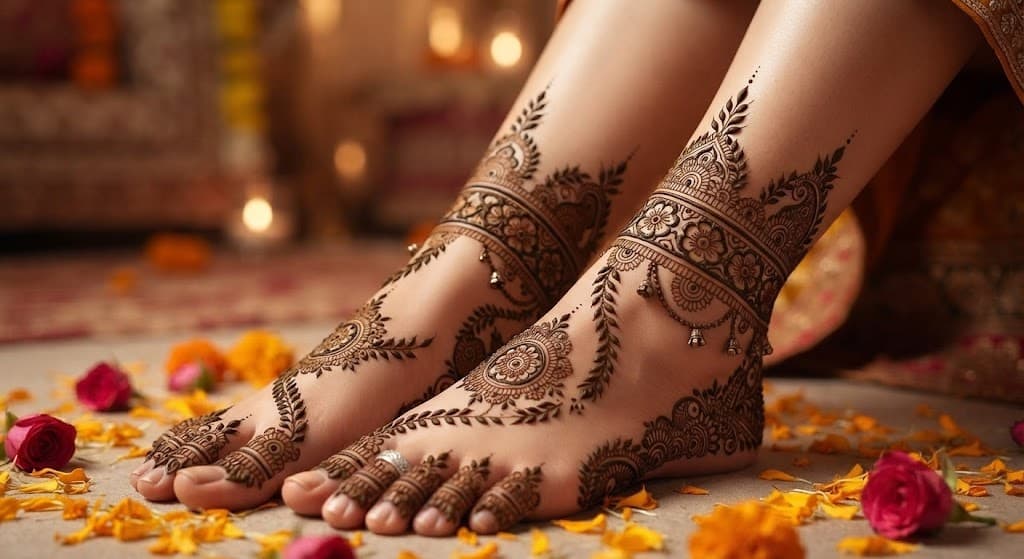
Feet are the part of mehndi that everyone forgets until the last minute, and then wishes they had planned. A bride's feet show every time she steps forward in the pheras; a woman's feet show in her Karwa Chauth puja photographs; anyone in sandals at a summer wedding shows her feet all evening. And feet hold the colour beautifully: the soles stain as deeply as the palms.
Below are 50 feet and leg mehndi designs, starting with a few dots on the toes and building up to full bridal feet and vines that climb the leg. They are sorted by part of the foot and by occasion. You will also find the traditions behind feet mehndi, the basic layouts, how to sit, dry and walk without smudging, what to wear on your feet, and a simple design to draw yourself.
Quick answer: Feet mehndi designs are henna patterns for the toes, the top of the foot, the sole and the ankle, and leg designs carry on up the shin or calf. Common designs include payal (anklet) patterns, a floral band across the top of the foot with capped toes, Arabic trails from the big toe to the ankle, and full bridal feet. Because soles and palms have the thickest skin, feet take some of the darkest, longest-lasting stains. Walking is off until the paste dries, so set aside time to rest, and book your feet two days ahead of the function if you can. Use natural henna only.
What's in this guide
- Why feet mehndi is different
- Feet mehndi traditions
- The feet mehndi layouts
- Simple feet mehndi designs
- Payal and anklet mehndi designs
- Arabic feet mehndi designs
- Toe mehndi designs
- Sole mehndi designs
- Leg mehndi designs
- Bridal feet mehndi designs
- Feet mehndi designs for festivals
- Feet mehndi for grooms
- Before your feet mehndi
- Sitting, drying and walking
- Feet mehndi and footwear
- How to draw a simple feet design
- Getting a dark colour on the feet
- Feet mehndi mistakes to avoid
- Staying safe
- Frequently asked questions
Why feet mehndi is different
It takes a deep colour. Soles and palms have the thickest layer of skin, so hands and feet take the darkest and most long-lasting henna stains.1 A sole design can look almost maroon when it is at its best.
It stops you walking. Once the paste is on, you need to stay put until it dries, and ideally keep it on for hours more. That changes how you plan the day, and it is why many artists do the feet while the hands are drying, or the other way round.
It meets your footwear. Sandals, juttis, kolhapuris, heels and closed shoes all show a different part of the foot. Choose the design for the shoes you will actually wear.
It sits with your jewellery. Payal (anklets) and toe rings are part of many women's everyday or bridal jewellery, and a good feet design frames them instead of hiding under them.
Feet mehndi traditions
Decorating the feet has a long history too. Some ancient wall paintings show women whose nails, palms and soles carry marks that are consistent with henna, though that is a reading of the pictures, not proof,1 and in India, Hindu women have motifs on their hands and feet for occasions such as weddings and engagements.1 Customs vary from family to family, so take these as broad patterns, not rules.
- Weddings. The bride's feet are often decorated along with her hands, and many artists design the two as a set.
- Bengal. Alta, the red dye also called mahavar, has long coloured women's hands and feet for marriage in Bengal,2 and some Hindu women apply mehndi instead of, or along with, alta on their feet during the Bodhu Boron ceremony.1
- Teej. Sinjara, the eve of Haryali Teej, is a day for mehndi on the hands and the feet.3
- Sindh. The groom's female relatives usually put henna on his hands and feet as part of the wedding ritual.1
- Beyond South Asia. In Saudi Arabia, the bride's hands and feet are decorated with henna patterns before the wedding, and young Somali women have henna on their hands and feet as they prepare to marry.1
That sense of celebration crosses borders. In 2024 UNESCO added the henna traditions of sixteen Arab countries to its heritage list, describing henna as "a symbol of joy" that belongs to births, weddings and everyday life.4
The feet mehndi layouts
Seven layouts cover most feet designs. Pick the layout before the style, and treat the times as a rough guide until your artist sees your feet.
| Layout | Where it goes | Time | Suits | Footwear |
|---|---|---|---|---|
| Toes and a band | Capped toes and one band across the top of the foot | Quick | Festivals, guests, everyday | Any sandal |
| Payal | A pattern ending at the ankle like an anklet | Quick to medium | Brides, Karwa Chauth, festivals | Sandals, juttis |
| Centrepiece | One motif, such as a mandala or a flower, on the top of the foot | Quick | Minimal looks | Open sandals |
| Arabic trail | Flowers sweeping from the big toe over the instep towards the ankle | Quick to medium | Guests, modern brides | Sandals, heels |
| Sole | A mandala or pattern on the sole | Quick to medium | Brides, traditional families | Any, once the paste is off |
| Leg | A vine or band climbing the ankle, shin or calf | Medium to long | Beach and poolside functions, short outfits | Sandals |
| Full bridal | The whole top of the foot and often the sole, to the ankle or beyond | Long | Brides | Juttis, sandals |
Simple feet mehndi designs
These designs are for festivals, family functions and anyone who wants colour on the feet without a long sitting. The time after each one is rough: quick means no more than about thirty minutes, medium an hour or two, and long several hours or more.
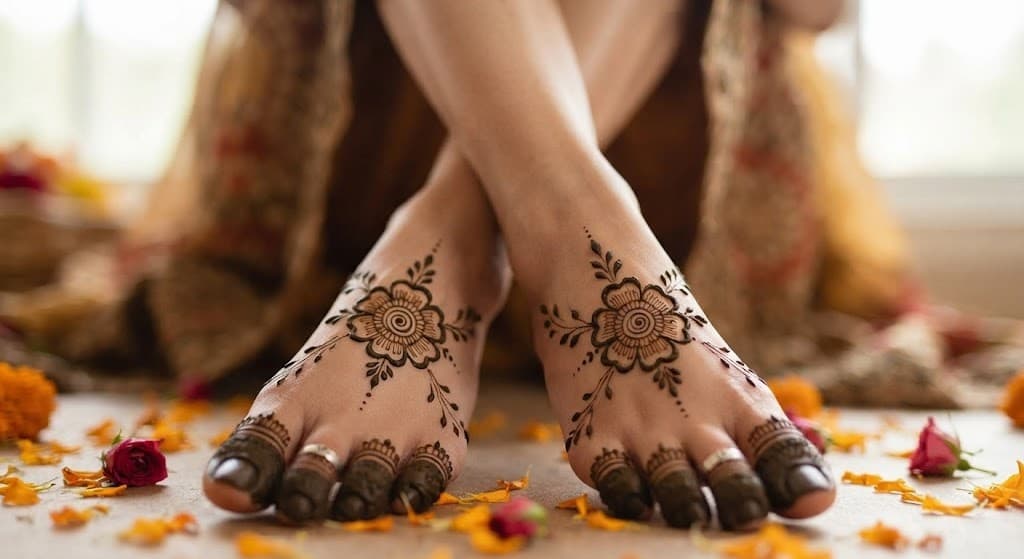
- Capped toes and dots. Every toe capped with paste and a row of dots across the base of the toes. Time: quick.
- One flower. A single five-petal flower on the top of the foot, with a dot in each petal. Time: quick.
- Dotted curve. A curving line of dots from the big toe towards the inner ankle. Time: quick.
- Two leaves. Two leaves crossing on the top of the foot, with the big toe capped. Time: quick.
- Mini mandala. A small mandala in the centre of the top of the foot. Time: quick.
- Big-toe vine. A fine vine wrapping the big toe and running a short way up the foot. Time: quick.
- Ankle dots. A ring of dots around the ankle and nothing else. Lovely with a thin anklet. Time: quick.
- Half mandala at the toes. A semicircle of petals at the base of the toes, opening towards the ankle. Time: quick.
- Heart and dots. A tiny heart on the top of the foot with a dotted trail to the second toe. Time: quick.
Payal and anklet mehndi designs
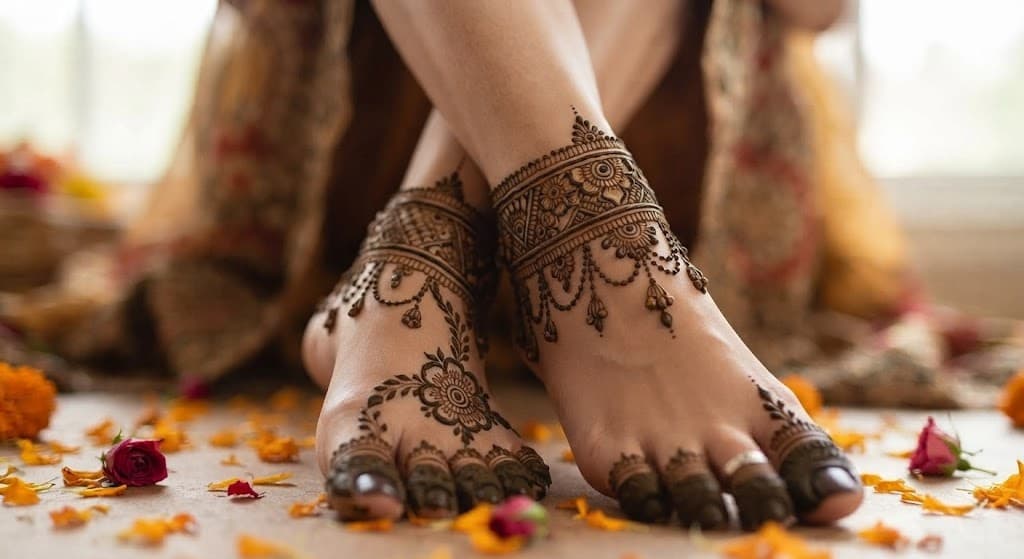
Payal means anklet, and a payal design ends at the ankle in a band, often with small drops or bells hanging from it, so the mehndi looks like jewellery.
- Classic payal. A band of florals around the ankle with tiny drops hanging towards the foot, and capped toes. Time: medium.
- Bell payal. A fine band with small bells drawn along its lower edge. Time: medium.
- Chain to the toe. A band at the ankle with a single chain running down the top of the foot to the second toe, like a foot ornament. Time: quick to medium.
- Double band. Two thin bands at the ankle with a row of dots between them. Time: quick.
- Lace payal. A scalloped lace edge around the ankle with a fine net above the toes. Time: medium.
- Moon payal. A band of tiny moons and dots around the ankle, lovely for Karwa Chauth. Time: quick to medium.
Arabic feet mehndi designs
An Arabic trail follows the natural line of the foot, which is why it looks so good there. Our guide to Arabic mehndi designs has more Arabic ideas.
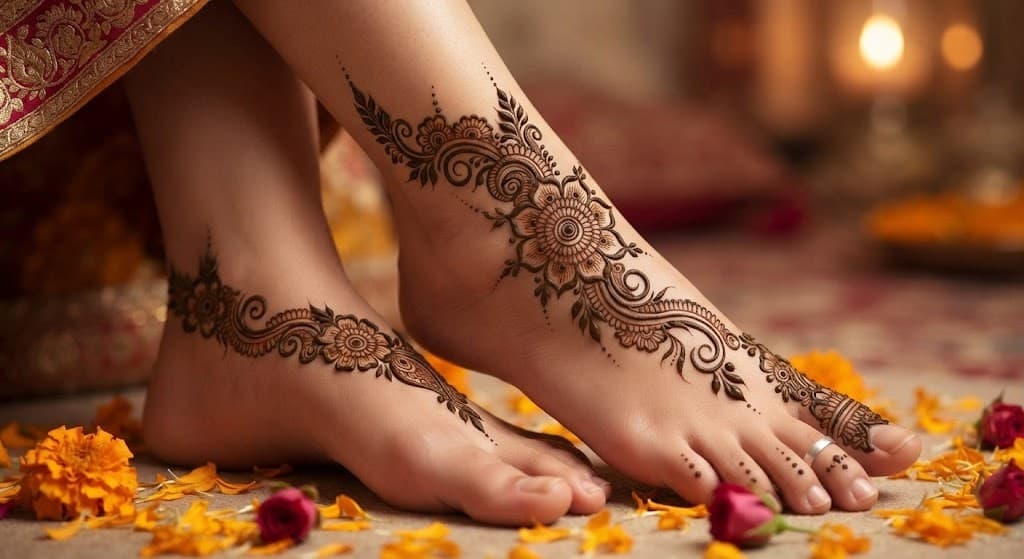
- Big toe to ankle. Bold shaded flowers sweeping from the big toe across the instep to the outer ankle. Time: quick to medium.
- Inner edge trail. Leaves and small blooms running along the arch side of the foot, from heel to big toe, so they show in a sandal. Time: quick.
- Rose and leaves. Two shaded roses on the top of the foot with leaves trailing towards the toes. Time: quick.
- Trail and payal. An Arabic trail that ends in a leafy band around the ankle. Time: medium.
- Mirror trails. Trails on both feet running in opposite directions, so the feet look balanced side by side. Time: medium.
- Khafif foot. One big flower with a heavy outline and lots of bare skin, for a bold modern look. Time: quick.
Toe mehndi designs
Toes are small, but a little detail there finishes any feet design. In India, toe rings, called bichiya in Hindi, are worn by Hindu women as a sign that they are married, usually on the second toe of both feet and usually in silver,5 so many designs leave room for them.
- Full caps. Every toe filled with paste, the simplest toe design of all. Time: quick.
- Half caps. The top half of each toe filled, in a crescent. Time: quick.
- Toe rings. A thin band drawn on the second toe, where a bichiya would sit, with dots on the others. Time: quick.
- Big-toe flower. A small flower on the big toe with the others capped. Time: quick.
- Dotted toes. Three dots in a triangle on each toe. Time: quick.
Sole mehndi designs
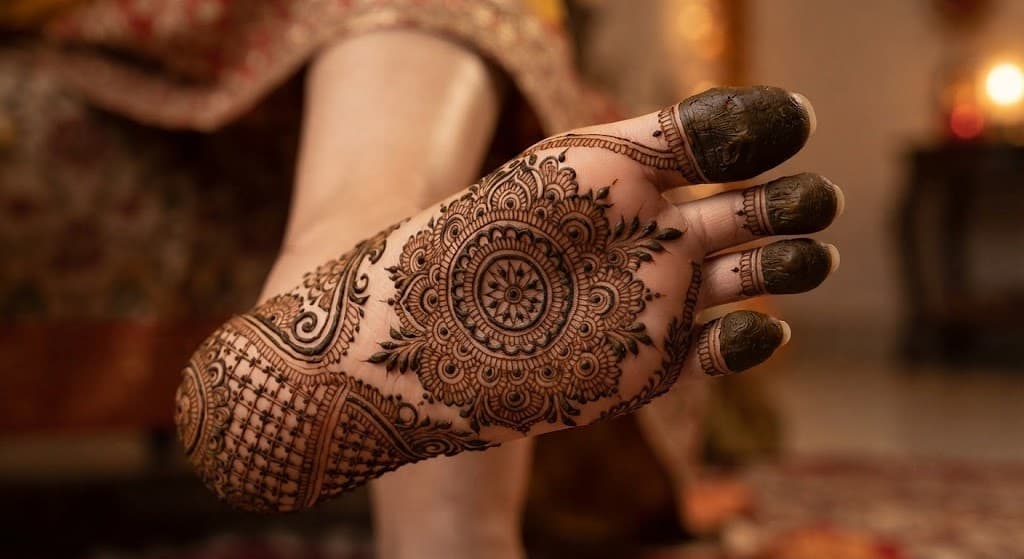
The sole takes one of the deepest stains on the body.1 Many brides have the soles decorated too, but you will need to rest until they are completely dry.
- Sole mandala. A round mandala in the centre of the sole, with dots around it. Time: quick to medium.
- Filled heel and toes. The heel and the pads of the toes filled solid, with the arch left bare. Time: quick.
- Sole lotus. An open lotus in the arch of the foot. Time: quick.
- Border sole. A fine border around the edge of the sole, with the centre left bare. Time: quick.
Leg mehndi designs
Leg designs climb from the ankle up the shin or the calf. They suit beach and poolside functions, sangeet outfits that show the ankle, and brides who want a dramatic look.
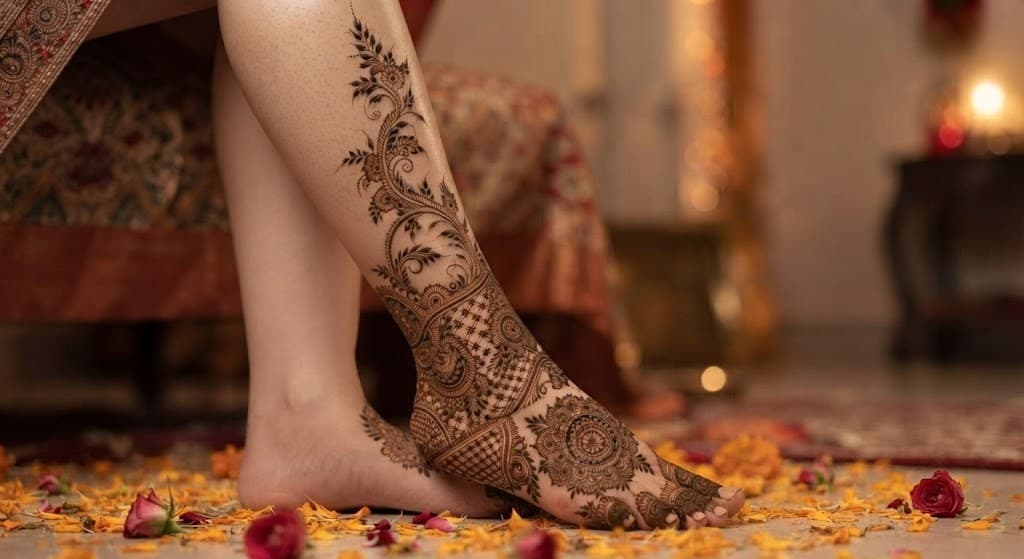
- Side leg vine. A vine climbing from the outer ankle up the side of the calf. Time: medium.
- Shin panel. A narrow panel of pattern running up the front of the shin from the top of the foot. Time: medium to long.
- Band at the calf. A wide band around the calf, like a cuff, with a vine joining it to the ankle. Time: medium.
- To the knee. A full bridal design climbing from the toes to just below the knee. Time: long.
- Wrapped leg. A vine that spirals once around the leg from the ankle to the calf. Time: medium.
- Back of the ankle. A small design on the back of the ankle above the heel, for something unusual. Time: quick.
Bridal feet mehndi designs
For a bride, feet are part of the full look and they appear in every full-length photograph, from the pheras to the vidaai. Our bridal mehndi designs guide covers the timing and booking for the whole bridal sitting.
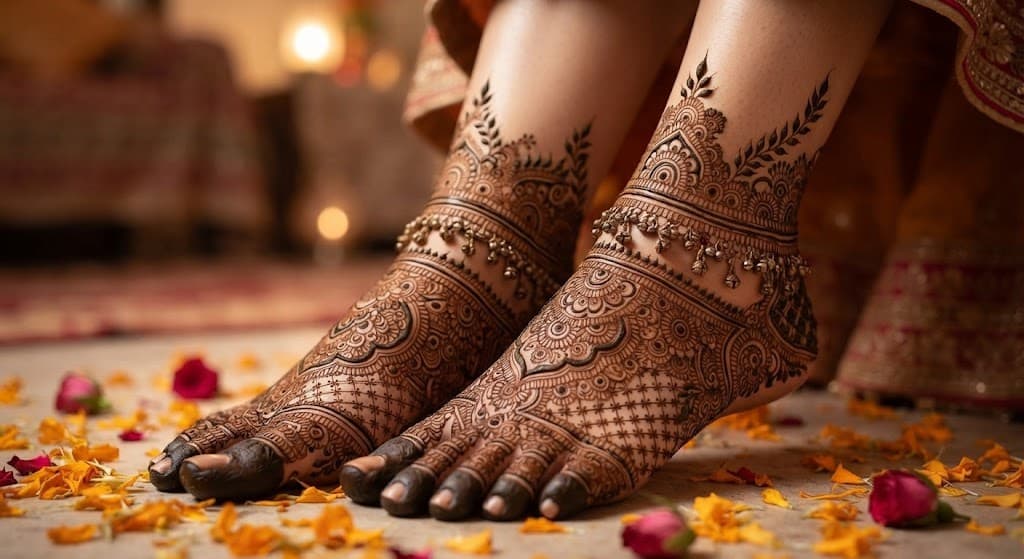
- Matched to the hands. The same motifs and borders as the hands, so the hands and feet look like one set. Time: long.
- Arches and payal. Arches over the top of the foot with a dense payal border at the ankle. Time: medium to long.
- Peacock on the foot. A peacock on the top of each foot, facing each other when the feet are together. Time: medium.
- Full foot and sole. The top of the foot, the toes and the sole all decorated. Time: long.
- Light bridal feet. A delicate lace pattern that leaves lots of skin bare, for a bride wearing pastels or heels; in 2025 Elle India noted modern brides choosing minimalist designs.6 Time: medium.
- Feet to the shin. A bridal design that continues up the shin, for a bride who will show her ankles. Time: long.
Feet mehndi designs for festivals
Many women decorate their feet for festivals as well as weddings. If you would like a sacred symbol in your design, keep in mind that many families keep these off the feet; ask your elders.
- Karwa Chauth moons. Tiny moons and dots strung across the top of the foot, with the toes filled. In 2026 the fast falls on Thursday, 29 October,7 and our Karwa Chauth mehndi designs recommend doing the feet first, so they dry before you have to walk. Time: quick.
- Diwali diya. A small diya on the top of each foot with a ring of dots. Diwali 2026 is on Sunday, 8 November;8 see our Diwali mehndi designs. Time: quick.
- Teej leaves. A band of leaves across the top of the foot, for the mehndi of Sinjara. Time: quick.
- Eid crescent. A plain crescent moon at the ankle with a bold flower on the top of the foot. Time: quick.
- Durga Puja border. A solid red-brown border around the edge of the foot, echoing alta, which many Bengali and Odia women wear for the puja.2 Time: quick.
Feet mehndi for grooms
In Sindh, the groom's hands and feet are typically decorated with henna by his female relatives as part of the wedding,1 and in other families a groom may choose a small design too.
- Sole dot. A single round dot of paste on each sole. Time: quick.
- Toe caps. The big toes capped, nothing else. Time: quick.
- Ankle band. A simple geometric band around the ankle. Time: quick.
Before your feet mehndi
A little preparation makes the design cleaner and the colour deeper.
- Finish your pedicure first. Get pedicures, scrubs and waxing done a day or two before. They take off some of the outer layer of skin, which is where the stain sits,1 so they belong before the paste goes on, not after.
- Come with bare, clean feet. A wash with plain soap is enough; leave out creams and oils, which sit between the paste and your skin.
- Wear the right clothes. Loose shorts, a skirt you can lift or a lehenga you can tuck up, so nothing brushes the wet paste.
- Plan the order. Many artists work on the feet while the hands are drying, or start with the feet so they have set by the time you need to stand. Ask yours how they like to work.
- Use the washroom first. Once your feet are done, getting up is the last thing you want to do.
Sitting, drying and walking
Henna paste dries in about fifteen to twenty minutes,9 but that is only the surface: the colour keeps building for as long as the paste stays on, and a longer wait gives a darker, longer-lasting stain.1
- Keep your feet up. Rest them on a stool or a cushion, not on the floor.
- Do not walk until it is dry. Even then, walk barefoot on a clean floor or in open slippers, and avoid rugs and grass. If your soles are done, stay off them until the paste comes off.
- Seal it. A dab of lemon juice and sugar on the dried paste helps it stay on.1
- Wrap it for the night. A loose layer of tissue over the dried paste traps body heat, which helps the colour deepen.9 Old socks on top keep the sheets clean.
- Scrape, do not wash. In the morning, scrape the dry paste off and keep your feet away from water for the rest of the day.
Feet mehndi and footwear
Choose the design for the shoes you will actually wear.
- Open sandals and kolhapuris. Show the toes and the top of the foot: toe designs, a band or an Arabic trail.
- Juttis and mojaris. Cover the toes and the front of the foot but show the ankle: a payal or an ankle band.
- Heels. Show the top of the foot and the ankle: a centrepiece or a light trail.
- Closed shoes. Hide almost everything except the ankle: an ankle band or a leg design.
- Barefoot for the ceremony. If your ceremony is done barefoot, the whole foot, and sometimes the sole, will show.
How to draw a simple feet design
A capped-toe design with a single flower is the easiest feet design to draw yourself. Sit on a low stool with the foot you are decorating resting on another stool in front of you.
- Practise on paper. Draw the flower and the dots a few times first.
- Cap the toes. Fill the tip of each toe with paste, working from the little toe to the big toe so your hand does not brush the wet ones.
- Draw the flower. A small five-petal flower on the top of the foot, about a third of the way from the toes to the ankle.
- Add the dots. A curving line of dots from the flower towards the inner ankle.
- Finish the ankle. A ring of small dots around the ankle, if you like.
- Leave it to dry. Keep the foot raised and still until the paste is dry, then keep it on as long as you can.
Made a mistake? Dab it away with a damp cotton bud while the paste is still wet, and redraw.
Getting a dark colour on the feet
Feet usually stain well, but a few habits help.
- Leave it on overnight if you can, wrapped loosely. Keep the paste on for at least four to six hours, and many people wear it overnight.1
- Keep your feet warm. Some people believe warming the design darkens the stain,1 so avoid sitting with your feet on a cold floor.
- Be patient. The stain is orange at first and deepens over about three days,1 so two days before the occasion is best, and one day at the latest.
- Go easy on water. Long soaks, pools and scrubbing all fade the design faster.
Our complete guide to mehndi has more on colour and aftercare.
Feet mehndi mistakes to avoid
Many disappointing feet designs come down to planning rather than skill.
- Leaving the feet until last. By the end of a long mehndi, everyone is tired and the function is starting. Ask for your feet early, so they have hours to dry and stain.
- Choosing a design your shoes will hide. A beautiful toe design is lost in closed juttis. Decide on the footwear first, then the design.
- Standing up too soon. A smudge or a crack on the arch or the toes leaves a blurred patch in the stain, and it is hard to redraw once the paste around it has set.
- Forgetting the sides. The edges of the foot show when you sit cross-legged or walk. Ask your artist to carry the border round, so the design does not stop abruptly.
- Ignoring the hands. Feet look finished when they echo the hands: the same flower, the same border or the same payal band.
Staying safe
Feet deserve the same care as hands: natural henna only, and no black henna or "instant" cones. The jet colour of black henna often comes from PPD, which is also used in hair dye and can set off dangerous skin reactions in some people.10 Health Canada lists three things to watch for: a paste or design that is very dark black, one that sets very fast, and one with little or no scent. It adds that a reaction to PPD may appear 1 to 14 days after contact.11 Before any paste touches your skin, ask what is in it, especially for a bride or a child. You can find mehendi artists on Shaadiwaale in cities such as Kolkata, Udaipur, Bengaluru and Chennai.
Frequently asked questions
How long after feet mehndi can I walk?
Wait. The paste dries in about fifteen to twenty minutes, but a step too soon can crack it and blur the lines. Keep your feet raised for as long as you can manage, ideally a few hours, and then walk barefoot on a clean floor or in open slippers.
What is the best feet mehndi design for a bride?
Bridal feet are often matched to the hands: arches or a peacock on the top of each foot, filled toes and a payal border at the ankle, often with the sole decorated too. A bride in pastels or heels may prefer a lighter lace pattern.
What is a simple feet mehndi design?
Capped toes with a small flower on the top of the foot, a mini mandala, a curving line of dots towards the ankle or a ring of dots around the ankle. Each takes only a few minutes and looks finished.
Why does mehndi on the feet go so dark?
Soles and palms have the thickest layer of skin, which takes up the most dye, so hands and feet hold the darkest and longest-lasting henna stains. The sole often comes out darker than the top of the foot.
How far up the leg can mehndi go?
As far as you like. Many bridal designs stop at the ankle or the shin, but side leg vines and calf bands go higher, and some brides take the design up to the knee for a beach or poolside function.
Can I wear shoes after feet mehndi?
Wait until the paste has come off, usually the next morning. Before that, open slippers are safest. Once the paste is off, wear what you like, but keep your feet away from water for the rest of the day so the colour can deepen.
How many days before an occasion should I get feet mehndi?
Two days before is best, one day at the latest. The stain starts orange and deepens over about three days, so feet done two days ahead will be close to their darkest on the day, and feet done the day before will still be deepening.
Can children have feet mehndi?
For most older children, yes: fresh natural henna only, in a small, quick design such as capped toes or a single flower. Leave out babies, and anyone with G6PD deficiency, since henna is known to be dangerous for people with this inherited condition,1 and never use black henna on children.
Share this guide
Send it to the family group, or keep it for later.
Questions about your wedding?
Our team answers questions about venues, vendors and the budget, free on WhatsApp.
About Shaadiwaale
Indian wedding planning in one place: venues and vendors with real prices, free kundli matching, invitations and tools to plan every function together.
Every function. Every family. One plan.
Notes
- Henna, Wikipedia. Soles and palms with the thickest skin, so hands and feet take the darkest, longest-lasting stains; ancient wall paintings at Akrotiri showing markings consistent with henna on nails, palms and soles; hands and feet decorated at Indian weddings and engagements; mehndi with or instead of alta in the Bodhu Boron ceremony; henna on the groom's hands and feet in Sindh; G6PD deficiency; the outer layer of skin where the stain sits; keeping the paste on four to six hours or overnight; warming believed to darken the stain; feet henna in Saudi A ↩
- Alta (dye), Wikipedia. Alta for marriage and for Durga Puja among Bengali and Odia women. ↩
- Teej, Wikipedia. Mehndi on hands and feet on Sinjara. ↩
- Henna: rituals, aesthetic and social practices, UNESCO Intangible Cultural Heritage, inscribed 2024 for sixteen Arab countries. Henna as a symbol of joy. ↩
- Toe ring, Wikipedia. The bichiya as a symbol of the married state for Hindu women, on the second toe, usually silver. ↩
- From Arabic to minimalist: 10 stunning mehendi designs trending in 2025, Elle India, Tanvee Khanna, 16 September 2025. Modern brides opting for minimalist designs. ↩
- Karwa Chauth 2026 date and time for Jaipur, Drik Panchang. Karwa Chauth on 29 October 2026. ↩
- 2026 Diwali puja calendar for New Delhi, Drik Panchang. Diwali on 8 November 2026. ↩
- Mehndi, Wikipedia. The paste drying in fifteen to twenty minutes; wrapping to hold in warmth. ↩
- Temporary tattoos, henna/mehndi, and "black henna": fact sheet, US Food and Drug Administration. Black henna and PPD. ↩
- Black henna temporary tattoos, Health Canada. Warning signs of black henna; reactions appearing 1 to 14 days after contact. ↩