Guide
Bridal Mehndi Designs 2026: 40 Ideas and the Complete Guide for Brides
Forty bridal mehndi designs, from full Rajasthani hands to minimal lines and portraits of the two of you, and everything around them: choosing, hiding his name, when to book and apply, a dark colour, safety, cost and what to ask your artist.
- Have your mehndi two days before the pheras: the colour takes about three days to darken
- Book your artist three to four months ahead, with a patch test and trial a few weeks before
- Agree the hidden name's spelling and script in writing before the day
- Never use black henna or instant cones: natural henna always comes off orange
Outfits and beauty · 39 min read · By The Shaadiwaale team · Updated 31 October 2026
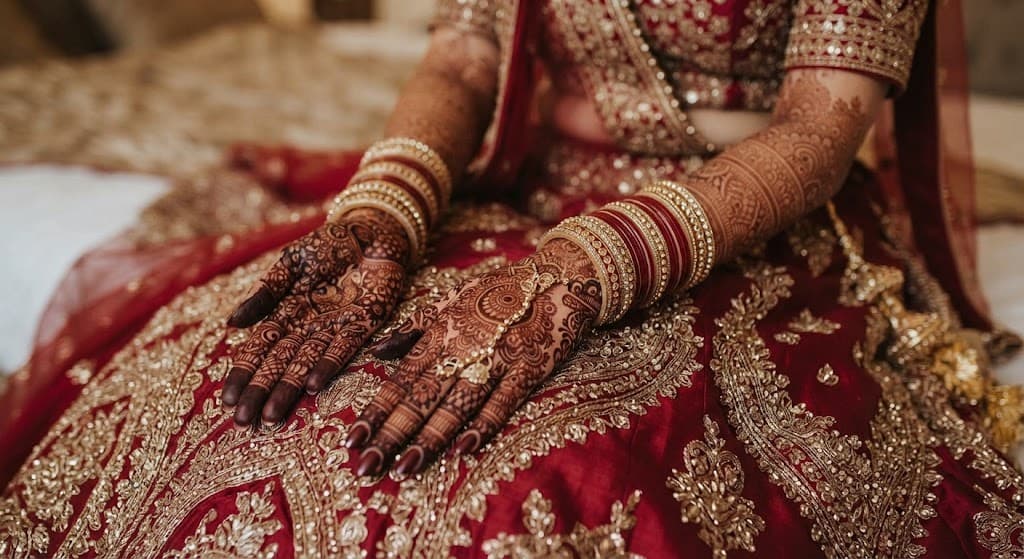
Of everything you will wear on your wedding day, your mehndi is the only thing made on you. It takes an afternoon, it carries your family's blessings and often his name somewhere in the vines, and it is in almost every photograph of your hands, from the varmala to the pheras to the moment someone slips a ring on your finger.
This guide has 40 bridal mehndi designs, from full Rajasthani hands to minimal lines and portraits of the two of you, sorted by style and by where they go. Then it covers everything around them: how to choose, hiding the groom's name, when to book and when to apply so the colour is darkest on the day, staying safe, what affects the price and what to ask your artist.
Quick answer: The classic bridal mehndi designs are full traditional hands to the wrist or elbow, with figures of the bride and groom, peacocks, elephants, a doli and the groom's hidden name, matched with feet designs to the ankle. Modern brides also choose minimal, Indo-Arabic and personal story designs. Book your artist three to four months before the wedding, do a patch test and trial a few weeks before, and have your mehndi two days before the pheras (one day at the latest): natural henna starts orange and darkens to reddish brown over about three days. Never use black henna or "instant" cones.
What's in this guide
- What makes mehndi bridal
- How to choose your bridal mehndi design
- Traditional bridal mehndi designs
- Modern and minimal bridal mehndi designs
- Personal bridal mehndi designs: the latest ideas
- Bridal mehndi designs by placement
- Designs that flatter your hands
- Hiding the groom's name
- Bridal motifs and what they say
- Bridal mehndi across communities
- Your brief for the artist
- Your bridal mehndi timeline
- The patch test and the trial
- When to apply for the darkest colour on your wedding day
- The day of your bridal mehndi
- Keeping the colour dark until the pheras
- Summer, winter and destination weddings
- When something goes wrong
- Safety for brides
- What bridal mehndi costs, and how artists price it
- Questions to ask your bridal mehndi artist
- Photographing your bridal mehndi
- Frequently asked questions
What makes mehndi bridal
UNESCO, recognising the henna traditions of sixteen Arab countries, describes henna as a symbol of joy at births and weddings,1 and in India it has been part of the bride's preparations for generations (The history of mehndi). At most weddings everyone gets some: the mothers, the sisters, the friends, often the groom. But the bride's mehndi is different in four ways.
| Bridal mehndi | Family and close friends | Guests |
|---|---|---|
| Coverage | Both hands, front and back, usually to the wrist or elbow, and feet to the ankle or beyond | Hands to the wrist, sometimes the back of the hand |
| Design | Dense and detailed, with figures, motifs and hidden names | Detailed but smaller, often matching the bride's style |
| Time | A long sitting, often several hours | Under an hour each |
| Meaning | Blessings for the marriage, the groom's name, the colour as a sign of love | Family celebration |
The bride's design is also the only one planned around a date. It has to be at its darkest on the day of the pheras, nikah or anand karaj, so it is timed like a recipe. We cover the basics of mehndi, the paste and the ceremony in our complete guide to mehndi and the rituals of the day in mehndi ceremony rituals and their meaning. This guide is about you: your design, your timing and your artist.
How to choose your bridal mehndi design
Pinterest boards full of brides' hands all start to look alike after a while. These six questions cut the choice down quickly, and they are the same questions a good artist will ask you.
1. What will you wear? A heavily embroidered lehenga with a lot of gold can take a dense traditional design; a pastel or minimal outfit often looks better with lighter, finer mehndi and more bare skin. Think about your jewellery too. A Punjabi bride's chura, the red and white bangles usually put on the morning of the wedding or the day before,2 covers a good part of the forearm, so the design can end at the wrist or carry on below the bangles. Haath phool, rings and kaleere change what shows, too.
2. How long can you sit? Full hands to the elbow and full feet can take most of a day. If you know you will be restless, or your mehndi shares the day with other functions, choose a design that fits the time you really have.
3. Hands only, or hands and feet? Feet are part of the traditional bridal look, but they add time, and you cannot walk until the paste dries. Decide early, because it changes the artist's quote and your schedule.
4. Traditional or modern? Traditional Indian and Rajasthani designs fill the skin; Arabic, Indo-Arabic and minimal designs leave more of it bare. Our guide to the types of mehndi designs explains each style and how to tell them apart.
5. What should it say? Your mehndi can carry the groom's name, the date, your families, the story of how you met, or the motifs your grandmother would expect. Make a short list before you meet your artist.
6. How will it be photographed? The back of the hand and the fingers show in almost every photograph; the palm shows when you hold your hands up for the camera. Many brides spend a little more of the artist's time on the backs for exactly that reason.
| If you want | Consider |
|---|---|
| The classic look your family expects | Full-hand traditional Indian or Rajasthani to the elbow (designs 1 to 7) |
| Something lighter for a pastel or modern outfit | Minimal, Indo-Arabic or lace designs (designs 11, 12 and 15) |
| A shorter sitting | A mandala, a bracelet design or a simple bridal design (designs 16, 17 and 20) |
| A design that is only yours | A story, a skyline, a date or portraits (designs 21 to 28) |
| Dark colour in the photographs | More of the design on the palm, where the colour is deepest (designs 29 and 30) |
Save the designs you like to a board on Inspiration and show it to your artist. A board of ten designs says more than a long description.
Traditional bridal mehndi designs
These are the designs most families mean when they say "proper bridal mehndi": dense, detailed, full of figures and meaning. A rough guide to the sitting for each design is given at the end (short means about an hour or less, medium a couple of hours, long most of an afternoon or more); your artist will give you a real estimate for your hands.
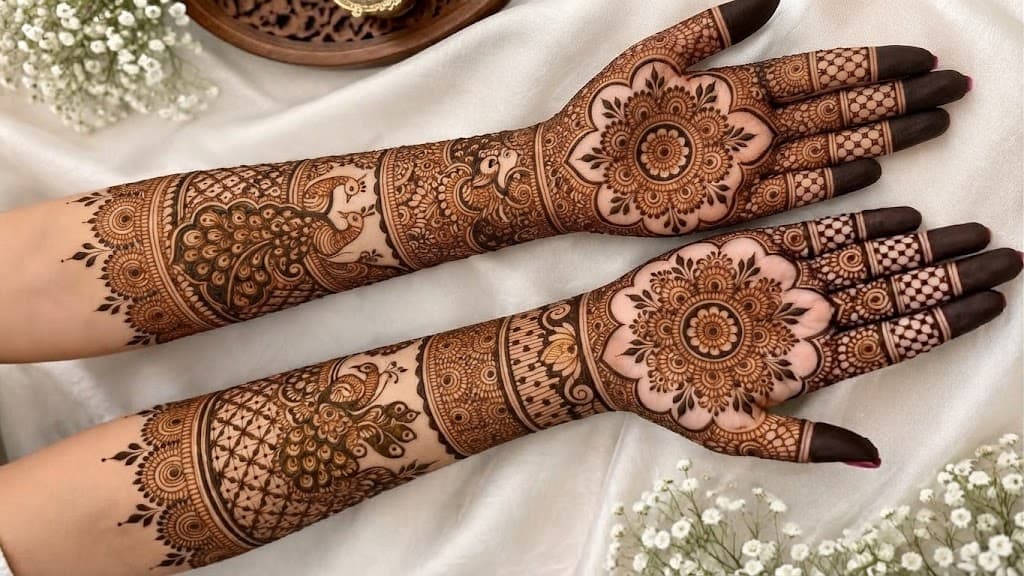
1. Full-hand Rajasthani bridal mehndi
Rajasthan is famous for its henna: the town of Sojat, whose mehndi received a geographical indication (GI) tag in 2021, is described as the largest mehndi-producing area in India3.4 The Rajasthani bridal design fills the palm, the back of the hand and every finger, usually to the elbow, with fine lines, dots and filled shapes, and often ends in a band of arches at the wrist. Best for: brides who want the full traditional look. Sitting: long.
2. Dulha-dulhan portrait palms
The bride on one palm and the groom on the other, so that the couple faces each other when you bring your hands together. Artists often place them under arches or in a palanquin, with a shehnai player or the baraat around them. It remains a classic. One Dubai-based artist told Gulf News that brides want a mix of the creative and the traditional, such as "figures like dulha dulhan" with a story like the baraat or the doli.5 Best for: a palm that tells everyone who you are marrying. Sitting: long.
3. The wedding storyboard
Instead of two figures, the whole wedding: the baraat arriving with the groom on his horse, the varmala, the pheras around the fire and the doli carrying the bride away, laid out in panels from the fingers to the elbow. It takes a skilled artist and a lot of your time, and it is the design guests will gather round to read. Best for: brides who love detail and do not mind being looked at. Sitting: long.
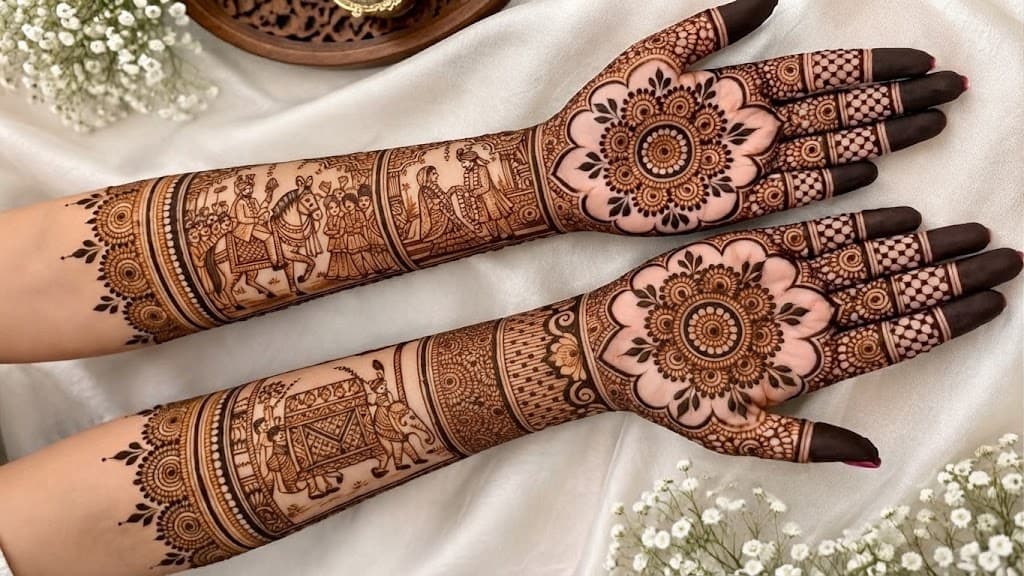
4. Peacock pair
A peacock on each palm or on the back of each hand, facing each other, with tail feathers sweeping towards the wrist. In mehndi the peacock is usually read as beauty, grace and love (Mehndi motifs and their meanings), and a facing pair across the two palms is a favourite bridal layout. Best for: a traditional design with a little less sitting than a storyboard. Sitting: medium to long.
5. Elephant procession
A decorated elephant with a raised trunk, sometimes carrying a howdah, walking up the back of the hand or the forearm. Elephants are traditionally a sign of good fortune and a royal welcome. One elephant on each hand looks grand; a line of them along the forearm looks like a wedding procession. Best for: brides who want something regal and a little playful. Sitting: medium to long.
6. Kalash and lotus palm centre
A kalash, the pot of plenty, or a lotus in full bloom at the centre of the palm, with the rest of the design radiating out from it. Both are among the most auspicious motifs in Indian art. It is a good choice if you would like the palm to carry a blessing rather than a portrait. Best for: a meaningful centrepiece without figures. Sitting: medium.
7. Jaal with bharwa fingers
Jaal means net: a lattice of fine lines across the back of the hand, like lace. Bharwa means filled: fingertips and borders coloured in solid with paste. Together they give a dense, rich look that frames the hands without telling a story. Best for: a traditional look that photographs well from every angle. Sitting: medium to long.
8. Mughal arches and florals
Domes, arches and jharokha windows from Mughal and Rajput architecture, filled with florals, often stacked from the fingertips to the wrist. It is formal and symmetrical, and it suits an outfit with zardozi or architectural embroidery. Best for: a palace or heritage wedding. Sitting: long.
9. Paisley-heavy traditional
The paisley, also called ambi or kairi after the mango, curled into every corner: along the fingers, around the palm centre, at the wrist. A Persian shape, the boteh, it became one of the most familiar motifs in Indian design,6 and it is often read as fertility and plenty. Best for: brides who want a classic, flowing traditional design. Sitting: medium to long.
10. The South Indian bridal round
Many South Indian families traditionally ground fresh henna leaves at home, maruthani in Tamil, gorintaku in Telugu, and applied a round in the centre of the palm with the fingertips capped in paste. Many South Indian brides now have a cone-drawn bridal design too, while the leaf round is still loved for festivals and family occasions (Types of mehndi designs). Some brides keep the round for one function and wear a full design for the wedding. Best for: a bride who wants her grandmother's mehndi and her own. Sitting: short for the round alone; medium with a full design.
Modern and minimal bridal mehndi designs
Not every bride wants every inch filled. These designs keep the meaning but leave more skin, more room for jewellery and, usually, a shorter sitting.
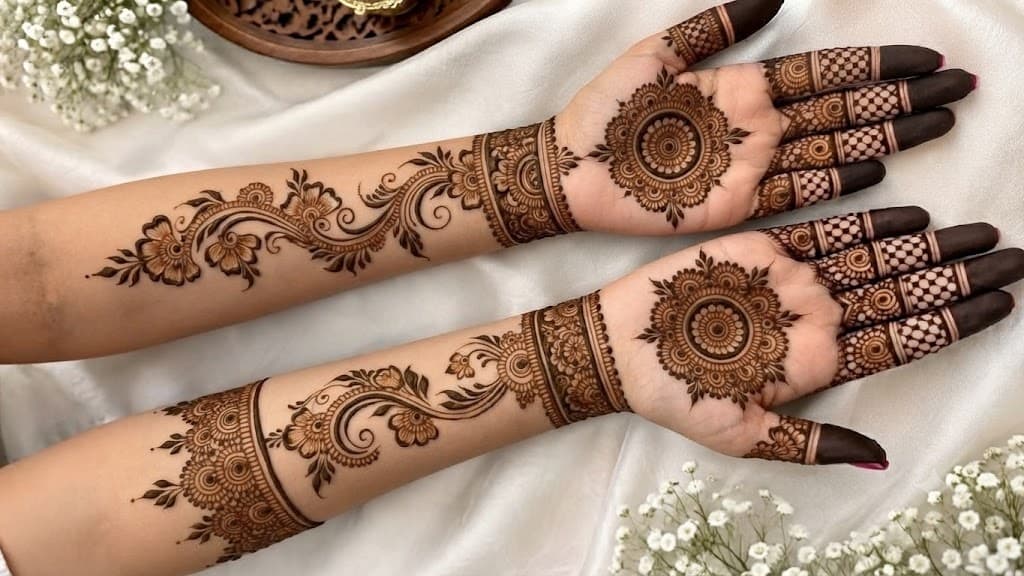
11. Minimal bridal mehndi
Fine lines, small motifs and a lot of bare skin: a delicate band at the wrist, a vine up one finger, a small mandala, perhaps the groom's initial. Minimal mehndi has become a choice for modern brides who want their hands to look chic rather than covered.7 It pairs beautifully with pastel outfits and statement rings. Best for: brides who want their mehndi to whisper. Sitting: short to medium.
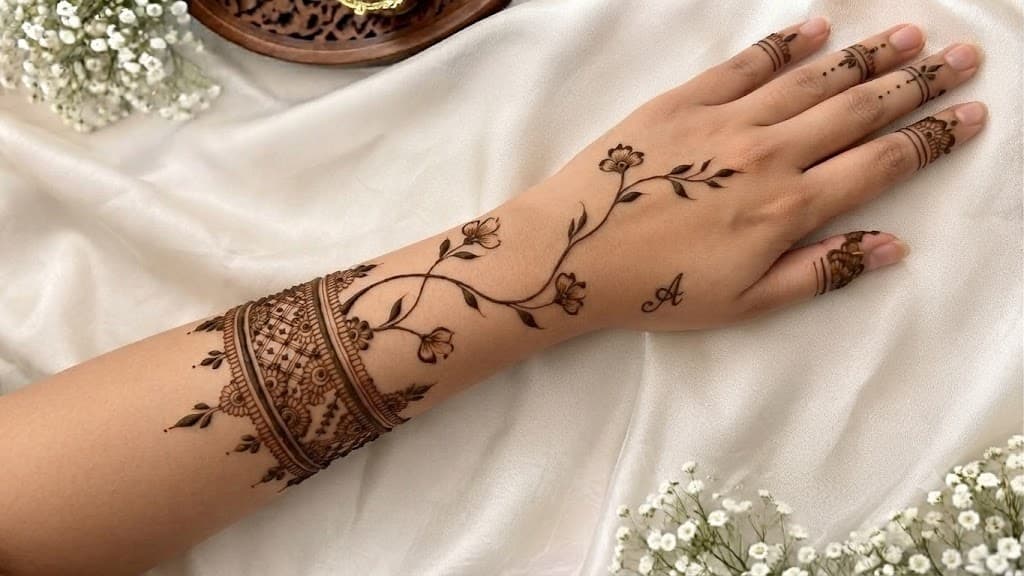
12. Indo-Arabic bridal
The flowing, diagonal trails of Arabic mehndi combined with the detail of Indian mehndi: a bold floral trail across the back of the hand, a fine mandala or figure in the palm. It is a favourite with brides who want detail without a full day's sitting. Best for: a balanced design that looks bridal from every side. Sitting: medium.
13. Pakistani bridal
Very fine lines, delicate shading and dense, intricate fills, often covering the hands completely. It looks traditional from a distance and extraordinary up close. Read more about how it differs from Indian mehndi in our types of mehndi designs guide. Best for: brides who want the finest detail possible. Sitting: long.
14. Khafif bridal
Bold, graphic florals and leaves in a few large shapes, with plenty of skin showing between them. It is quick, striking and very modern, and it photographs clearly even from across a room. Best for: destination and day weddings. Sitting: short to medium.
15. Lace glove
A pattern that looks like a lace glove: a fine net from the fingertips, stopping in a scalloped edge at the wrist or mid-forearm. It looks elegant with Western-style gowns at a reception as well as with lehengas. Best for: a bride who wants a polished, even finish. Sitting: medium.
16. One big mandala
A single large mandala in each palm, with matching fingertips and a lighter pattern on the backs. It is easy to read, very symmetrical and leaves the arms bare for bangles. Best for: brides with a shorter sitting who still want a full palm. Sitting: short to medium.
17. Bracelet and cuff designs
A wide cuff of mehndi at the wrist, with chains running to rings on the fingers, so that the design looks like jewellery. Some brides choose it because they will wear a lot of real jewellery and want the mehndi to frame it rather than compete with it. Best for: brides wearing heavy bangles, a chura or haath phool. Sitting: short to medium.
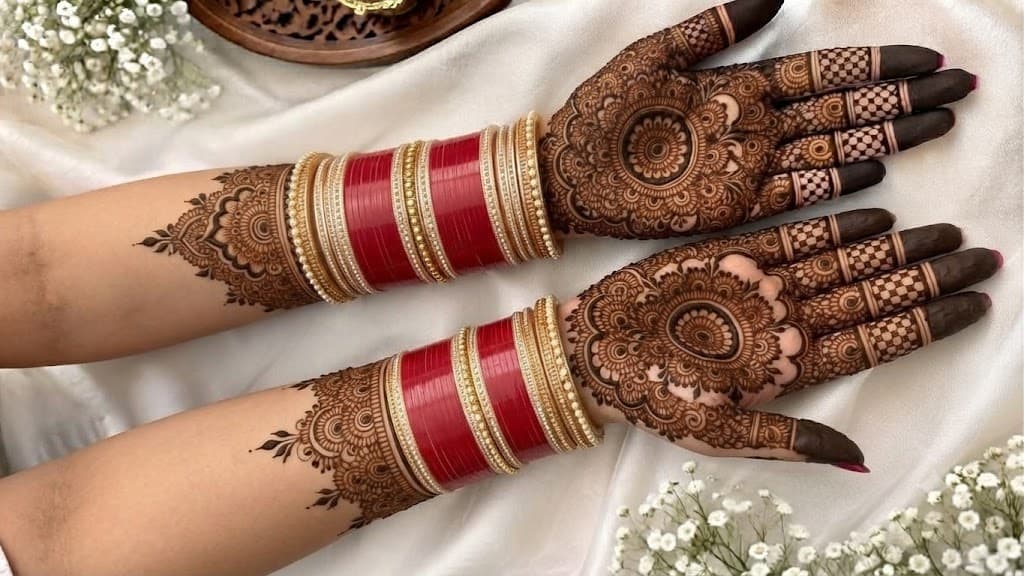
18. Geometric and Moroccan
Triangles, diamonds, grids and straight lines instead of curves, often in a strong band across the hand. It reads as modern and architectural, and it suits a minimal or Western outfit. Best for: brides who find florals too soft. Sitting: medium.
19. Roses and open florals
Large roses and open flowers with leaves and vines, shaded rather than filled. The rose works in almost any style, and a rose bridal design sits halfway between traditional and Arabic. Best for: a romantic look that is not too dense. Sitting: medium.
20. Simple bridal mehndi
A simple bridal design is still a bridal design. A full palm mandala, a jaal on the back of the hand, filled fingertips and the groom's initials somewhere small can be done well in an hour or two and look lovely in every photograph. If your wedding is small, your sitting is short, or you just prefer it, simple is a perfectly good choice. Best for: court marriages, small weddings and brides who prefer less. Sitting: short to medium.
Personal bridal mehndi designs: the latest ideas
Personal designs, which tell your story rather than one every bride shares, are one of the clearest recent shifts in bridal mehndi. Gulf News described brides moving from traditional florals to "personalized patterns that tell a story", and one artist described requests for "a design that tells the couple's love story or the story of how they met".5 These ideas can be the whole design or a small panel inside a traditional one.
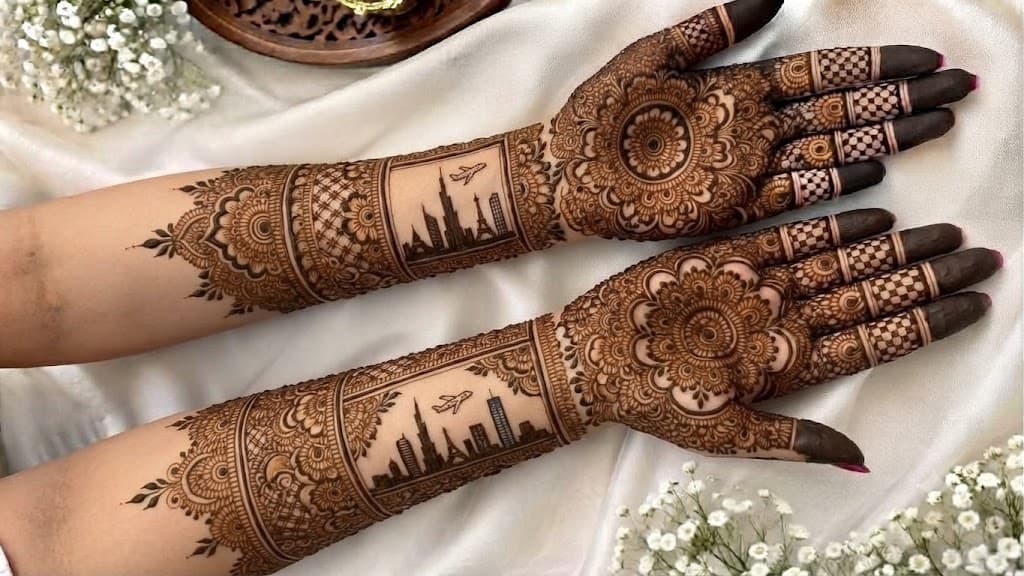
21. Your love story in panels
Three or four small scenes from the fingers to the wrist: where you met, the proposal, a first trip, the wedding. The artist draws them as tiny framed panels inside a traditional design, so the hands still look bridal from a distance. Best for: couples with a story they love telling. Sitting: long.
22. Skylines and places
The skyline of the city where you met or where you will live, a monument from your hometowns, or the outline of the place you are getting married. Brides have asked for city skylines, and for planes if the couple flew to meet each other.5 Best for: long-distance couples and destination weddings. Sitting: medium, as a panel.
23. The date and initials
The wedding date in numerals along a finger, or the groom's initial worked into a motif: Elle India suggested the initial of the future spouse's name as a bridal idea for 2025.7 It is small, quick and easy to hide or show off. Best for: minimal and modern designs. Sitting: short, as an addition.
24. Portraits of the two of you
Not stylised figures but your faces, drawn from photographs. It is one of the most demanding bridal designs: one bride told Gulf News her henna took thirteen and a half hours, and that she knew she wanted her groom's face on her hand.5 Only book it with an artist who can show you portraits they have drawn on real hands, and do a trial. Best for: brides with patience and a very skilled artist. Sitting: long.
25. Family in the design
Your parents' initials, your siblings, a grandparent who is no longer here, or your dog's paw print in the corner of a palm. Many families love seeing themselves in the bride's mehndi. Ask your artist to keep each detail small, so the design stays a bridal design and not a family album. Best for: brides who want to carry their people with them. Sitting: short to medium, as additions.
26. Symbols from your life together
The ring from the proposal, the coffee cup from your first date, the logo of the app where you matched, a cricket bat, a song's first notes. Brides have even asked for the wedding logo and the logo of the dating app that brought them together.5 Best for: a playful touch inside a traditional design. Sitting: short, as additions.
27. Sacred symbols, placed with care
Many brides want a Ganesha, an Om, the kalash or a verse in their design. If you do, place it on the palm or the back of the hand rather than the feet, and ask your elders how your family feels about sacred symbols in mehndi that will fade, wash and touch everything for a fortnight. We explain the usual etiquette in Mehndi motifs and their meanings. Best for: a blessing at the centre of the design. Sitting: short to medium.
28. Words in your own script
A line from a poem, the groom's name in Devanagari, Gurmukhi or Urdu, or a word that means something to you both. Script is harder than it looks in paste, so give the artist the exact text written out, check the spelling together, and ask to see their lettering on paper first. Best for: brides who love words more than pictures. Sitting: short, as an addition.
Bridal mehndi designs by placement
Where the mehndi goes matters as much as the style. Palms and soles have the thickest skin and take up the most dye, so they stain darkest;8 the backs of the hands and the forearms stain lighter but show in more photographs. Most bridal designs cover all four, with the detail where it will be seen.
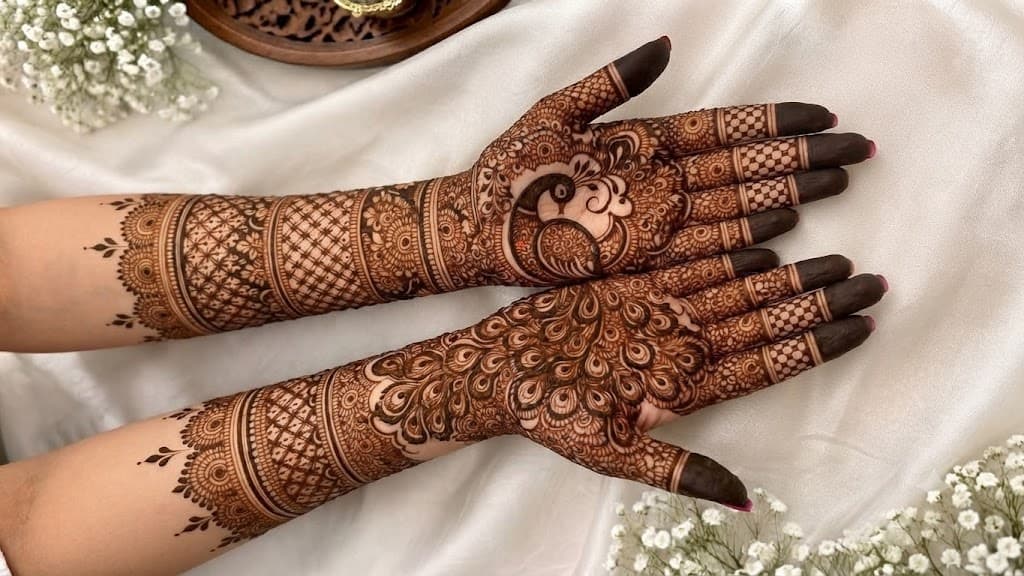
29. Front hand: the full bridal palm
Every part of the palm filled, with a centrepiece such as a mandala, a lotus or figures, and the fingers filled to the tips. It is the darkest-staining part of your design and the one your family will look at first. Sitting: medium to long.
30. Front hand: two palms, one design
The design is drawn across both palms so that it only makes sense when you hold them side by side: a mandala split in half, the bride on one palm and the groom on the other, or a doli on one side and the groom's baraat on the other. It is a lovely photograph and a lovely moment when you join your hands. Sitting: medium to long.
31. Back hand: the full back
A dense design from the fingertips to the wrist, often matching the palm: arches at the knuckles, a jaal across the back, filled fingers. Because the back of the hand is in almost every photograph, from the varmala to the ring exchange, many artists save their best detail for here. Sitting: medium to long.
32. Back hand: lace with finger rings
A lighter, lace-like back hand with a band at the wrist and a ring of mehndi on each finger. It leaves room for real rings and haath phool, and it photographs cleanly. Sitting: medium.
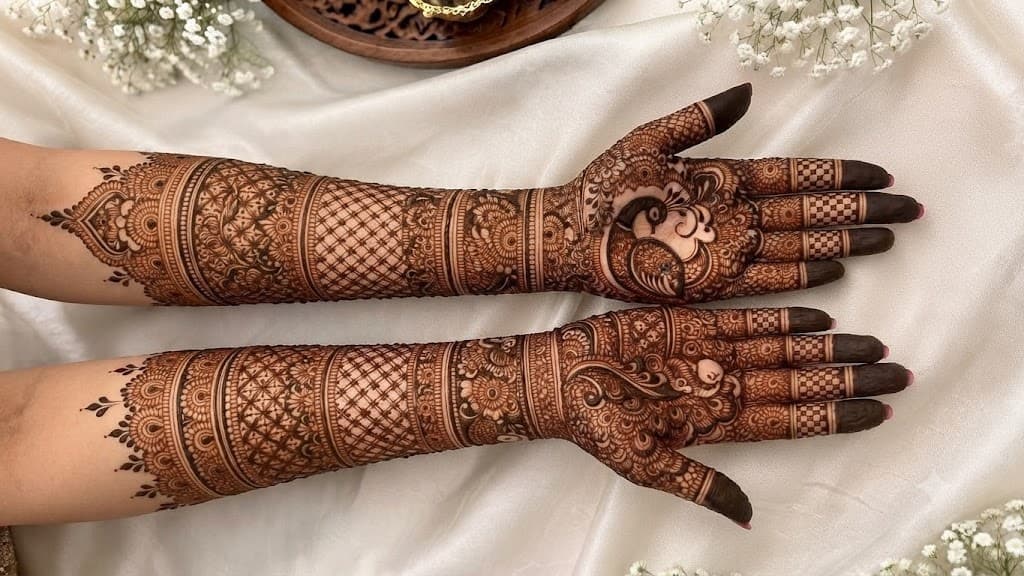
33. Arms: to the elbow
The traditional bridal length. The design usually changes as it climbs: dense at the hand, a band at the wrist, then panels or lace on the forearm. The forearm stains lighter than the hand, so it often looks best with open patterns rather than heavy fills. Sitting: long.
34. Arms: above the elbow
Some brides take the design up to the upper arm, particularly with sleeveless blouses. It is a long sitting and needs more paste time to dry, so plan for it. Sitting: long.
35. Fingers: filled fingertips
Solid caps of paste on every fingertip, a classic finishing touch in Indian mehndi. They stain very dark and make any design look complete. Sitting: short.
36. Fingers: rings and bands
Thin rings, bands and tiny vines on each finger, sometimes with a motif on the middle finger. They are ideal if you will wear a lot of real rings or want your engagement ring to stand out. Sitting: short.
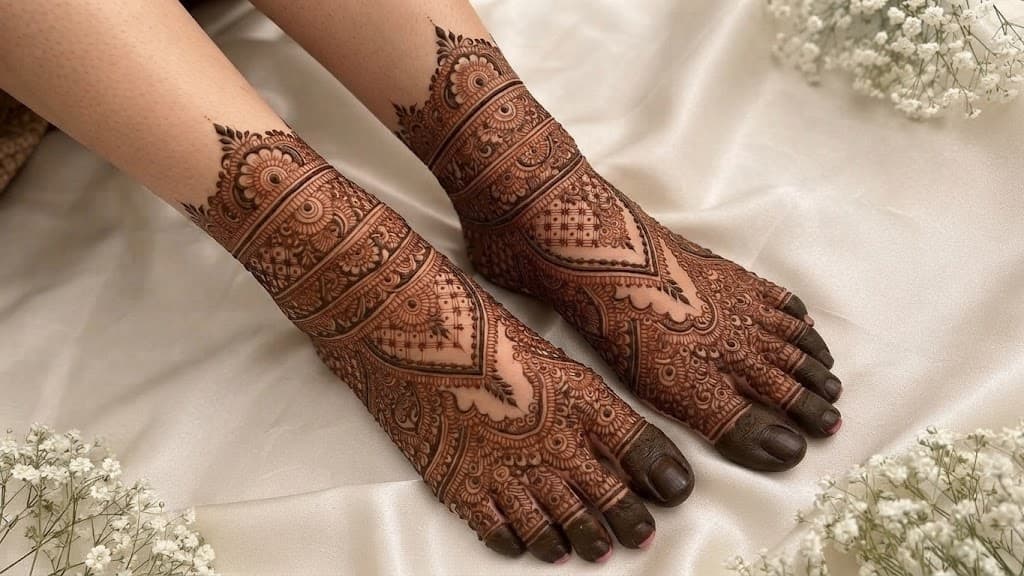
37. Feet: the bridal payal
The top of the foot covered in a pattern that ends at the ankle like an anklet (payal), sometimes with bells drawn along the edge, and filled toes. It matches traditional hands and suits brides who will wear real payals too. Sitting: medium.
38. Feet: up to the knee
The design climbs from the toes to the shin or the knee in a band, for brides who will show their feet and legs at a beach or poolside function. Remember that you cannot walk on wet paste: you will be sitting for a long time. Sitting: long.
39. Feet: the sole
Soles stain very deeply,8 and in many traditions the bride's soles are filled or decorated with a mandala. Sitting: short to medium.
40. Hands and feet: the matching set
Hands and feet designed together, with the same motifs, the same borders and the same style, so that they look like one piece of jewellery in the full-length photographs. Ask your artist to plan the set as one design rather than four separate ones. Sitting: long.
Designs that flatter your hands
A good artist adjusts every design to the hands in front of them. Bring this up at the trial, because it changes the design more than most brides expect.
- Small hands or shorter fingers. Vines and lines that run up the length of each finger make the fingers look longer. Wide horizontal bands across every finger do the opposite. A little bare skin between motifs also keeps a small hand from looking crowded.
- Long, slim fingers. Rings, bands and horizontal motifs on each finger balance them beautifully, and they can carry the densest traditional fills.
- Wide palms. A large central mandala or a design split into panels fills the space without looking empty in the middle.
- Deeper skin tones. Henna stains every skin, but on deeper skin tones the finished colour reads as a rich, dark brown, and very fine detail can be harder to see from across a room. Many artists suggest bolder lines and more contrast between filled shapes and bare skin, which is exactly what Khafif and Indo-Arabic designs do well.
- Fair skin. Fine lines and delicate shading show clearly, but so does the orange stage, so timing your mehndi two days before the ceremony matters even more.
The best test is your own hand: at the trial, ask the artist to draw a small part of the design on you and look at it from across the room, as your guests will.
Hiding the groom's name
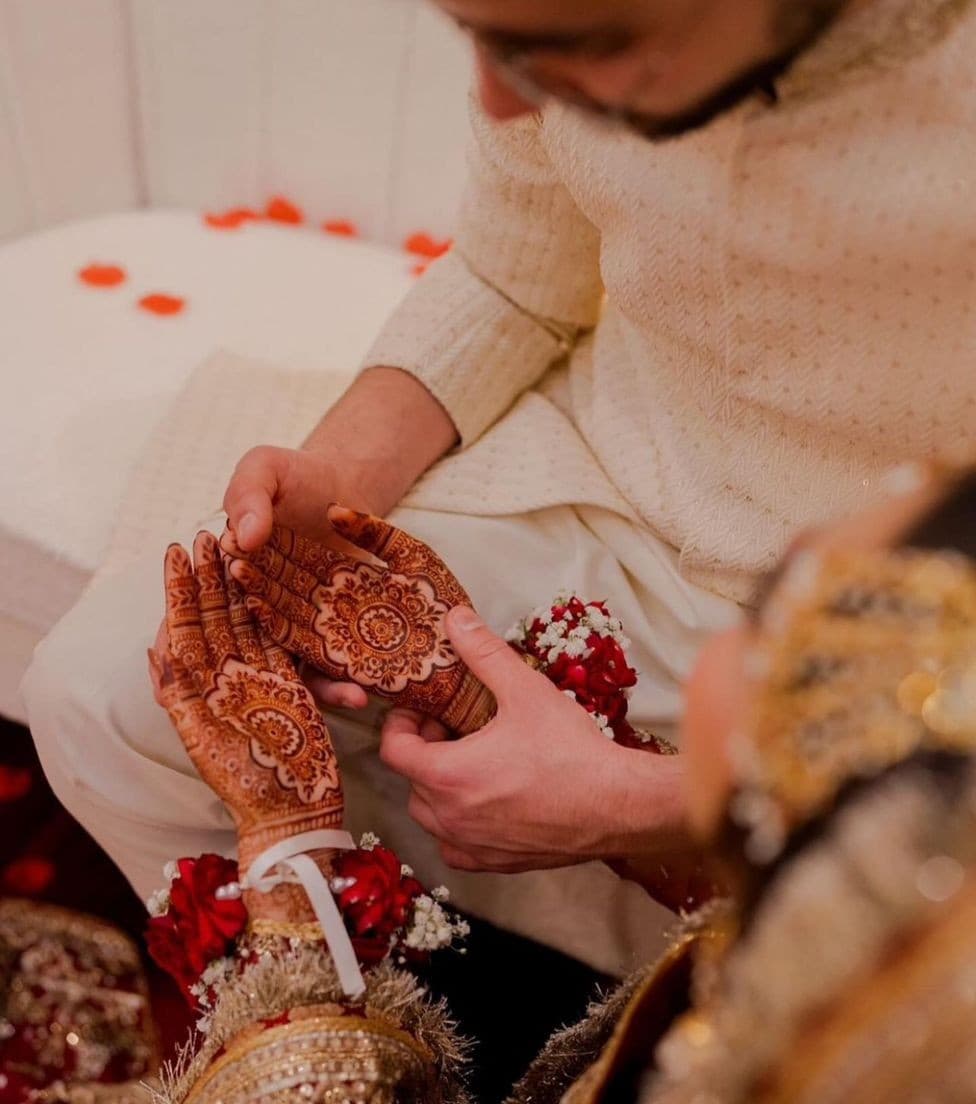
In many bridal designs there is a secret: the groom's name or initials, hidden in the pattern.9 In many families he has to find it later, often in front of everyone, and the teasing starts if he cannot. Our article on mehndi ceremony rituals explains how the hunt plays out in different families.
A few things make it work:
- Decide what to hide. Initials are easy to hide and easy to find; a full name is harder to place but makes a better game. Some brides hide the wedding date too.
- Agree the spelling and the script. English letters, Devanagari, Gurmukhi or Urdu: write it out for the artist on WhatsApp before the day, so nobody is guessing with wet paste.
- Choose how hard it should be. Tell the artist whether you want it barely findable (in a peacock's feathers or the lattice of a jaal) or in plain sight (along a finger or in the palm's centre).
- Know where it is yourself. Ask the artist to show you, and take a photo the next day once the colour has developed, in case the groom needs a hint.
- Tell the photographer. The hunt is one of the funniest moments of the wedding week. Make sure someone is there to photograph it.
Some grooms return the favour: a small initial of the bride's name in the groom's mehndi, hidden in a simple design on his palm.
Bridal motifs and what they say
Every motif in a traditional bridal design has a meaning, and where it goes on your hands matters too. Meanings vary by family and region; our dictionary of mehndi motifs covers many more.
| Motif | What it is often said to mean | Where it often goes on a bride |
|---|---|---|
| Bride and groom | The couple, often at the varmala or the pheras | The two palms, facing each other |
| Doli (palanquin) | The bride's journey to her new home | The back of the hand or the arm |
| Baraat and horse | The groom arriving | The back of the hand or the forearm |
| Peacock | Beauty, grace and love | The palm or the back of the hand |
| Elephant | Good fortune and a royal welcome | The back of the hand or the wrist |
| Kalash | Abundance and a full home | The palm or the wrist |
| Lotus | Purity and new beginnings | The centre of the palm or the wrist |
| Shehnai and dhol | The music of the wedding | The arms or the sides of the hand |
| Paisley | Fertility and plenty | Everywhere, as a filler |
| Sun and moon | A lifetime together | The palms |
Bridal mehndi across communities
How the bride's mehndi is done, who brings it and when it happens vary from family to family. A few customs that change what you plan for your design:
| Community | Custom | What it means for your mehndi |
|---|---|---|
| Punjabi and Sikh | The bride's mehndi is often sent by her future mother-in-law, and a dark colour is said to show how much the mother-in-law will love her. The red and white chura is put on the morning of the wedding or the day before). | Plan where the design ends on the forearm, because the chura will cover part of it. |
| Rajasthani and Marwari | Dense, fine designs to the elbow and full feet, with arches, figures and filled fingers. | Allow for one of the longest sittings of any bride. |
| Bengali, Odia and Bihari | Women traditionally decorate their hands and feet with alta for marriage, a red dye once made from lac and now mostly synthetic). Many brides wear mehndi as well. | If you will wear alta on your feet, keep your feet mehndi light or skip it. |
| Tamil, Telugu, Kannada and Malayali | Many families traditionally use fresh leaf paste in a round on the palm, with capped fingertips. | Decide whether you want the leaf round, a cone design or both, and on which day. |
| South Asian Muslim | The mehndi is a common tradition for brides as well as other girls at weddings, and in Pakistan it is often a lively evening with candles, sweets and dancing. | Plan the sitting before the evening, so your design is dry before the dancing. |
Customs vary within every family. Sources for this table: the Punjabi customs,10 the chura,2 alta11 and the Muslim mehndi9.12
For the rituals of the day in every community, read mehndi ceremony rituals and their meaning.
Your brief for the artist
A written brief saves time, avoids surprises and gets you comparable quotes. Copy this list, fill it in and send it to every artist you are considering.
- Dates and place: the date, start time and place of your mehndi, and the date of the main ceremony.
- Coverage: hands to the wrist, to the elbow or above; front and back; feet to the ankle, the shin or the knee.
- Style: traditional, Rajasthani, Pakistani, Indo-Arabic, minimal or a mix, with three to ten reference photos.
- Must-have motifs: figures, peacocks, the doli, a kalash, a skyline, a date.
- The hidden name: the exact spelling, the script, and how hard you want it to be to find.
- Your outfit and jewellery: the colours you will wear, and whether you will have a chura, haath phool, rings or payal.
- Anything to avoid: for example, sacred symbols on the feet, or figures if your family prefers patterns.
- Your skin: any allergies, sensitive skin, eczema, pregnancy or past reactions to mehndi.
- Your family: how many people want mehndi, which hands, and for how many hours.
- What you will provide: chairs, good light, a quiet room for your sitting, food and water for the artist's team.
Your bridal mehndi timeline
Good bridal artists are booked months ahead for the busy winter season (roughly November to February in much of India, with dates set by each year's auspicious days). Here is a timeline that works for most brides; add each step to your wedding checklist so nothing slips.
| When | What to do |
|---|---|
| Five to six months before | Start a board of designs you like. Shortlist three to five artists and ask whether they are free on your dates. |
| Three to four months before | Book your artist and pay the advance, with the terms in writing. Confirm who will do your hands, how many assistants will come for the family, and the start time. |
| Six to eight weeks before | Decide your coverage (hands to the wrist or elbow, feet or not) and your style. Write down the name or initials to hide, in the script you want. |
| Three to four weeks before | Patch test and trial with the artist's own paste. Look at the colour two or three days later and photograph it. |
| One to two weeks before | Agree the final design, the place, the timing, chairs, lighting and food for the artist's team. Send the number of family members who want mehndi. |
| Two to three days before mehndi | Finish waxing, threading, facials, manicures and pedicures. They should all happen before your mehndi, not after. |
| The day before mehndi | A gentle scrub on your hands and feet. An early night. |
| Two days before the wedding (one at the latest) | Your mehndi. |
| The next morning | Scrape off the dry paste. Keep your hands away from water for as long as you can. |
| The wedding day | Your colour is close to its darkest if you had mehndi two days before, still darkening if one day. |
The patch test and the trial
The patch test tells you whether your skin is happy with the artist's paste. A small dab of the actual paste the artist will use, on the inside of your arm, a few weeks before the wedding. Keep an eye on the spot for a couple of weeks: allergic reactions to PPD, the chemical in black henna, can appear 1 to 14 days after contact.13 If your skin itches, burns or blisters, you have time to heal and to change the paste or the artist. Do it even if you have worn mehndi all your life: a new artist means a new paste, and you do not know what is in it.
The trial tells you whether you like the artist's work. Ask for a small part of your actual design, perhaps one finger, a wrist band or a motif, rather than a random pattern. Then look at three things:
- The lines. Even, clean lines and neat fills matter more than how busy the design is.
- The colour after two or three days. Natural henna comes off orange and darkens over about three days.8 Judge the trial on day three, not on the first evening.
- How you felt. You will sit with this person for hours on one of the most emotional days of your life. If they were calm, kind and listened, that matters.
Many artists charge for a trial, sometimes adjusting it against the booking. Ask when you book.
When to apply for the darkest colour on your wedding day
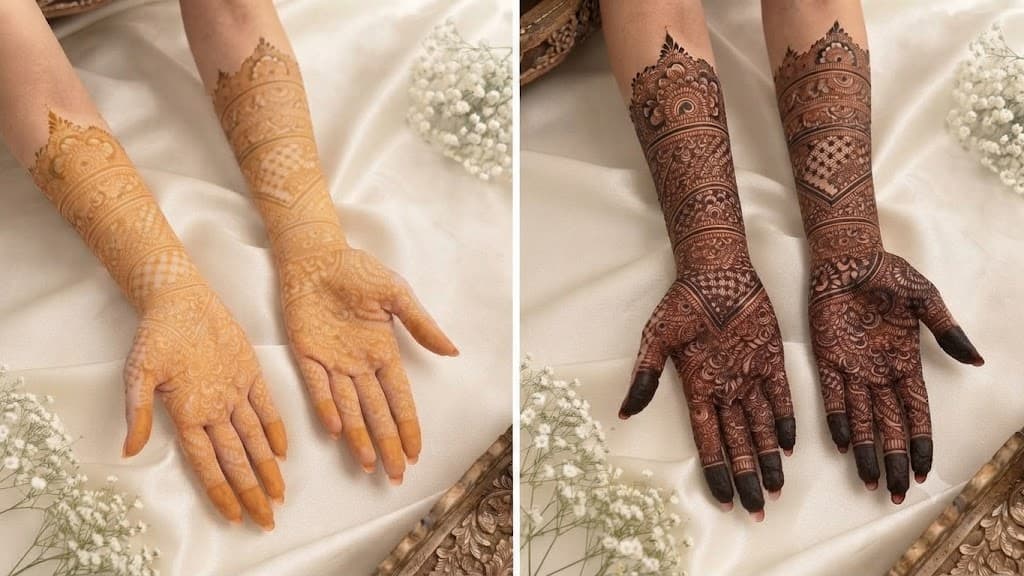
Henna works slowly. The paste releases a dye called lawsone, which moves into the outer layer of your skin and binds to it.8 When the paste comes off, the stain is orange; over the following three days it darkens to a deep reddish brown, and then fades gradually, usually within one to three weeks.8 The longer the paste stays on your skin, the darker and longer lasting the stain.8
So the best day for your mehndi is two days before the ceremony where you want your hands at their darkest, usually the pheras, the nikah or the anand karaj. One day before also works, but the colour will still be developing on the day.
Example: say your pheras are on a Saturday evening. Mehndi on Thursday afternoon gives you colour near its darkest on Saturday evening. Mehndi on Friday gives colour that is still darkening: noticeably lighter and more orange at the pheras. Mehndi on Saturday morning will still look orange. These days are an example; plan from your own dates.
A few other timing questions come up at almost every wedding:
- Haldi and mehndi on the same day. If your family's customs allow, do the haldi first: it ends with a bath, and water on fresh mehndi lightens it.
- A sangeet the same evening. Many families pair the mehndi with the sangeet. Start your sitting early, so the paste is dry before the dancing, or sit out the first hour of the sangeet with your hands wrapped.
- Several big days. If your reception is two or three days after the wedding, mehndi two days before the wedding still looks good at the reception; it holds well for the first week if you are gentle with your hands.
- A court marriage first. If you are registering your marriage before a celebration, as many couples do, plan your bridal mehndi around the celebration, not the registration. Our guide to court marriage in India explains the timeline.
The day of your bridal mehndi
Bridal mehndi is a long sitting. Full hands to the elbow and full feet can take most of a day, and the most detailed designs take much longer. A little planning makes the difference between a joyful afternoon and an exhausting one.
Before you sit down
- Eat properly and use the washroom. Once the paste is on, both get complicated.
- Wear a loose, front-opening top or a sleeveless kurta, nothing you have to pull over your head afterwards.
- Tie your hair back and take off your rings, bangles and watch.
- Wash your hands and feet with plain soap and dry them well. Skip lotion and oil: they sit between the paste and your skin.
- Set up a comfortable chair with a backrest, cushions under your arms and a stool for your feet, away from the direct blast of the air conditioning. Many artists say cold skin takes colour less easily.
During the sitting
- Most artists do the hands first and the feet while the hands dry, or the feet first if you will need to walk later. Ask yours how they like to work.
- The paste dries in about fifteen to twenty minutes and starts to crack.9 Once it is dry, the paste is often sealed by dabbing on a mixture of lemon juice and sugar, so it does not dry out or fall off.8
- Have a helper for the afternoon: someone to feed you, hold your water with a straw, answer your phone and keep the aunties happy.
- Take breaks between hands and feet if you need them. A good artist will plan for it.
After the sitting
- Keep the paste on for as long as you can, ideally overnight. Wrapping the dried paste loosely, in tissue for example, is a common way to hold in body heat for a more intense colour.9
- Sleep on an old sheet, with your hands and feet loosely wrapped.
- The next morning, scrape the dry paste off with a blunt butter knife or your fingers. Do not wash it off.
Keeping the colour dark until the pheras
Most of the darkness comes from two things you control: a good natural paste and time on your skin.8 Warmth helps too, many artists say. The rest is being kind to your hands for two days.
- Keep away from water for as long as you can after scraping, ideally until the next day.
- Rub in a little oil or balm once the paste is off, as many families do.
- No scrubbing, waxing or bleaching over the design. All of them remove the top layer of skin, and the colour with it.
- Go easy on hand sanitiser and hot water. Both dry the skin and speed up fading.
- Let someone else do the dishes. This is the best excuse you will ever have.
For more on colour, including the old tricks with cloves and why most of them are family tradition rather than science, read the colour section of our complete guide to mehndi.
Summer, winter and destination weddings
The weather and the place change how your mehndi behaves, so plan for them.
- Hot weather and outdoor sittings. The paste dries faster and can crack and flake off early, taking colour with it. Sit in the shade with a fan rather than in direct sun, and ask your artist to seal the paste a little more often.
- Humid or monsoon weather. The paste takes longer to dry, so leave extra time before you need to move, eat or dance.
- Winter. Many artists find cold hands take colour less easily. Keep the room warm, hold a hot cup before you start, and wear socks once your feet are dry.
- Beach and pool weddings. Salt water and chlorinated pools fade mehndi quickly, and sand wears it off your feet. Plan the swim for after the photographs, not before.
- Travelling to your wedding. If you fly or drive to the venue after your mehndi, carry your balm and keep your hands away from water on the journey. If your artist is travelling with you, their travel and stay will be part of the quote.
When something goes wrong
Even the best-planned mehndi has hiccups. Most of them are easy to fix if you know what to do.
- A smudge while the paste is wet. Do not wipe it. Ask the artist to fix it: they can lift a small area with a cotton bud and redraw it, or turn the smudge into part of the design.
- The colour looks light after scraping. Wait. Natural henna keeps darkening for about three days,8 so judge it on the wedding day, not the first morning. Never reach for an "instant" product to darken it.
- Patchy fingers. Fingers get used and washed most, so they fade first. Rings, a little oil and someone else doing the dishes all help.
- The sitting is running late. Ask the artist to finish the palms and the backs of the hands first, and to send an assistant to start your feet.
- Itching, burning or blisters. Scrape the paste off, wash gently and see a doctor. The safety section below has more.
Safety for brides
Natural henna is safe for most people: reactions to it are uncommon and usually mild, often to the lemon juice or essential oil in the paste rather than the henna itself.8 The serious skin reactions come from "black henna" and other pastes with chemicals added to make the colour faster or darker, and a bride's skin is the last place you want to find that out.
- Never use black henna. So-called black henna often gets its colour from a coal-tar hair dye containing PPD (p-phenylenediamine), which can cause dangerous skin reactions in some people.14 Reactions can include redness, itching, blisters, swelling and pain, and can leave you allergic to hair dye later;13 in some cases they leave permanent scars in the shape of the design.15
- Know what natural henna looks like. Natural henna gives a brown, orange-brown or reddish-brown colour; black or blue needs other ingredients.14 Natural paste goes on green to brown and comes off orange. If the stain is already black when the paste comes off, something other than henna is doing the work.
- Say no to "instant" cones. Natural henna paste must set for many hours to darken completely,13 so anything that promises colour in minutes, or comes without an ingredient list, should stay away from your skin.
- Patch test a few weeks ahead, with the artist's actual paste, and watch the spot for up to two weeks.
- G6PD deficiency. Henna is known to be dangerous for people with G6PD deficiency, an inherited condition that affects red blood cells.8 It has caused life-threatening reactions, mostly in babies and young children, and the doctors who reported one case say henna should be discouraged for G6PD-deficient people of any age.16 If you have it, talk to your doctor before your wedding.
- Pregnant? Check with your doctor before your mehndi, and avoid any black or chemical henna.
If your skin itches, burns, blisters or swells, scrape the paste off, wash gently with soap and water and see a doctor promptly. Do not cover a reaction with more paste or home remedies. Our complete guide to mehndi has the full safety checklist.
What bridal mehndi costs, and how artists price it
Bridal mehndi prices vary widely, because two quotes can cover very different amounts of work. Artists usually price in one of three ways:
- By coverage: palms only, hands to the wrist, hands to the elbow, plus feet. More skin, more hours, more paste.
- As a package: the bride plus a set number of family members, sometimes with a trial included.
- For guests: per hand, per guest or per assistant per hour.
| What | How it changes the price |
|---|---|
| Coverage | Each step from palms to wrist to elbow, and adding feet, adds hours |
| Detail | Portraits, storyboards and very fine Pakistani-style work take far longer than Arabic or minimal designs |
| The artist | Well-known artists with long waiting lists charge more |
| The date | Peak wedding dates and festival weeks are the busiest |
| Travel and timing | Travel to your home or another city, very early starts and late finishes |
| Family and guests | The number of assistants and the hours they stay |
| Taxes and extras | Whether GST, a trial and the artist's travel are included |
The only way to compare artists fairly is to give each one the same brief. For example: "Bride: both hands front and back to the elbow and feet to the ankle, traditional with figures and the groom's initials hidden. Family: fifteen women, both hands to the wrist. Saturday afternoon, at home in Jaipur, starting at 1 pm." That brief is an example; write your own and send it to three artists.
You can find mehendi artists on Shaadiwaale by city, such as Jaipur, Delhi NCR, Mumbai, Bengaluru and Hyderabad, and ask for quotes. Put the quote into your wedding budget next to everything else; our look at what a wedding costs in India in 2026 shows where mehndi sits in the bigger picture.
Questions to ask your bridal mehndi artist
Ask these before you pay an advance, and get the answers in writing on WhatsApp or email.
Our list of questions to ask before you pay an advance works for every vendor, mehndi artists included.
Photographing your bridal mehndi
Your mehndi is at its most photogenic twice: when the paste is fresh and glossy, and two days later when the colour has deepened. Tell your photographer which moments you care about, and share this shot list:
- The artist at work, and the paste going on
- The finished design while the paste is still on, close up
- Your hands framing your face
- Both palms held together, if the design joins across them
- The hidden name, and the groom searching for it
- Your hands with your sisters' and friends' hands around them
- Your hands with the chura, rings and haath phool on the wedding day
- Your feet with the payal design, on the day
- Your hands in the groom's hands at the pheras or the ring exchange
Save the designs and poses you like on Inspiration to show your photographer and your artist.
Frequently asked questions
How many days before the wedding should bridal mehndi be applied?
Two days before the main ceremony is best, one day at the latest. Natural henna comes off orange and darkens to reddish brown over about three days, so mehndi two days before gives colour near its darkest on the day, while mehndi one day before gives colour that is still developing and lighter.
How long does bridal mehndi take?
It depends on coverage and detail. Hands to the wrist in a modern design can take an hour or two; full hands to the elbow and full feet in a traditional design can take most of a day, and portrait designs much longer. Ask your artist for an estimate for your exact design.
Which bridal mehndi design is best?
The one that suits your outfit, your sitting time and your story. Traditional full hands with figures and a hidden name are the classic choice; minimal, Indo-Arabic and personal designs suit brides who want more bare skin or a shorter sitting.
What is the latest bridal mehndi design for 2026?
Personal designs are a growing choice: love stories in panels, skylines of the places that matter to you, wedding dates, initials and portraits, often set inside a traditional design. Minimal bridal mehndi with fine lines and bare skin is also popular with modern brides.
Can a bride have a simple mehndi design?
Yes. A full palm mandala, a jaal on the back of the hand, filled fingertips and the groom's initials hidden somewhere small is a simple, beautiful bridal design, and it takes an hour or two rather than a whole day.
Why do brides hide the groom's name in their mehndi?
It is a much-loved tradition: the groom's name or initials are hidden in the design, and in many families he has to find them, often in front of everyone. It is a playful moment that brings the two families together.
Front hand or back hand: which matters more for a bride?
Both, for different reasons. The palm stains darkest and carries the main motifs; the back of the hand shows in almost every photograph. Most bridal designs cover both.
How can I make my bridal mehndi darker?
Use a fresh, natural paste, keep it on for as long as you can (overnight if possible), seal it with lemon and sugar once dry, keep your hands warm, scrape rather than wash it off, and keep away from water until the next day.
Is black henna safe for a bride?
No. So-called black henna often contains PPD, a hair dye chemical that can cause blistering and scarring. Natural henna is never black when the paste comes off.
How much does bridal mehndi cost?
Prices vary widely with the coverage, the detail, the artist, the date and travel. Give three artists the same written brief and compare their quotes item by item. Shaadiwaale lists mehendi artists by city, so you can ask several for quotes.
When should I book my bridal mehndi artist?
Three to four months before the wedding, and earlier for a popular artist or a peak date in the busy winter season. Book a patch test and a trial for three to four weeks before.
Can I wear my chura over fresh mehndi?
The chura usually goes on the morning of the wedding or the day before,2 so time your mehndi so the paste is dry and scraped off by then. Plan the design so it ends at the wrist or continues below where the chura will sit.
Share this guide
Send it to the family group, or keep it for later.
Questions about your wedding?
Our team answers questions about venues, vendors and the budget, free on WhatsApp.
About Shaadiwaale
Indian wedding planning in one place: venues and vendors with real prices, free kundli matching, invitations and tools to plan every function together.
Every function. Every family. One plan.
Notes
- Henna: rituals, aesthetic and social practices, UNESCO Intangible Cultural Heritage, inscribed 2024 for sixteen Arab countries. Henna as a symbol of joy at births and weddings. ↩
- Chura (bangles), Wikipedia. The chura put on the morning of the wedding or the day before; red and white. ↩
- Sojat mehndi from Rajasthan gets GI tag, Deccan Herald, 26 September 2021. ↩
- Popular Indian product used for body art given GI label, Asia IP, 12 November 2021. Sojat as the largest mehndi-producing area in India. ↩
- New mehendi trends: Tinder and skylines, Gulf News, Megha Merani, updated 9 July 2022. Brides in the UAE moving to personalised designs: love stories, skylines, planes and logos; a portrait design that took thirteen and a half hours; dulha-dulhan figures with a story. ↩
- Paisley (design), Wikipedia. The Persian boteh. ↩
- From Arabic to minimalist: 10 stunning mehendi designs trending in 2025, Elle India, Tanvee Khanna, 16 September 2025. Minimal designs for modern brides; the initial of the future spouse's name. ↩
- Henna, Wikipedia. Lawsone and how it binds to the skin; the stain orange at first and darkening over about three days to reddish brown; fading within one to three weeks; palms and soles staining darkest; longer paste time giving a darker stain; sealing with lemon and sugar; mild reactions to natural paste; G6PD deficiency. ↩
- Mehndi, Wikipedia. Names or initials hidden in bridal designs; mehndi among South Asian Muslims; the paste drying in fifteen to twenty minutes; wrapping to hold in body heat. ↩
- Punjabi wedding traditions, Wikipedia. The bride's mehndi sent by her future mother-in-law, and the saying about the mother-in-law's love (citing K. Myrvold, 2004). ↩
- Alta (dye), Wikipedia. Alta once made from lac, now mostly synthetic; worn for marriage in Bengali, Bihari and Odia traditions. ↩
- Weddings in Pakistan: process and religion, Intersections, Duke University. The mehndi evening with candles, sweets and dancing. ↩
- Black henna temporary tattoos, Health Canada. Reactions to black henna and when they can appear; natural henna needing many hours to darken. ↩
- Temporary tattoos, henna/mehndi, and "black henna": fact sheet, US Food and Drug Administration. Black henna and PPD; natural henna's brown, orange-brown or reddish-brown colour. ↩
- Black henna warning, Florida Department of Health, 2016. Permanent scarring in the shape of the design. ↩
- Life-threatening haemolysis induced by henna in a Sudanese child with G6PD deficiency (a case report), Eastern Mediterranean Health Journal, WHO, 2017. ↩