Ideas
Mehndi Designs for Kids 2026: 40 Easy, Quick and Safe Ideas
40 quick mehndi designs for kids, from a dot flower to little animals and festival motifs, with what parents need to know about safety, how to keep a child still and how to look after the colour.
- 40 designs: easy, fingertip, animal, back hand, girls at a wedding, boys and festivals
- Natural henna only: never black henna or instant cones on a child
- No henna for babies or anyone with G6PD deficiency; ask a doctor if unsure
- Keep it to a few minutes, one hand is plenty for little ones
Outfits and beauty · 17 min read · By The Shaadiwaale team · Updated 20 October 2026
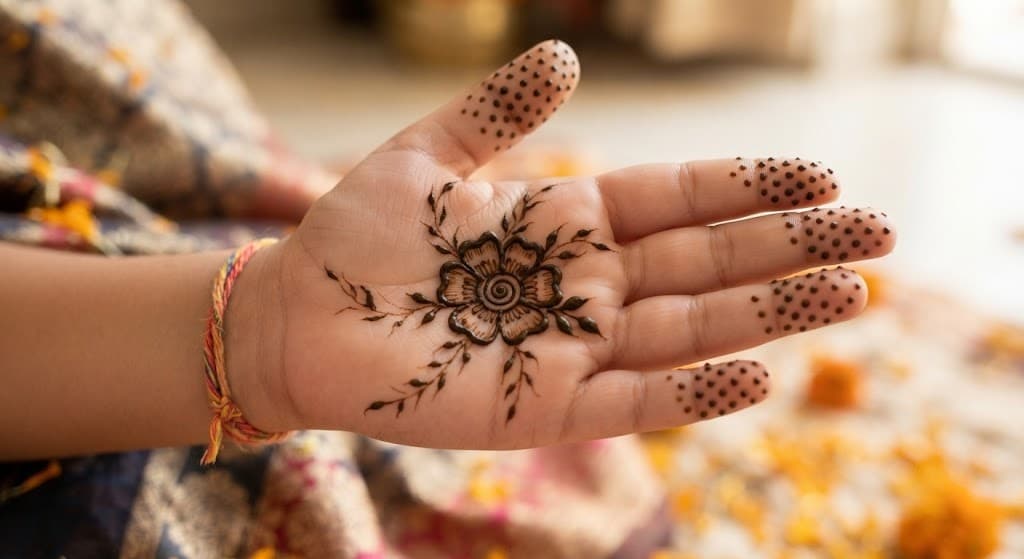
Watch any family wedding and you will see it: a line of children waiting for their turn with the mehendi artist, then holding up a palm with one small flower for every aunt to admire. Children love mehndi. What they do not love is sitting still, so the best designs for them are small, bold and finished in minutes.
This guide brings together 40 mehndi designs for kids, from a single dot flower to fingertip patterns, little animals, festival motifs and a mini version of the bride's design for older girls. Safety comes first, because a child's skin needs more care than an adult's, not less. After the designs you will find how to keep a child still while the paste dries, how to draw an easy design yourself, and how to look after the colour.
Quick answer: Mehndi designs for kids are small, simple henna patterns a child can sit through, such as a flower or a smiling sun in the palm, dotted fingertips, a heart, a star or a little butterfly on the back of the hand. Keep each design to a few minutes, and use fresh natural henna only, never black henna or "instant" cones. Skip henna for babies and for any child with G6PD deficiency, an inherited condition henna is known to be dangerous for. If you are not sure, ask your child's doctor before their first mehndi.
What's in this guide
- Is mehndi safe for kids?
- Mehndi designs for kids at a glance
- Easy mehndi designs for kids
- Simple fingertip designs
- Animal and fun designs
- Back hand designs for kids
- Designs for girls at a family wedding
- Mehndi for boys
- Festival designs for kids
- How to keep a child still for mehndi
- How to draw an easy design on your child
- Drying, colour and aftercare
- Planning children's mehndi at a wedding
- Frequently asked questions
Is mehndi safe for kids?
For most older children, a small design in fresh natural henna is a happy part of a wedding or a festival. Health Canada describes natural henna as generally safe to use directly on skin.1 Rules differ by country, though. The US Food and Drug Administration has approved henna only for colouring hair, and not for applying to the skin as mehndi.2 For parents, three things matter most.
Babies and G6PD deficiency. G6PD deficiency is an inherited condition, more common in boys and men than in girls and women, and henna is known to be dangerous for anyone who has it.3 Doctors writing in a WHO journal in 2017 described a six-year-old boy whose G6PD deficiency had never been diagnosed. Henna was put on his hands and feet for his kindergarten graduation, and he developed life-threatening haemolysis, which means his red blood cells were breaking down. The doctors note that most reported cases have been young infants or newborns, and their advice is to discourage henna for infants in general, and for G6PD-deficient people whatever their age.4 So no henna for babies, and if you do not know whether your child has G6PD deficiency, ask their doctor first.
Black henna. So-called black henna is not the natural product: its jet colour often comes from PPD, an ingredient that the FDA warns can cause dangerous skin reactions for some people.2 Health Canada gives three signs to look out for: the paste or design is very dark black, it sets very quickly, and it has very little or no scent. An allergic reaction may take anywhere from 1 to 14 days to show, and someone can come into contact with PPD once without any reaction at all,1 so one trouble-free design proves nothing. Never let anyone put black henna or an "instant" cone on a child, at a wedding, a fair or a beach stall.
What else is in the paste. Natural henna can occasionally cause a mild allergic reaction, and that is often linked to lemon juice or essential oils mixed into the paste rather than to the henna itself.3 Ask your artist what goes into their cones. For a child, you may prefer a plain paste.
A few simple habits keep things safe:
- Try a small dot a day or two before. Put a little of the same paste on the inside of the arm a day or two ahead, and check the spot before the full design. It can show a reaction to something in the paste, but not everything: a reaction to PPD can take up to 14 days to appear, and a dot tells you nothing about G6PD deficiency.
- Skip sore skin. No paste on scraped, sunburnt or irritated skin.
- Keep the paste away from eyes and mouth. Small children put their hands in their mouths, so stay with them until the paste is dry.
- Watch your child afterwards, not only the skin. If the design itches, swells or blisters, take the paste off and see a doctor; Health Canada advises contacting your health care provider after a reaction to black henna.1 A G6PD reaction shows elsewhere: in the reported case, the boy had a headache and was short of breath, the whites of his eyes had turned yellow, his urine was the colour of tea and he was extremely pale, three days after the henna.4 Signs like these after mehndi need a doctor the same day. Health Canada also describes anaphylaxis, an allergic reaction that tightens the airways, comes on quickly and may be life-threatening,1 so if your child has any trouble breathing, get emergency help at once.
Our complete guide to mehndi has more on safety for the whole family.
Mehndi designs for kids at a glance
Choose by how long your child will sit. The times are rough and depend on the child and the artist.
| Design | Where it goes | Rough time | Good for | Tip |
|---|---|---|---|---|
| Dot flower or sun | Centre of the palm | A few minutes | Younger children, a first mehndi | Let them watch it being drawn |
| Fingertips | Tips of the fingers | A few minutes | Children who cannot sit long | Do one hand only if they get restless |
| Animal or fun shape | Palm, wrist or back of the hand | 5 to 10 minutes | Children who want to choose | Let them pick the animal |
| Wrist band | Around the wrist | 5 to 10 minutes | Boys and girls | Looks like a bracelet or a watch |
| Festival motif | Palm or back of the hand | A few minutes | Eid, Diwali, Raksha Bandhan, Teej | Match it to the day |
| Mini bridal | Palm and fingers | 15 to 30 minutes | Older girls at a family wedding | Only for a child happy to sit |
Easy mehndi designs for kids
These are the easiest designs of all, and each needs only a cone of natural henna and a few minutes. Every design in this guide is quick, which here means up to about half an hour, and most take far less.
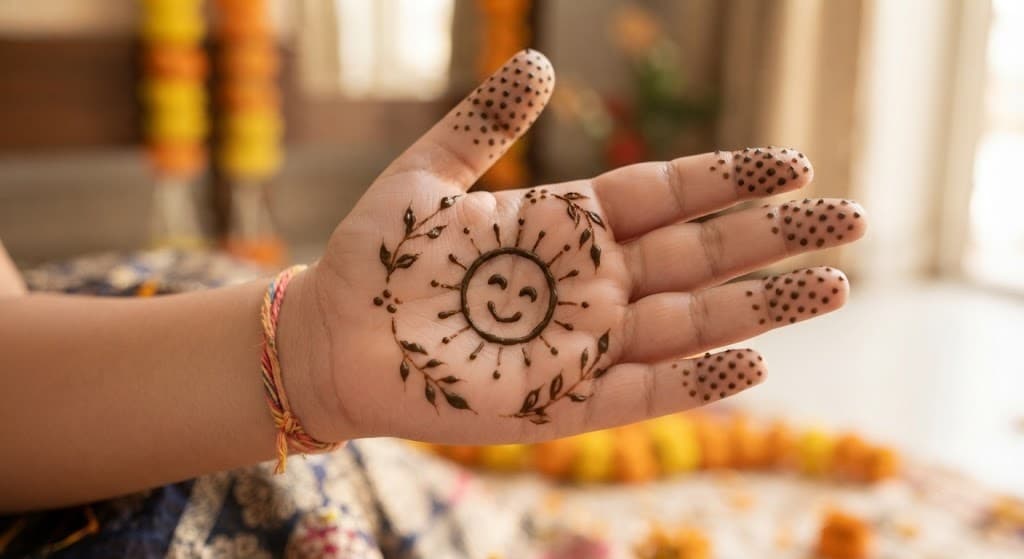
- Dot flower. Five dots around a bigger dot in the centre of the palm. A good first mehndi, and the easiest design to draw. Time: quick.
- Single flower. A five-petal flower in the palm, outlined, with a tiny dot in each petal. Time: quick.
- Smiling sun. A circle with short rays all round it and a smiling face inside. Time: quick.
- Heart. A small outlined heart in the centre of the palm, left plain or filled with dots. Time: quick.
- Star. A five-pointed star with tiny dots scattered round it, like a night sky. Time: quick.
- Moon and stars. A crescent moon near the wrist with three small stars above it. Time: quick.
- Rainbow arches. Three arches, one inside another, across the palm, with a few dots for rain underneath. Time: quick.
- Crossed leaves. Two leaves crossing at the base of the palm, with a dot where they meet. Time: quick.
Simple fingertip mehndi designs for kids
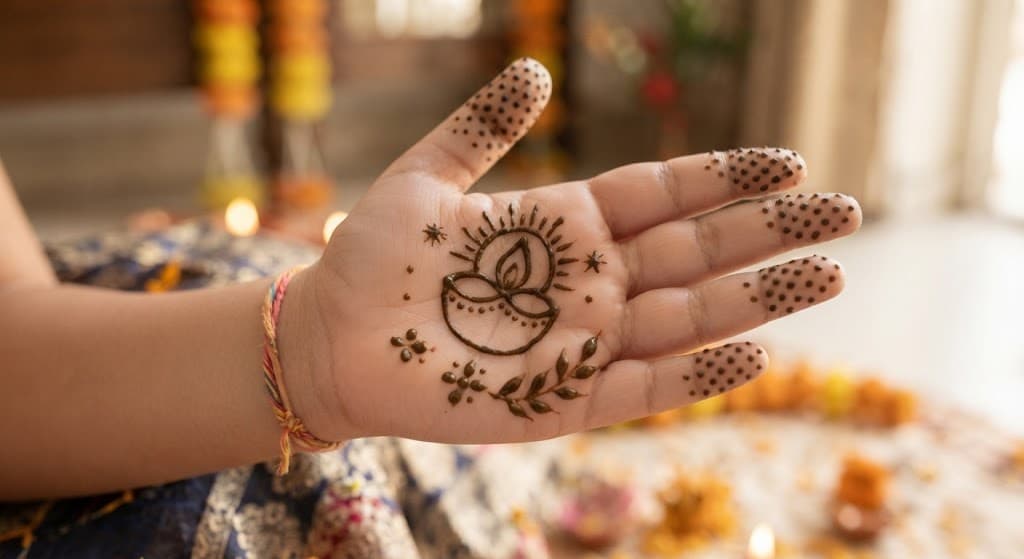
Fingertip designs suit little ones who cannot sit for long. Each finger takes seconds, and the child can watch every one being done.
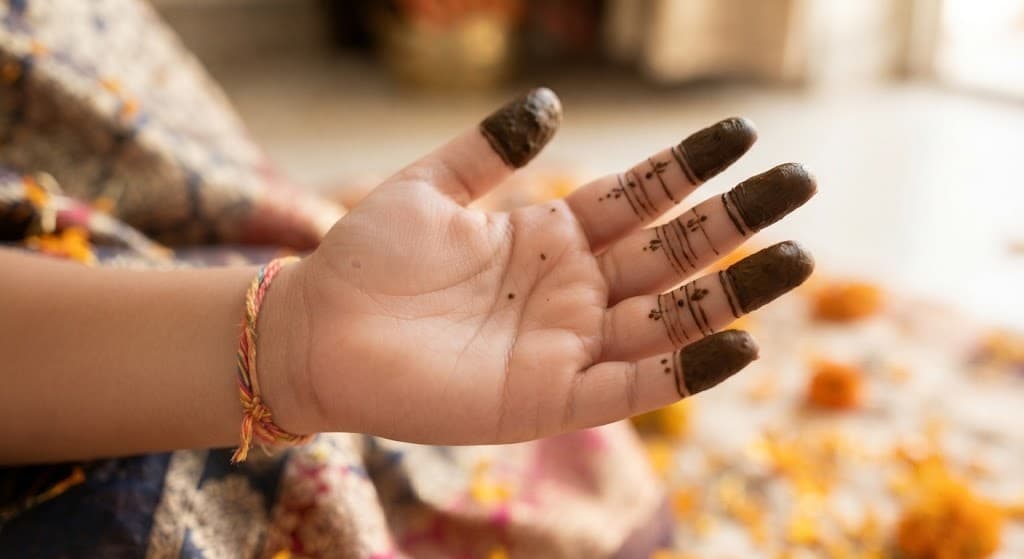
- Capped fingertips. Each fingertip filled with paste, the classic and the simplest of all. Time: quick.
- Dotted tips. Three dots in a triangle on each fingertip. Time: quick.
- Heart on every finger. A tiny heart on the pad of each fingertip. Time: quick.
- Ring lines. A thin line around the base of each finger, like a ring, with one dot on top. Time: quick.
- Leaf fingers. A small leaf running up each finger from the knuckle. Time: quick.
- Dotted arc. A curve of dots across the top of the palm, just under the fingers, with every tip capped. Time: quick.
Animal and fun mehndi designs for kids
Let your child choose. A design they asked for is one they will sit still for. Animals and shapes like these are easy to draw, and a child's own idea, a kite, their pet or a rocket, works just as well.
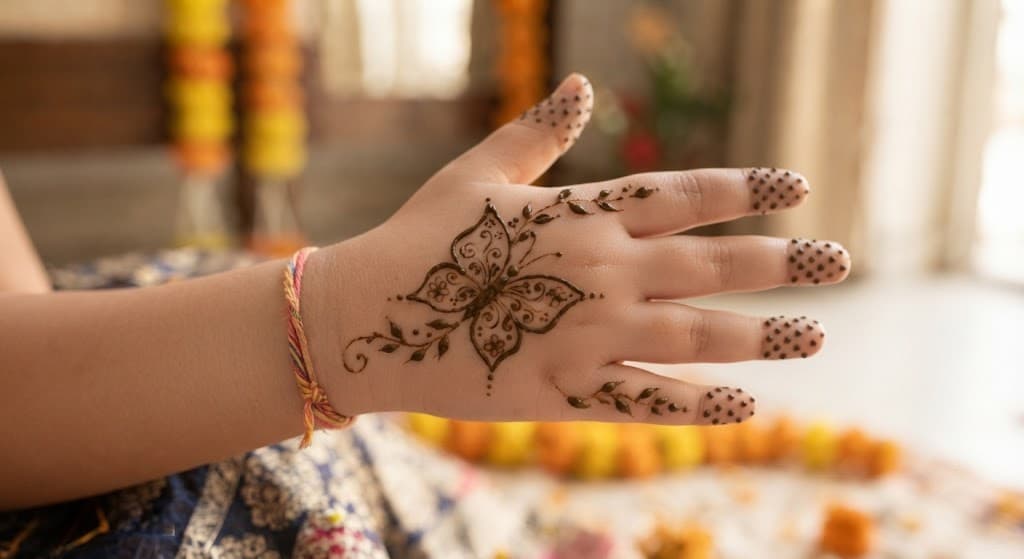
- Butterfly. Two pairs of wings decorated with dots, on the back of the hand or the wrist. Time: quick.
- Fish. A small fish with a scaly body and a swishing tail in the palm, with bubbles rising towards the fingers. Time: quick.
- Elephant. A little elephant seen from the side, with a decorated cloth on its back. Time: quick.
- Peacock feather. A single feather with an eye at its tip, curving up one finger. Time: quick.
- Turtle. A round shell patterned with small shapes, with four short legs and a head peeping out. Time: quick.
- Owl. Two big round eyes and a pointed beak, with feathers drawn as rows of small arches. Time: quick.
- Kite. A diamond kite with a long string of bows trailing down towards the wrist, lovely for Makar Sankranti. Time: quick.
- Initial in a heart. The first letter of the child's name inside a heart in the palm. Time: quick.
Back hand mehndi designs for kids
The back of the hand is what shows in photographs. These keep it light, and our guide to back hand mehndi designs has plenty more that can be drawn smaller.
- Bracelet band. A band of dots and small loops around the wrist, like a bracelet. Time: quick.
- Wrist flower. One flower at the wrist with a leaf on either side. Time: quick.
- Tiny vine. A short vine of leaves from the middle finger towards the wrist. Time: quick.
- Knuckle dots. A dot on every knuckle and a ring line on each finger. Time: quick.
- Mini Arabic trail. Two or three small shaded flowers in a short diagonal, a child-sized take on the Arabic style. Time: quick.
Mehndi designs for girls at a family wedding
At a family wedding, many girls want a design like the bride's. A smaller version of the same idea keeps them happy without hours in a chair, and our bridal mehndi designs are full of ideas to borrow in miniature.
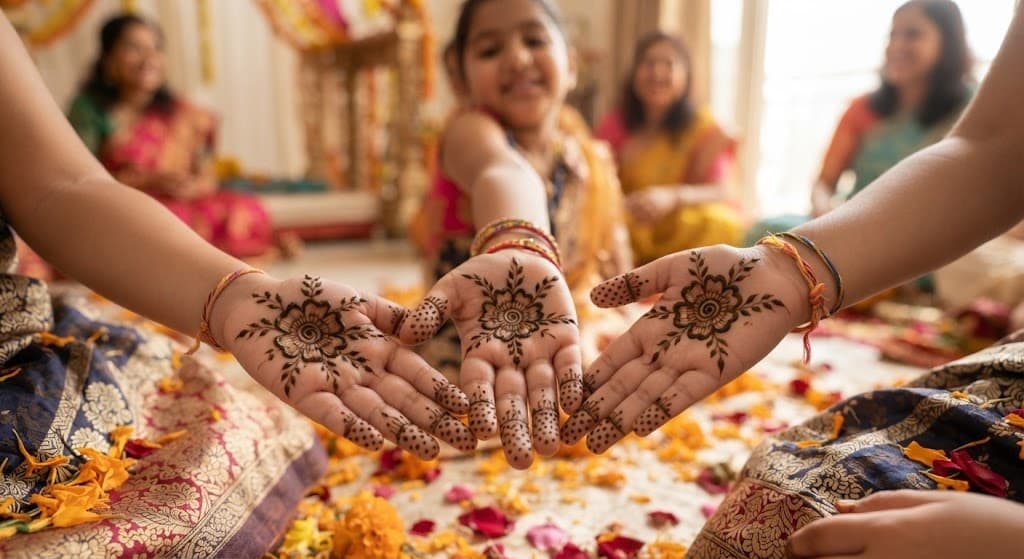
- Mini mandala and caps. A small mandala in the palm, called a gol tikki in many families, with all five fingertips capped. Time: quick.
- Half palm. A pattern covering the palm up to the base of the fingers, with the fingers bare apart from their tips. Time: quick.
- Little bride. The bride's main motif, such as a lotus or a peacock, drawn small in the palm. Time: quick.
- Bel to the wrist. A vine, which is what bel means, from the index finger across the palm to the wrist. Time: quick.
- Matching cousins. The same small motif on every child at the function, so they look like a set in the photographs. Time: quick.
Mehndi for boys
Whether boys have mehndi varies from family to family, but in many families boys want it too, especially when their sisters and cousins are having it, and nobody likes to be left out on a wedding day. Keep the design small and bold. Remember that G6PD deficiency is more common in males,3 so the G6PD question matters even more for boys.
- Sun in the palm. A round sun with straight rays, nothing else. Time: quick.
- Bold star. One large outlined star on the back of the hand. Time: quick.
- Watch strap. A geometric band around the wrist, like a watch. Time: quick.
Festival mehndi designs for kids
Festivals are a lovely time for a first mehndi. Customs vary from family to family, so ask what yours usually does.
- Eid crescent. A crescent moon and a few stars in the palm. Girls as well as women put on mehndi for Chaand Raat, the eve of Eid al-Fitr.5 Time: quick.
- Diwali diya. A small diya, the clay lamp of Diwali, with a flame and a ring of dots, in the palm. Diwali falls on Sunday, 8 November in 2026;6 our Diwali mehndi designs have more. Time: quick.
- Rakhi on the wrist. A rakhi drawn around the wrist, with a round centre and two strings. It echoes the thread a sister ties around her brother's wrist on Raksha Bandhan.7 Time: quick.
- Teej swing. A little swing hanging from a leafy branch. Swings are part of Teej, girls put henna on their hands and feet for it, and on Sinjara, as the day before Haryali Teej is called, women do the same.8 Time: quick.
- Navratri dandiya. Two crossed dandiya sticks with a few dots around them. Time: quick.
How to keep a child still for mehndi
The design is the easy part. Keeping a small hand still for ten minutes, and then keeping it off everything for the fifteen to twenty minutes the paste takes to dry, is the real job.
- Pick the right moment. After a meal and a trip to the washroom, and never when they are hungry or sleepy.
- Let them choose. Show them three designs and let them pick one. Children sit better for something they asked for.
- Keep it short. For small children, one hand is plenty. You can always add the other hand later if they are still keen.
- Give them something to watch. A story, a song, or a cartoon on a phone held by someone else.
- Rest the hand on something soft. A folded towel or a cushion on a table, palm up, so the hand stays steady and still.
- Bring a helper. Another adult can feed snacks, hold a drink with a straw and wipe noses while the paste dries.
- Praise as you go. Telling them how still they are being works better than telling them to stop wriggling.
How to draw an easy mehndi design on your child
The smiling sun is a good first design to draw yourself, and you do not need to be an artist. Use a ready-made cone of natural henna whose maker names the ingredients.
- Wash and dry the hand. Plain soap and water, with no cream or oil afterwards.
- Practise on paper. Draw the sun two or three times until the circle feels easy.
- Settle the hand. Rest it palm up on a folded towel, with the fingers relaxed.
- Draw the circle. A coin-sized circle right in the middle of the palm.
- Add the rays and the face. Short straight lines all round the circle, then two dots for eyes and a curve for the smile.
- Cap the fingertips. A dot on each fingertip finishes it off.
- Let it dry. Keep the hand still, and if a line goes wrong, wipe it with a damp cotton bud while the paste is wet.
Drying, colour and aftercare
Henna paste dries in about fifteen to twenty minutes,9 and that is the stretch when small hands need to stay away from clothes, faces and cousins.
How long to leave it on is up to you and your child. For adults, the paste is usually kept on for at least four to six hours, often overnight, and the longer it stays on, the darker and longer-lasting the stain.3 With a child, take it off when they have had enough. The colour will be lighter, and most children are just as proud of it.
- Skip the sugar seal for little ones. A dab of lemon juice and sugar helps the paste stay on,3 but on a small child it gets sticky very quickly, and lemon juice is one of the things linked to mild reactions.3 It is optional.
- For bedtime, wrap it. A layer of tissue over the dried paste holds in body heat,9 and a pair of clean cotton socks over the hands keeps the sheets clean.
- Scrape, do not wash. When it is time, lift the dry paste off with the back of a spoon or rub it away with dry fingers, and keep the hands out of water for a while afterwards.
- Expect orange first. The stain is orange when the paste comes off and darkens over the next three days.3 For a wedding or a festival, one or two days before gives the colour time to deepen by the day itself. The evening before works too, and suits children, but the colour will still be darkening on the day.
- It fades on its own. After reaching its darkest, the stain holds for a few days and then wears off as the skin renews, typically within one to three weeks.3
Planning children's mehndi at a wedding
At a family mehndi, the children often end up waiting until the bride is done. A little planning gives them their turn without anyone getting tired or cross.
- Count the children when you book. Tell your artist how many children want mehndi, so they can plan the time or bring a second artist.
- Ask about the paste. Check that every child will get natural henna, and ask what is mixed into it.
- Do the children early. Small children are at their best early in the function, before the music and the late hours take over.
- Set up a children's corner. A low table, towels, wet wipes, snacks and drinks with straws.
- Keep the designs short. Agree a small menu, such as a flower, a sun, a butterfly or fingertips, so each child takes a few minutes.
Describing the henna traditions of sixteen Arab countries, which it inscribed on its list of intangible cultural heritage in 2024, UNESCO calls henna "a symbol of joy" and notes that families and communities pass on the traditions "through observation and hands-on practice".10 Children watching the artist at a family mehndi are doing just that.
You can find mehendi artists on Shaadiwaale in cities such as Delhi NCR, Lucknow, Kochi and Indore. Our mehndi designs hub has 150 designs for every age and occasion.
Frequently asked questions
What is the easiest mehndi design for kids?
A dot flower: five dots around a bigger one in the centre of the palm. It takes a minute or two, needs no drawing skill, and looks finished. Capped fingertips are just as easy and pair well with it. If your child wants something more, a smiling sun or a small heart is the next step up.
Is mehndi safe for kids?
For most older children, a small design in fresh natural henna is fine. Do not use henna on babies or on anyone with G6PD deficiency, an inherited condition henna is known to be dangerous for, and if you are unsure, ask your child's doctor first. Never use black henna or "instant" cones, which can contain PPD, a chemical that can cause dangerous skin reactions.
At what age can a child have mehndi?
There is no fixed age. The doctors who reported one serious case advise that henna be discouraged for infants in general and for people with G6PD deficiency at any age. Beyond that, it is sensible to wait until your child is old enough to sit still for a few minutes and keep their hands out of their mouth. If in doubt, ask your child's doctor.
How long should a child keep mehndi on?
As long as they are comfortable. The paste is dry after fifteen to twenty minutes, and from then on, more time means a deeper colour. Adults keep it on for at least four to six hours, often overnight, but a child can take it off sooner. The stain will simply be lighter, and still pretty.
How long does mehndi last on kids?
The stain starts orange and darkens over about three days. After that it holds for a few days and then fades as the skin renews, typically within one to three weeks. Washing hands often, as children do, can make it fade faster, and the fingers, which are used and washed most, usually fade first.
Can boys have mehndi?
Yes, if your family is happy with it. A sun in the palm, a bold star or a band around the wrist all suit boys and take only a few minutes. G6PD deficiency is more common in males, so if you are not sure whether your son has it, ask his doctor before his first mehndi.
What should I do if my child reacts to mehndi?
Take the paste off straight away and wash the skin gently. If the design itches, swells or blisters, see a doctor. If your child turns pale, the eyes look yellow or the urine turns dark, see a doctor the same day, and get emergency help for any trouble breathing. If you are not sure what was in the paste, watch the skin for two weeks: a PPD reaction can appear 1 to 14 days after contact.
Can I use black henna or instant mehndi on my child?
No. Black henna often gets its dark colour from PPD, which can cause dangerous skin reactions, and "instant" cones can contain it too. Watch for a paste that is very dark black, sets very quickly or has little or no smell. Natural henna stains orange at first, darkens to reddish brown over a few days and needs hours on the skin, so a quick jet-black design is a warning sign.
Share this guide
Send it to the family group, or keep it for later.
Questions about your wedding?
Our team answers questions about venues, vendors and the budget, free on WhatsApp.
About Shaadiwaale
Indian wedding planning in one place: venues and vendors with real prices, free kundli matching, invitations and tools to plan every function together.
Every function. Every family. One plan.
Notes
- Black henna temporary tattoos, Health Canada. Natural henna generally safe on skin; three warning signs of black henna; reactions 1 to 14 days after contact; a first contact may cause no reaction; contacting a health care provider after a reaction to black henna; anaphylaxis. ↩
- Temporary tattoos, henna/mehndi, and "black henna": fact sheet, US Food and Drug Administration. Henna approved in the United States only as a hair dye; PPD in black henna and dangerous skin reactions. ↩
- Henna, Wikipedia. G6PD deficiency, more common in males; mild allergic reactions often linked to lemon juice or essential oils; keeping the paste on four to six hours or overnight; longer paste time giving a darker, longer-lasting stain; sealing with lemon and sugar; the stain orange at first and darkening over three days; the stain fading within one to three weeks. ↩
- Life-threatening haemolysis induced by henna in a Sudanese child with glucose-6-phosphate dehydrogenase deficiency, Kheir, Gaber, Gafer and Ahmed, Eastern Mediterranean Health Journal (WHO), volume 23, 2017. A six-year-old boy with undiagnosed G6PD deficiency, and his signs three days after henna; most reported cases in young infants or newborns; henna to be discouraged in infants and in G6PD-deficient people o ↩
- Chand Raat, Wikipedia. Women and girls decorating their hands with mehndi on the eve of Eid al-Fitr. ↩
- 2026 Diwali puja calendar for New Delhi, Drik Panchang. Diwali on 8 November 2026. ↩
- Raksha Bandhan, Wikipedia. Sisters tying a rakhi on their brothers' wrists. ↩
- Teej, Wikipedia. Swings at Teej; girls applying henna to their hands and feet; mehndi on hands and feet on Sinjara. ↩
- Mehndi, Wikipedia. The paste drying in fifteen to twenty minutes; wrapping to hold in body heat. ↩
- Henna: rituals, aesthetic and social practices, UNESCO Intangible Cultural Heritage, inscribed 2024 for sixteen Arab countries. Henna as a symbol of joy; traditions passed on through observation and hands-on practice. ↩