Ideas
Arabic Mehndi Designs 2026: 60 Simple, Front Hand, Back Hand and Feet Ideas
60 Arabic mehndi designs, from a three-flower vine to full bridal hands, sorted by where they go and what they are for, with what is in for 2026 and how to draw an Arabic trail yourself.
- 60 designs: simple, front hand, back hand, fingers, feet, bridal and Indo-Arabic
- Arabic mehndi is a bold floral trail with plenty of bare skin, quicker than Indian
- For 2026, UAE artists report demand for minimal, wrist-length designs
- Always natural henna: never black henna or instant cones
Outfits and beauty · 19 min read · By The Shaadiwaale team · Updated 20 October 2026
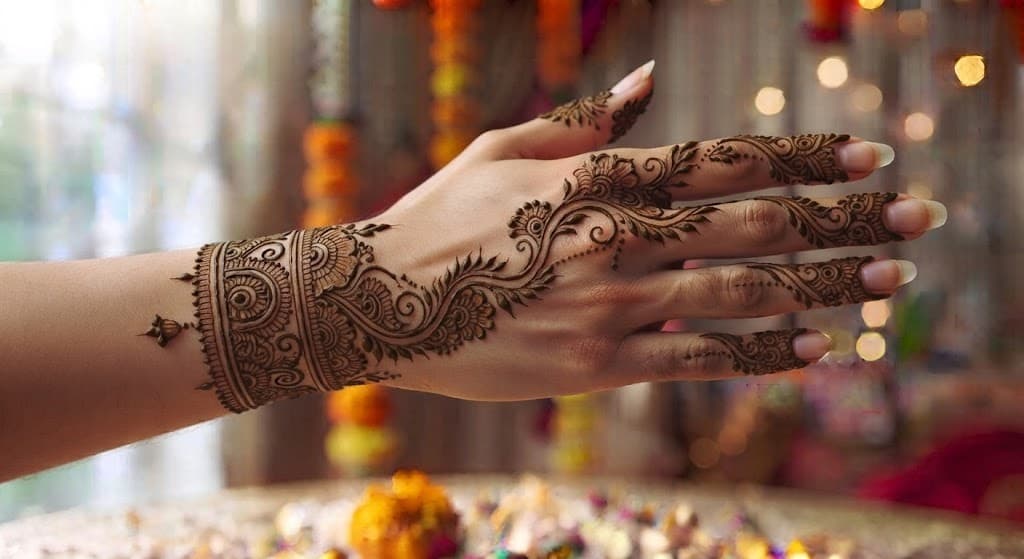
If you have ever had mehndi done in a hurry at a cousin's sangeet, chances are it was Arabic: a bold vine of flowers and leaves running across the back of your hand, finished in a few minutes and still looking lovely two days later. Arabic mehndi is quick, it suits almost every hand and outfit, and it is one of the easiest styles to learn to draw.
This guide has 60 Arabic designs, from a single leafy trail to full bridal hands, grouped by where they go and what they are for. It also explains what makes a design Arabic, what artists in the UAE say is in demand this year, and how to draw a simple trail yourself.
Quick answer: Arabic mehndi is a style of henna design built on bold, flowing floral trails, usually running diagonally from one finger across the hand to the wrist, with shaded flowers and leaves and plenty of bare skin. It is quicker and lighter than traditional Indian mehndi, which fills the hand with fine detail. Simple Arabic designs take a few minutes to half an hour; full Arabic hands for a bride take longer. For 2026, henna artists in the UAE report that younger clients prefer minimal designs, and wrist-length designs and clean back-hand patterns are in high demand there. Always use natural henna, never black henna or "instant" cones.
What's in this guide
- What is Arabic mehndi?
- Where Arabic mehndi comes from
- Arabic, Indian, Indo-Arabic or Khafif?
- What is in for 2026
- Simple Arabic mehndi designs
- Arabic mehndi designs for the front hand
- Arabic mehndi designs for the back hand
- Arabic finger designs
- Full hand Arabic mehndi designs
- Arabic mehndi designs for feet and legs
- Bridal Arabic mehndi designs
- Indo-Arabic mehndi designs
- Arabic designs for festivals, guests and children
- How to draw a simple Arabic trail
- A few Arabic mehndi words
- Choosing an artist for Arabic mehndi
- Getting the best from an Arabic design
- Staying safe
- Frequently asked questions
What is Arabic mehndi?
Henna designs differ from region to region: South Asian designs are known for small, intricate patterns and lines, while Middle Eastern designs are typically floral.1 In India, "Arabic mehndi" is the name for designs in that floral, open spirit, and it is a familiar sight at weddings and festivals.
What counts as Arabic varies from artist to artist, so take these five signs as a guide, not rules. You can usually recognise an Arabic design by:
- A trail. The design runs in a line, most often diagonally from the tip of one finger, usually the index finger, across the hand to the wrist.
- Big flowers and leaves. Fewer, larger motifs instead of many small ones.
- Shading. Petals and leaves are half filled, dotted or hatched, which gives them depth.
- Bare skin. The empty skin around the trail is part of the design, not a gap to fill.
- Bold outlines. Lines thick enough to read clearly from across a room, and in photographs.
In the UAE, traditional designs are still in demand with Emirati families. One henna artist in Ras Al Khaimah told Khaleej Times that while her younger customers like modern, minimal designs, "when I go to Emirati families, they want the very traditional Khaleeji and Arabic designs".2
For the other styles and how they compare, read the types of mehndi designs, and for every style in one place, our mehndi designs hub.
Where Arabic mehndi comes from
Across the Arab world, henna has marked celebrations for generations. When UNESCO inscribed those traditions in 2024, on a joint nomination from sixteen Arab countries, it called henna "a symbol of joy" and listed births and weddings among the festive occasions it belongs to.3
In India, the name Arabic mehndi is used for designs in that floral spirit, and tastes in mehndi keep moving. Gulf News reported that brides in the UAE were moving from traditional floral designs to personal patterns that tell a story;4 in 2025, Elle India wrote that modern brides were opting for minimalist designs;5 and in 2026, Khaleej Times reported high demand in the UAE for wrist-length designs and jewellery-style motifs.2 The trail stays; what fills it moves with the times.
Arabic, Indian, Indo-Arabic or Khafif?
These four styles are often confused, because most real designs borrow from more than one. This table shows the differences at a glance.
| Arabic | Traditional Indian | Indo-Arabic | Khafif |
|---|---|---|---|
| Where the design sits | A trail across the hand | The whole hand, often to the elbow | A trail, with detailed panels |
| Bare skin | Plenty | Almost none | Some |
| Typical motifs | Flowers, leaves, vines | Figures, peacocks, paisleys, arches | Flowers with peacocks or paisleys inside |
| Lines | Bold | Fine to medium | Medium |
| Time | Quick to medium | Long | Medium |
| Suits | Guests, festivals, modern brides | Traditional brides | Brides and close family |
If you want the look of Arabic mehndi with a little more detail, Indo-Arabic is the answer; if you want it bolder and lighter, Khafif.
What is in for 2026
Henna artists in the UAE told Khaleej Times in May 2026 that tastes are moving towards lighter designs. A Dubai artist said that "most youngsters now prefer minimal and elegant patterns instead of very heavy traditional styles", and the article reported high demand for "wrist-length designs with finer detailing, jewellery-style motifs, and clean back-hand patterns".2 Arabic mehndi suits all three.
The same article described "hengua", a mix of henna with jagua, a blue-tinted dye2 that comes from a different plant.6 Jagua stains blue-black, so a hengua stain can look much like the black henna this guide warns against.6 It is new, so if you are offered it, ask exactly what is in the paste and do a patch test first, as you would with any product that is not plain henna.
Simple Arabic mehndi designs
Each design ends with a rough time. Quick is anything up to about half an hour in an artist's hands, medium is one to two hours, and long runs from several hours to most of a day.
These ten are quick, pretty and easy to wear to work or college. Each can be done in a few minutes by an artist, and several are simple enough to try yourself.
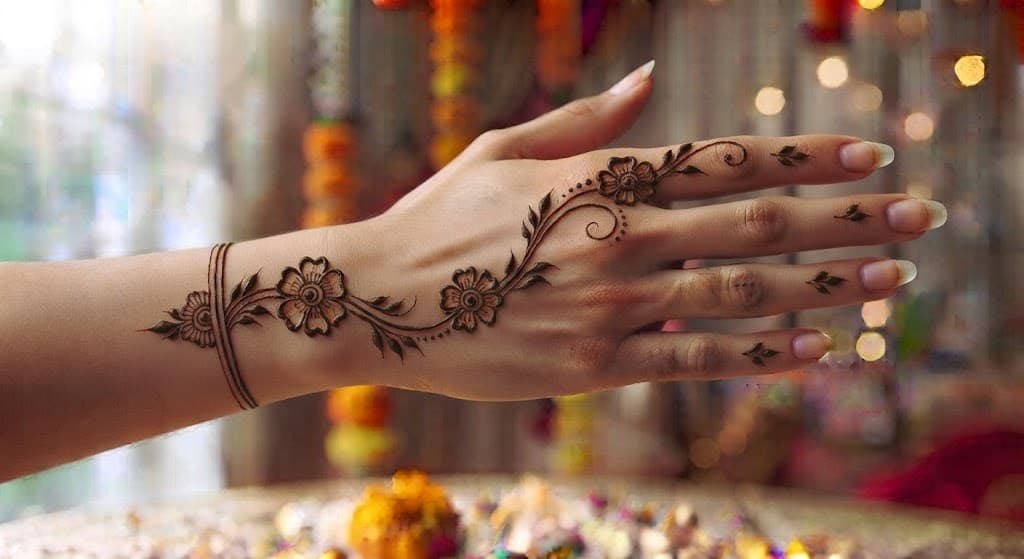
- The three-flower vine. Three open flowers on a single curving vine from the index finger to the wrist, with a few leaves between them. The best place to start if you are new to Arabic mehndi. Time: quick.
- One leaf spray. A short spray of five or six leaves on the back of the hand, angled towards the thumb. Light enough for an office week. Time: quick.
- Dotted outline flower. A single large flower drawn in dots rather than a solid line, with a dotted stem. Soft and modern. Time: quick.
- Corner trail. A small trail that starts at the base of the little finger and curls round to the outer edge of the wrist. Leaves most of the hand bare. Time: quick.
- Two-finger trail. A vine running down the index and middle fingers only, ending in a flower at the knuckles. Quick and very neat. Time: quick.
- Leaf bracelet. A ring of leaves around the wrist with one small flower at the front. Pretty with a single bangle. Time: quick.
- Half-moon flower. A flower cut in half by the edge of the hand, so it seems to continue round the side. A clever trick for a small design. Time: quick.
- Shaded petal. One big petal shape on the back of the hand, half filled and half outlined, with a curl of vine. Bold in photographs. Time: quick.
- Vine and dots. A thin vine with a line of dots running beside it, from fingertip to wrist. Easy for beginners. Time: quick.
- Mirror trails. The same small trail on both hands, running in opposite directions so the hands mirror each other. Lovely when you hold them together. Time: quick.
Arabic mehndi designs for the front hand
On the palm, Arabic designs stain darkest, because the skin there is thick and takes up the most dye.6 Most front-hand Arabic designs run from the thumb or the index finger across the palm.
- Thumb to little finger. A trail of flowers sweeping from the base of the thumb across the palm to the little finger. The classic front-hand Arabic design. Time: quick.
- Palm diagonal with fingertips. A diagonal trail across the palm, with the fingertips capped to finish it. Time: quick.
- Centre flower and two vines. A large flower in the middle of the palm with vines running up two fingers. Balanced and easy to read. Time: quick to medium.
- Wrist-up trail. A trail that starts at the wrist and climbs the palm to the middle finger. Shows well when you hold your hand up. Time: quick.
- Crescent palm. Flowers arranged in a crescent along the outer edge of the palm, leaving the centre bare. Modern and light. Time: quick.
- Heart in the vine. A palm trail with a small heart hidden among the leaves. Sweet for engagements. Time: quick.
- Double palm trail. Two parallel vines crossing the palm, one fine and one bold. Time: medium.
- Full Arabic palm. The palm filled with large shaded flowers and leaves, with the fingers lightly decorated. The darkest-staining Arabic design. Time: medium.
Arabic mehndi designs for the back hand
The back of the hand is where most people show off Arabic mehndi. It is the side that shows when you hold a glass, a garland or someone's hand, and an open trail suits its shape.
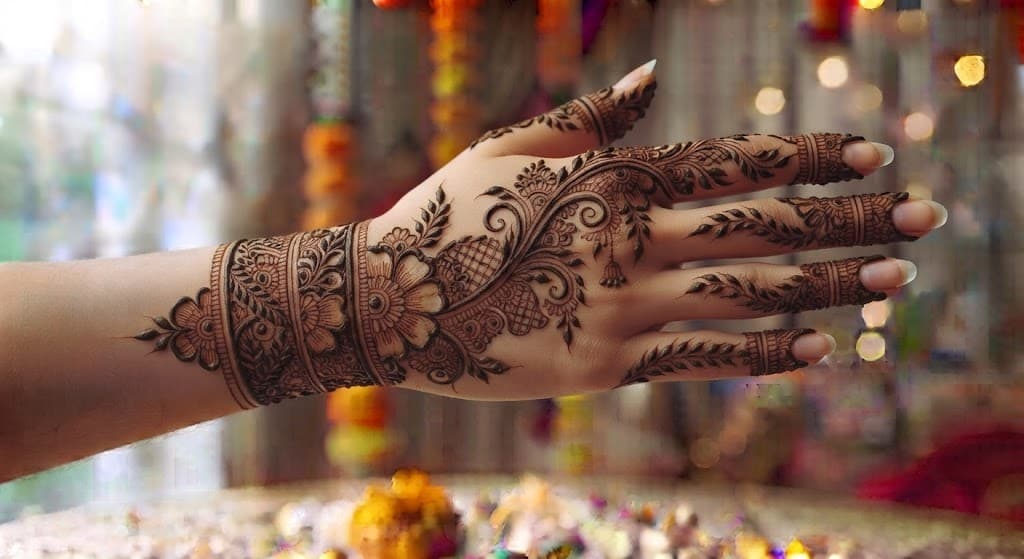
- Index finger to wrist. The signature Arabic design: large flowers and leaves from the tip of the index finger diagonally to the opposite side of the wrist. Time: quick.
- Twin vines. Two vines, one starting at the index finger and one at the little finger, that meet in a single bloom above the wrist. Fills a wide hand nicely. Time: quick to medium.
- Jewellery-style cuff. A band of fine leaves at the wrist with a single flower at its centre, like a bracelet. The jewellery-style look Khaleej Times reported in high demand in the UAE.2 Time: quick.
- Haath phool trail. A trail that ends in a ring on the middle finger and a band at the wrist, like a hand ornament. Time: quick to medium.
- Shaded rose cluster. Three roses with shaded petals clustered at the knuckles, with leaves trailing to the wrist. Time: medium.
- Peacock trail. An Arabic vine with a peacock's head and a sweep of tail feathers worked into it. A traditional touch in a modern layout. Time: medium.
- Wrist-length with fine detail. A clean trail that ends neatly at the wrist, with finer shading inside each flower. Time: medium.
- S-curve. A trail that curves like an S from the little finger to the thumb side of the wrist. Graceful on slim hands. Time: quick.
- Lattice leaf. A large leaf on the back of the hand filled with a fine net, on a short vine. Time: medium.
- Stacked flowers. Three flowers stacked one above the other up the centre of the hand, from wrist to knuckles. Symmetrical and bold. Time: quick to medium.
Arabic finger designs
Fingers finish an Arabic design, and they can also be the whole design.
- Vine on the index finger. A leafy vine climbing the index finger, the starting point of most Arabic trails. Time: quick.
- Leaf tips. A small leaf at the tip of each finger instead of a solid cap. Time: quick.
- Alternating fingers. A small flower on the index and ring fingers, with the others bare. Time: quick.
- Ring bands. A band of tiny leaves at the base of each finger, like a ring. Time: quick.
- Shaded fingertips. Fingertips half filled with soft shading instead of solid caps. Time: quick.
- One finger, one flower. A single detailed flower on the middle finger only. Minimal and striking. Time: quick.
Full hand Arabic mehndi designs
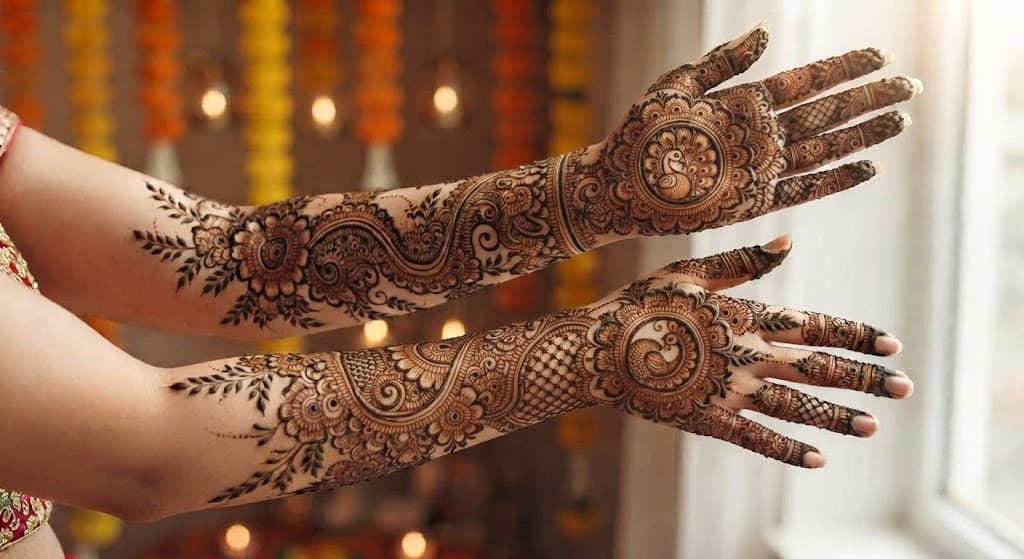
Full hand Arabic designs cover the front and back of the hand while keeping the open, flowing feel. They suit close family at a wedding, festival evenings and brides who want a lighter look.
- Trail front and back. A trail on the back of the hand that wraps round the edge to continue across the palm. One design, two sides. Time: medium.
- Matching halves. The same flowers repeated on the palm and the back, so the hand looks finished from every angle. Time: medium.
- Arabic to the wrist with fingers. Full trails on both sides, every finger decorated, ending in a leafy band at the wrist. Time: medium.
- Layered trails. Two or three trails stacked across the hand, each a little smaller than the last. Time: medium to long.
- Arabic sleeve. A trail that continues past the wrist and up the forearm in a loose vine. Lovely with sleeveless blouses. Time: long.
Arabic mehndi designs for feet and legs
Arabic designs suit feet beautifully, because a trail follows the line of the foot. Remember that you cannot walk until the paste is dry, so plan to sit for a while afterwards.
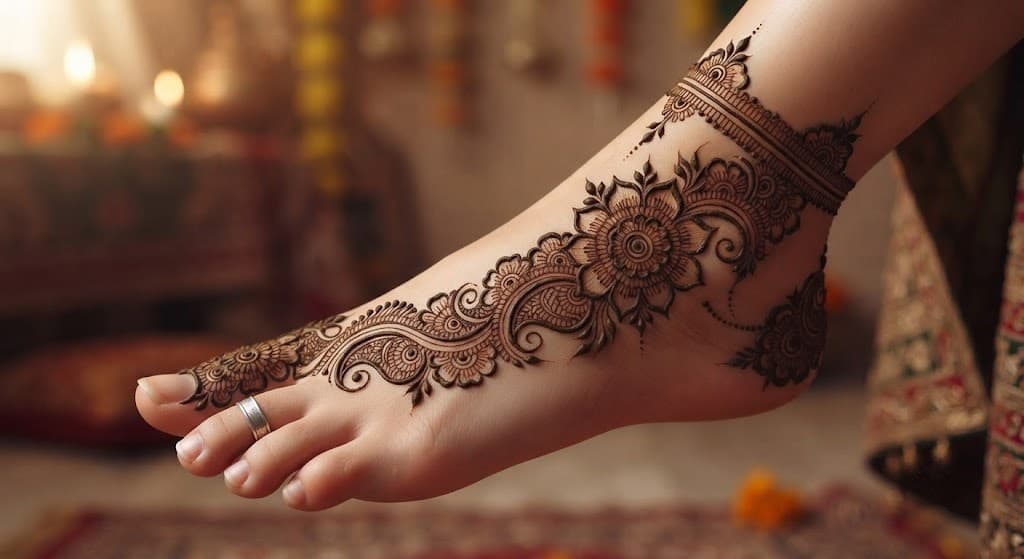
- Big toe to outer ankle. Blooms and leaves following the line of the foot from the big toe over the instep to the outer ankle. The classic Arabic foot design. Time: quick to medium.
- Ankle vine. A vine circling the ankle like an anklet, with one flower on the top of the foot. Time: quick.
- Side of the foot. A trail along the inner edge of the foot, from the heel to the big toe. Shows beautifully in sandals. Time: quick.
- Leg trail. A vine climbing from the ankle up the outside of the calf. For beach functions and shorter outfits. Time: medium.
- Toes and a flower. Capped toes and a single large flower on the top of the foot. Time: quick.
- Matching hand and foot. The same trail on the back of the hand and the top of the foot, for a matched set in full-length photographs. Time: medium.
Bridal Arabic mehndi designs
Arabic or Arabic-led designs suit brides who want a lighter look, especially with pastel outfits and day weddings, or a shorter time in the chair. A bridal Arabic design is fuller and more detailed than a guest design, but it keeps the bare skin and the flow. Our full guide to bridal mehndi designs covers timing, the hidden name and booking an artist.
- Bridal trail to the elbow. Bold trails on both hands that continue up the forearms, with detailed shading in every flower. Time: long.
- Arabic back, figures in the palm. An Arabic trail on the back of each hand and the bride and groom drawn small in the palms. Time: long.
- Hidden name in the leaves. The groom's initials worked into the veins of an Arabic leaf. Easy to hide, fun to find. Time: quick, as an addition.
- Arabic hands with full feet. Arabic trails on the hands paired with a fuller design on the feet, ending at the ankle. Time: long.
- Pastel bride's Arabic. A light, airy Arabic design with fine shading and a lot of bare skin, to go with a pastel lehenga. Time: medium.
Indo-Arabic mehndi designs
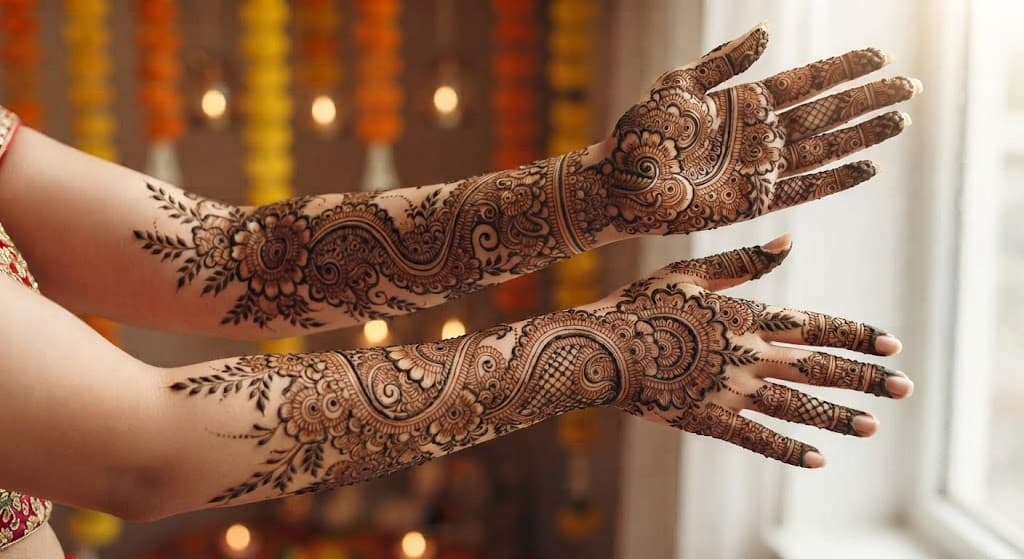
Indo-Arabic keeps the Arabic trail but fills it with Indian detail: a peacock inside a petal, a paisley chain, a patch of fine net. It is an easy way to get a detailed look without the long sitting of traditional mehndi.
- Paisley trail. An Arabic vine where every leaf is a paisley, filled with fine lines. Time: medium.
- Peacock in the petal. The largest flower in the trail has a tiny peacock drawn inside it. Time: medium.
- Jaal-filled leaves. The big leaves of an Arabic trail filled with a fine net. Time: medium.
- Two sides, two styles. A bold Arabic vine over the back of the hand, with a delicate Indian mandala filling the palm. Time: medium.
- Arches and trail. A small row of arches at the wrist with an Arabic trail rising from it to the fingers. Time: medium to long.
Arabic designs for festivals, guests and children
Arabic mehndi is the go-to style whenever many people need designs in a short time.
- Eid. Women and girls put on mehndi on Chaand Raat, the night before Eid al-Fitr.7 Start an Arabic trail with a crescent moon and end it with a small star at the wrist. Time: quick.
- Karwa Chauth. A round moon at the top of a trail, with the karva pot drawn small at the wrist. Karwa Chauth 2026 falls on Thursday, 29 October;8 see our Karwa Chauth mehndi designs. Time: quick.
- Diwali. A small diya worked into a trail of marigolds. Diwali 2026 is on Sunday, 8 November;9 see our Diwali mehndi designs. Time: quick.
- Wedding guests. A three-flower vine on one hand, done in a few minutes so the queue keeps moving. Time: quick.
- Children. A tiny vine on one finger or a single flower on the back of the hand, in natural henna only. Our complete guide to mehndi explains which children should not have henna at all. Time: quick.
How to draw a simple Arabic trail
You can draw a simple Arabic design yourself with a natural henna cone. Practise on paper a few times first.
- Cut a fine tip. Snip the very end of the cone so the paste comes out in a thin line. A thinner line is easier to control.
- Rest your wrist. Sit at a table with your hand flat and your wrist supported, so the cone hand stays steady.
- Plan the line. Imagine a gentle diagonal from the tip of your index finger to the opposite side of the wrist. Do not draw it yet; the flowers come first.
- Place three flowers. Draw a large flower near the knuckles, a medium one in the middle of the hand and a small one near the wrist, along that imaginary line.
- Join them with a vine. Draw a smooth, curving stem between the flowers, following the diagonal.
- Add leaves. Pointed leaves along the vine, alternating from side to side, larger near the big flower.
- Shade. Fill half of each petal and leaf, or add dots, to give the design depth.
- Finish the finger. Carry a fine vine up the index finger and cap the tip.
Hold the tip of the cone so it barely touches the skin and press with an even, light pressure. Wipe a wrong line away straight away with a damp cotton bud. When you have finished, let it dry and keep it on for as many hours as you can.
A few Arabic mehndi words
- Khafif. The word means "light" in Arabic: a bold, open style with large outlined flowers and a lot of bare skin.
- Khaleeji. Khaleej means "gulf", so Khaleeji designs are the traditional styles of the Gulf countries.
- Bel. A vine of leaves and flowers, the backbone of an Arabic trail.
- Shading. Filling part of a petal or leaf with lines, dots or a lighter wash of paste, so it looks three-dimensional.
- Haath phool. Literally a hand flower, also called hathphool: jewellery that links a ring to a bracelet, and often copied in mehndi.
- Indo-Arabic. A mix of the two styles, sometimes called fusion mehndi: an Arabic trail filled with Indian detail.
- Jagua. A different plant dye with a blue tint, mixed with henna in the newer "hengua".
Choosing an artist for Arabic mehndi
Arabic designs look simple, which is exactly why a good artist shows. When you choose one:
- Look at the lines. Bold lines should be even from start to finish, with no wobbles where the artist paused.
- Look at the shading. Ask to see close-ups. Good shading is consistent across every petal and leaf.
- Check the flow. The trail should feel like one movement across the hand, not a row of separate flowers.
- Ask about speed for guests. If you are booking for a function, ask how many guest designs each artist or assistant can do in an hour.
- Ask what is in the paste. A good artist will happily tell you, and will never use black henna.
Getting the best from an Arabic design
A few small choices make a big difference to how an Arabic design looks and lasts.
- Choose the hand. If you are having just one hand done, choose the one you use less, so the paste can stay on undisturbed for longer.
- Mirror the two hands. If both hands are done, ask for the trails to run in opposite directions, so the hands look balanced side by side.
- Keep the bare skin. The open skin is what makes the style. Resist the urge to ask the artist to fill every gap.
- Ask for shading. Shaded petals and leaves make even a simple trail look rich, and they keep their shape as the colour fades.
- Think about jewellery. A trail that ends at a ring or a bangle looks intentional. Tell the artist what you will wear.
- Time it. Natural henna comes off orange and deepens over about three days,6 so have your design done a day or two before the occasion. The longer the paste stays on, the darker the stain.6
For more on colour and aftercare, read our complete guide to mehndi.
Staying safe
Because Arabic mehndi is so quick, a quick cone can seem the natural partner. It is not. A henna artist told Khaleej Times that people "pick cones that give instant colour, and many of these have harmful chemicals", and advised sticking to organic henna.2 So-called black henna usually owes its colour to PPD, an ingredient of hair dye that can trigger dangerous skin reactions in some people.10 Health Canada's warning signs are a very dark black colour, a paste that sets very quickly, and little or no scent.11 Be wary of a jet-black colour and of a paste that sets in moments.11
Natural henna leaves a brown, orange-brown or reddish-brown stain10 that starts orange before slowly deepening. Ask for a patch test first, especially for a bride or a child, and choose a mehendi artist on Shaadiwaale who is happy to tell you what goes into their paste, in cities such as Mumbai, Hyderabad, Lucknow and Delhi NCR.
Frequently asked questions
What is Arabic mehndi?
Arabic mehndi is a henna style built on bold floral trails with shaded flowers and leaves and plenty of bare skin, usually running diagonally from one finger across the hand to the wrist. It is lighter and quicker than traditional Indian mehndi, which covers the hand in fine detail.
How is Arabic mehndi different from Indian mehndi?
Arabic mehndi uses a few large flowers and leaves in an open trail, with bold lines and bare skin. Indian mehndi fills the hand with fine patterns, figures and motifs such as peacocks and paisleys, often to the elbow, and takes much longer.
Which is the easiest Arabic mehndi design for beginners?
The three-flower vine: three flowers of different sizes along a diagonal, joined by a curving stem with a few leaves. A single leaf spray or a vine with dots are also easy. Practise on paper first and rest your wrist on a table.
Is Arabic mehndi suitable for a bride?
Yes. A bridal Arabic design is fuller, with detailed shading, trails up the forearms and often a fuller design on the feet. It suits brides with pastel outfits or a shorter sitting, and some add figures or a hidden name in the palms.
Should Arabic mehndi go on the front or the back of the hand?
Both work. The back of the hand shows in most photographs, and an open trail suits its shape. The palm takes a darker colour. Many people have the trail on the back and a lighter design or capped fingertips on the palm.
How long does an Arabic mehndi design take?
An artist can draw a simple trail in a few minutes. Covering the front and back of one hand in Arabic takes an hour or two, and bridal Arabic with the forearms and feet can run to several hours. Your artist can estimate your exact design.
What is hengua?
Hengua is a mix of henna and jagua, a different plant dye with a blue tint, which a Khaleej Times report on UAE henna artists called a new trend in 2026. Because it is not plain henna, ask exactly what is in the paste and do a patch test before trying it.
How do I make my Arabic mehndi darker?
Start with fresh, natural henna and leave the paste on for as many hours as you can. When it has dried, dab on a little lemon juice mixed with sugar, then scrape the paste away instead of washing it, and keep your hands dry until the next day. The stain goes on deepening for around three days.
Share this guide
Send it to the family group, or keep it for later.
Questions about your wedding?
Our team answers questions about venues, vendors and the budget, free on WhatsApp.
About Shaadiwaale
Indian wedding planning in one place: venues and vendors with real prices, free kundli matching, invitations and tools to plan every function together.
Every function. Every family. One plan.
Notes
- Mehndi, Wikipedia. Designs differing by region: South Asian designs with small, intricate patterns and lines; Middle Eastern designs typically floral. ↩
- Hengua to minimalistic motifs: UAE henna artists reveal top designs for Eid Al Adha, Khaleej Times, Nasreen Abdulla, 26 May 2026. Minimal and elegant patterns, wrist-length designs, jewellery-style motifs and clean back-hand patterns; traditional Khaleeji and Arabic designs for Emirati families; hengua; instant cones with harmful chemicals. ↩
- Henna: rituals, aesthetic and social practices, UNESCO Intangible Cultural Heritage, inscribed 2024 for sixteen Arab countries. Henna as a symbol of joy at births and weddings. ↩
- New mehendi trends: Tinder and skylines, Gulf News, Megha Merani (page last updated 9 July 2022). Brides in the UAE moving to personal designs. ↩
- From Arabic to minimalist: 10 stunning mehendi designs trending in 2025, Elle India, Tanvee Khanna, 16 September 2025. Modern brides opting for minimalist designs. ↩
- Henna, Wikipedia. Palms staining darkest; the stain orange at first and deepening over about three days; longer paste time giving a darker stain; jagua (Genipa americana) staining blue-black. ↩
- Chaand Raat, Wikipedia. Women and girls decorating their hands with mehndi on the eve of Eid al-Fitr. ↩
- Karwa Chauth 2026 date and time for Jaipur, Drik Panchang. Karwa Chauth on 29 October 2026. ↩
- 2026 Diwali puja calendar for New Delhi, Drik Panchang. Diwali on 8 November 2026. ↩
- Temporary tattoos, henna/mehndi, and "black henna": fact sheet, US Food and Drug Administration. Black henna and PPD; natural henna's brown, orange-brown or reddish-brown colour. ↩
- Black henna temporary tattoos, Health Canada. Warning signs of black henna: a very dark black colour, a paste that sets very quickly, little or no scent. ↩